Crann 'never felt like a medical appointment'
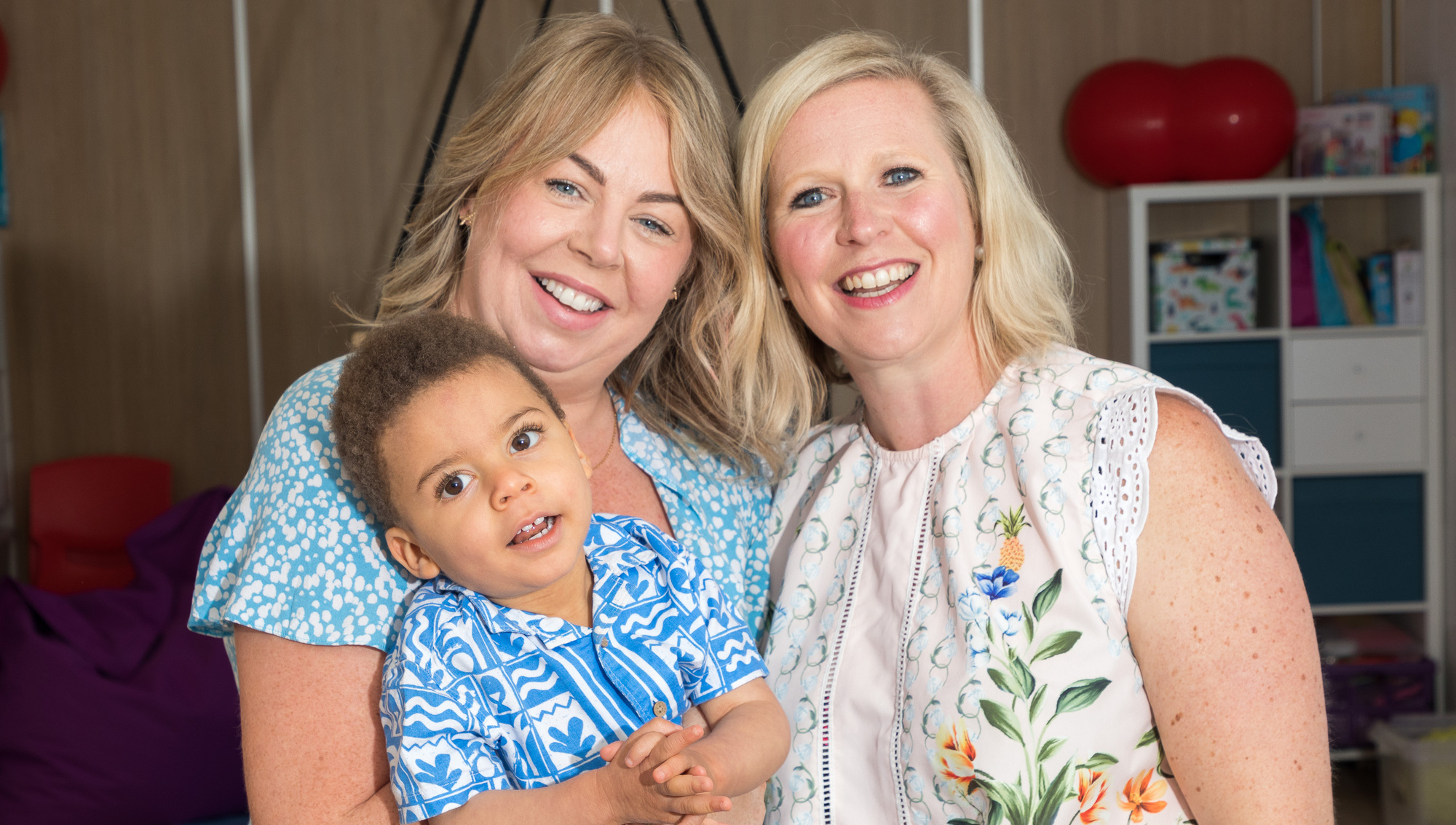
Emma O'Sullivan and her son Zé and senior paediatric occupational therapist Sarah Kennington in the Play Therapy Room at the Crann Centre, Classis, Co Cork. Picture: David Creedon
Her 22-month-old son, Zé, is “doted on by everybody”, including his grandparents, says Emma.
She is chatting to me as she watches her mum in the back garden with Zé. “He’s in her lap, and she’s singing songs to him.”
At certain points of a very difficult pregnancy, Emma recalls feeling guilty. She had hyperemesis throughout — affected women experience extreme levels of nausea and vomiting. She had “desperate migraines, everything would go black”, so she couldn’t drive, and she’d come home from her job as a finance manager in the motor industry and have to go straight to bed.
With stage four endometriosis, as well as adenomyosis, conditions affecting the reproductive system, doctors had told Emma it was unlikely she would have children.
However, after full excision surgery in Britain in 2019, medics said she would be able to get pregnant — but there was a 90% chance she wouldn’t carry to term.
Later that year, she met Zé’s dad but miscarried in May 2020. Once covid was over, and almost 39 by then, Emma knew she wanted to have a baby.
“We started testing to see if we were eligible for IVF,” she says.
During testing, Emma was violently sick, but it “didn’t click that I could be pregnant”.
She eventually discovered she was pregnant at eight weeks.
“It was a massive shock — we were supposed to be going for IVF.”
While pregnant, she couldn’t shake the feeling there was something amiss with her baby.
“At the 20-week scan they said his head was small, but that he still had plenty of time to grow. They were concerned about a bright spot on his bowel — it could mean cystic fibrosis or Down syndrome.”
Read More
Though both of these were eventually ruled out, Emma’s feeling of unease persisted.
The first night following Zé’s birth, Emma mentioned her nagging gut instinct to the midwife, who put it down to her not having slept.
The hearing test was the first sign something was wrong.
“He failed it. There was no response from his left ear, and only a tiny amount from his right.”
Re-tested days later, Zé was found to be completely deaf in his left ear. He had very mild high frequency loss in his right.
“They talked about a hearing aid for his right ear, a cochlear implant for the left. The nurse mentioned a new screening test for a virus — CMV — which they do on babies who fail the hearing test. She said of all babies they’d tested, only one had the virus.”
Zé tested positive for CMV (cytomegalovirus).
“[Following] an MRI, doctors said he might never walk or live independently; he might be in a wheelchair,” recalls Emma.
She says Zé was lucky the CMV was caught early. While antiviral medication would not reverse damage already done, it would stop the virus in its tracks, preventing further damage. He later developed epilepsy, but treatment has kept him seizure-free since last August.
He has also been diagnosed with left hemiplegic cerebral palsy.

Emma says she’d be lost without her “massive support team” — a key element is the Crann Centre, based near Ovens, Co Cork, which provides supports to more than 900 families living with neurophysical disabilities across Cork and Munster. Some 993 families have registered since services began in 2019.
“There’s 20% growth year-on-year in referrals. We now receive a minimum of seven a week; we’re just coming up to our 1,000th family,” says Crann head of services Eimear Daly.
Daly says Crann serves all ages “across the life-span”. Clients come through one of two pathways — a disability pathway which encompasses anyone with a congenital disability, and a neurorehabilitation pathway specific to three conditions: Stroke, MS and spinal cord injury.
Crann offers a two-generation model of care. “Basically, whole-family wraparound support. We recognise that disability affects the fabric of the family,” says Daly.
Supports include those that encompass psychological wellbeing, counselling, play therapy, art therapy, and SibShops for siblings, who benefit from sharing their experience with other children in similar situations.
Clinical therapy supports include occupational therapy, physiotherapy, and rehab. “We also have Munster’s only community-based, nurse-led specialist continence clinic,” says Daly.
“Crann is self-referral,” says Emma, who heard about the centre last year from a friend.
“I thought we could do with another bit of help … I like that they take care of not just the child, but the family and support system too.”
Zé has been having weekly occupational therapy at Crann for two months, and Emma sees the benefits. “He’s sitting up for longer periods on his own, he’s passing toys from hand to hand, he’s reaching for toys with his left hand [the weaker one] and he loves the swing.
“Sarah Kennington, his therapist, explained about neuroplasticity and how what she’s doing is making new pathways in his brain.
Emma is delighted Zé will attend the playgroup at Crann. “There’s a lot of comparison at [typical] playgroups. At Crann, I won’t get questions like: ‘Oh, he’s not walking yet?’”
She has attended counselling at Crann for five months. “I can say whatever I like, I can cry. The counsellor has given me good tools and breathing exercises to help me.”
Daly says families describe Crann as getting the Crann hug.
“They’ve a feeling of being held and supported to navigate living life with a disability.”
This wraparound care is Emma’s experience too. “When Sarah’s working with Zé, she’ll say: ‘I’m doing this now to work this part of his brain.’ Then she’ll start chatting again about life. So it never feels like a medical appointment; it feels fun.
“The receptionist remembers you had an appointment with the neurologist during the week. They’re so in touch at Crann. To them, you’re not a number.”
And Zé, she says, comes alive when he goes to Crann.
.
- The Crann Centre aims to raise €75,000 through its most important annual fundraising event: Walk ‘n’ Roll. Register on iDonate and complete 5km in your own way between now and Sunday, June 7.
- Funds raised support vital services for families living with neuro-physical disabilities. To mark this year’s Walk ‘n’ Roll, families who attend Crann will complete their final 1km at the centre’s fully accessible playground this Saturday. The event will conclude with a celebration featuring entertainment and activities.
- Sign up for Walk ‘n’ Roll: idonate.ie/event/WalknRoll2026