HEAR and DARE focused on access opportunities for all students
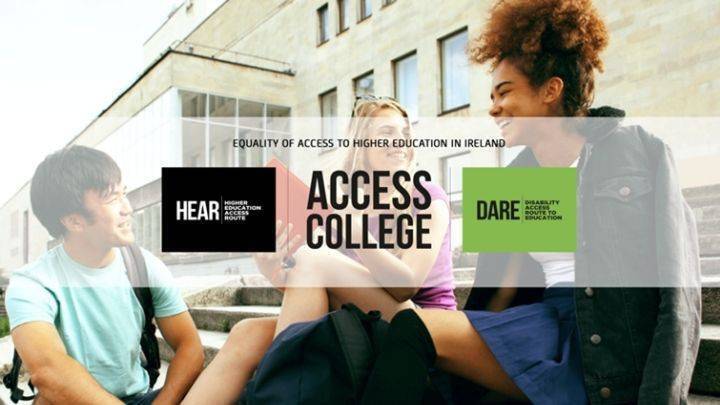
Separate from grants or financial assistance, the HEAR and DARE schemes aim to provide targeted support to students who may not traditionally go on to third-level education.
There are a number of important changes to access programmes for 2026, aimed at creating more opportunities for disadvantaged young people to access higher education.
The Higher Education Access Route (HEAR) is a national alternative admissions scheme open to students who are underrepresented in higher education due to their socioeconomic background.
The Disability Access Route to Education (DARE) is a similar admissions scheme open to students who, as a result of having a disability, have experienced additional educational challenges.
Separate from grants or financial assistance, the HEAR and DARE schemes aim to provide targeted support to students who may not traditionally go on to third-level education.
Students who qualify for HEAR, DARE, or both schemes in some cases, may be offered a course of study even if their total Leaving Certificate score is lower than the general admissions cut-off.
This means that students may be offered a place even if they do not have enough points for their preferred course.
This is to take into account the evidence that shows students who are disadvantaged socio-economically, or who have a disability, face greater obstacles when it comes to progressing on to higher education.
Another benefit of qualifying for these schemes is that students are offered extra assistance by their college throughout the academic year.
The vast majority of publicly funded higher education institutions operate both schemes, including Mary Immaculate College, University College Cork (UCC), Trinity College (TCD), and Munster Technological University.
For September 2026, four new priority groups are being introduced for HEAR along with a revised scoring system to determine eligibility.
For next September, the new priority groups include:
- Students who have been in the care of the State;
- Members of the Traveller and Roma Communities;
- Those under the age of 23 who have become a parent while in post-primary education;
- Students from socioeconomically disadvantaged backgrounds who also have a disability.
Under the revised scheme for 2026, applicants will be awarded a score, to ensure those with higher scores are prioritised for HEAR.
It is intended that the new scoring system will allow HEAR to target colleges places toward those most disadvantaged.
The four new HEAR priority groups will be awarded an automatic score of 7, therefore prioritizing members of these groups in the offers process through the CAO.
It will also for the first time, recognise how the homelessness crisis affects the educational outcomes of post-primary students.
Under the revised scheme, an immediate 2.5 HEAR score will be applied for applicants who have experienced homelessness or live in emergency accommodation during their post-primary education.
Students hoping to apply for HEAR must meet a range of financial, social and cultural criteria.
This includes family income and DEIS School Attendance. Students must be under the age of 23, be under the HEAR Income Limit, plus a minimum score of 2.5 to be eligible.
The DARE scheme also offers reduced points places to students who, as a result of having a disability, have experienced additional educational challenges.
The scheme considers a range of disabilities including ADHD, visual impairments, hearing impairments, dyspraxia, significant ongoing illness and mental health conditions.
As research shows that students with physical disabilities, visual impairments and those who are deaf or hard of hearing are particularly under-represented in higher education, colleges have agreed to prioritise these two groups when allocating reduced points places.
As part of your application, DARE requires you to submit evidence of your disability.
An evidence of disability form for 2026 can be downloaded from accesscollege.ie You can apply to both HEAR and DARE through the CAO.
More information on both schemes can be found on accesscollege.ie