Photography and film make the cut in Youghal
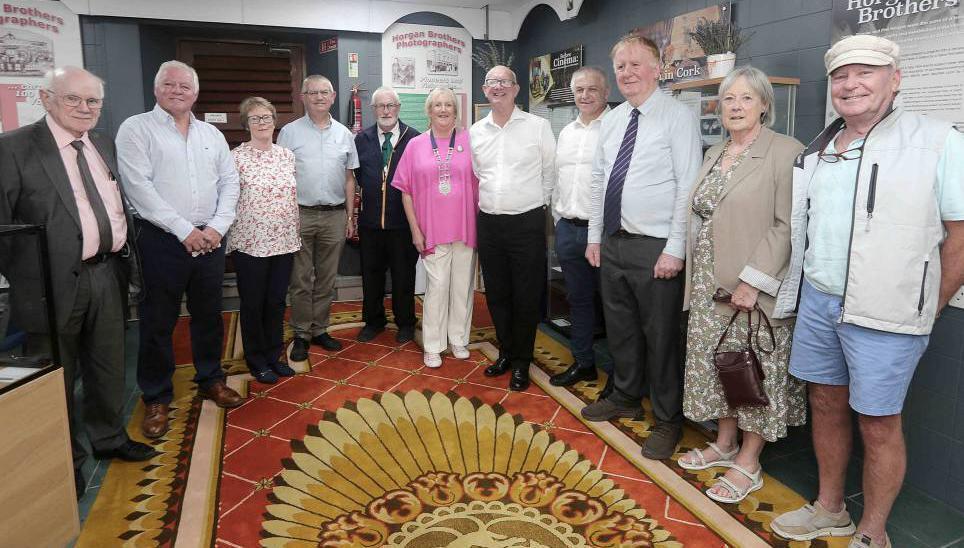
Members of Youghal Film and Photography Museum’s volunteer committee. Photos: John Hennessy
Film and photography connoisseurs are assured of a happy story if visiting Youghal’s Film and Photography Museum, which opened in June 2024.
The centre celebrates Youghal’s -and Ireland’s- historic links with the evolution of film and photography amidst a treasure trove of memorabilia and memories, including many items of rare vintage.
The premises, formerly a butcher shop, stands within a director’s roar of the clock tower on North Main Street.
It was acquired through the munificence of the Hanratty family butchers and transposed with support from the Youghal Business Alliance, Cork County Council and private donors. It is now “the only singular film & photography museum in Ireland” according to curator Ed Guiry.
The voluntary group tasked with turning the duckling into a swan included Ted Horgan, grandson of James and grand nephew of James’s brothers, Thomas and Philip Horgan.
In the late 19th/early 20thcenturies the three brothers were considered Ireland’s equivalent of the pioneering French filmmakers Auguste and Luis Lumiere.
The Horgans made their own cameras, brought the ‘new magic’ of photography to communities and established their own photo studio and, later, cinema.
Progressing to film-making, they travelled the region, capturing and displaying everyday life, across social, religious and sporting divides, including King Edward VII’s visit to Lismore in 1903.
Blessed with an irrepressible sense of fun, around 1910 they created Ireland’s earliest surviving animation, depicting Youghal’s clock tower inverted, pirouetting and dancing.
The Horgan family has contributed many items from their ancestors’ collection to the volunteer-driven enterprise. Their generosity helps to open a fascinating window into an Ireland long past, through vintage cameras, photographs and film footage. Their exhibits include magic lanterns, which Ed describes as “early home entertainment”, whereby “the slides were hand-painted miniature cartoons, each accompanied by a story for children”.
The Horgans’ contributions further include a nine lens tin plate camera. “These preceded film,” says Ed. “The photographer coated a light-sensitive chemical on a piece of tin. When exposed to light, the picture was captured. With no negative, you only got one copy.”
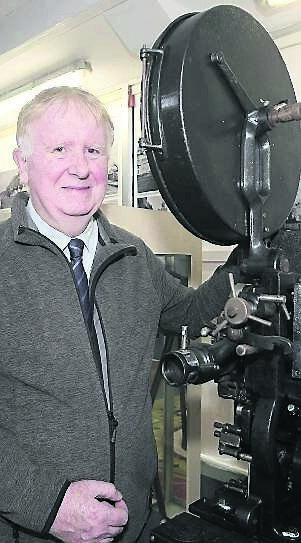
Further contributors to the museum include veteran Waterford photographer Andy Kelly and Patrick McCoole, Limerick, whose gifted 35mm cinema camera from 1925 resides near the doorway.
Patrick also donated high-end travel movie cameras used on cruise liners in the 1940s. “These were extremely expensive and would have been the iPhone’s of their day”, informs Ed, a man of extensive knowledge and a possessor of many stories. He says the museum also has home projectors used by the returned travellers to screen their adventures -possibly whether their families and friends liked it or not!
The museum is also awaiting a delivery from foremost German film cameraman Manfred Romboy, who is dispersing equipment to Youghal on his retirement.
Space in the single-museum is maximised through using tiered glass cases. This creates a ‘Tardis-like’ effect of the room being bigger on the inside! Every item is captioned and a trained ‘tour guide’ is always available.
Beneath some vintage photographs, a flat display case contains a ‘pocket camera’ used by soldiers in WW1 to document life in the wretched trenches. Beside it, a 1930’s stereo graphic camera reflects “the first three-dimensional photographs”, Ed explains.
To the left, large story boards divide the glass cases, charting the tale of cinema’s evolution in Cork, the story of Youghal’s Hurst family, who opened Youghal’s first cinema in 1914 and, gloriously, Youghal’s ‘summer of all summers’ in 1954, when John Huston brought names like Gregory Peck, Richard Basehart, Leo Genn and Noel Purcell when filming the opening scenes of Moby Dick. Classic scenes from that filming also form part of a window montage facing onto the street.
A lengthy strip of predominantly yellow carpet catches the eye. Bearing the MGM logo, with feathers representing native Indians, it was made by Youghal Carpets as a sample for one of the studio’s casinos in Las Vegas.
It was rescued from a skip and eventually donated to the museum by Youghal’s local radio station. “It was designed to withstand forty thousand people a year walking on it!”, Ed reveals. “Its beyond diamond quality — it’s industrial strength carpet!”
Despite the unique artefacts, the intriguing history and glamorous milestones, locals are particularly drawn to one corner of the museum over others. Six rows of seats face a screen, on which many hours of footage spill on a loop.
This is where archival footage of local occasions are screened in a social setting. Here, St. Patrick’s Day parades, Eucharistic processions, sun-drenched park entertainment, hurling matches, train arrivals, beach outings and so on, permit past and passed ancestors to re-enter, movingly in every sense, the lives of their descendants. Locally-made documentaries and themed talks are also regularly held in this space.
n The Youghal Film and Photography Museum opens noon to 4 pm Fridays, Saturdays and Sundays, from April to late October. Admission free, donations accepted. Volunteer guides always welcome.
Facebook: Youghal Film and Photography Museum.