Teaching English, a career passport to world

There will always be openings for English language teachers, and the option to travel is a certainty
Teaching English, a career passport to world

A CELTA or a postgraduate teaching qualification will open doors for you. Teachers don’t have to limit themselves to face-to-face teaching; they can teach online, offer proofreading services etc.

Like so many TESOL (Teaching English to Speakers of Other Languages) teachers, Elizabeth Shannon never envisioned herself in a classroom teaching international students. 

“The original plan was journalism and media, but I had a change of heart after graduation,” she explains on her current teaching position at the Language Dept in the Faculty of Arts Humanities & Social Sciences, University of Limerick. “While I knew I’d most likely need to do a post grad to have realistic career options, I didn’t know what in.” 

Then she spotted an advert in a national newspaper for a full-time post grad course in TESOL in University of Limerick, and applied. 

“Before I knew it, I’d given my notice for my temp job in Revenue — I just wasn’t cut out to work in taxation. What drew me to it? I had a background in English and was a good communicator, but I guess what really attracted me was the prospect of working somewhere I didn’t know the language. I really fancied the challenge of that.” 

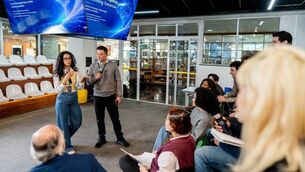
Elizabeth Shannon, English language teacher at the Language Department in the Faculty of Arts Humanities & Social Sciences, University of Limerick.

International students are a diverse mixture, she says, and depending on the time of year, the students in ULLC (University of Limerick Language Centre) are a mix of people using some of their holidays to brush up on their language skills for work or study; students preparing for their study abroad semester in UL; students trying to achieve the language and/or educational requirement for undergraduate or postgraduate study; teenagers learning about Irish culture; closed groups of teachers doing language and pedagogy workshops; as well as international nursing and healthcare students receiving in-sessional support sessions. 

“There is no typical student or course, which means it’s a very dynamic environment in which to work. For the academic year, I spend most of my teaching time coordinating and delivering a pre-sessional English for Academic Purposes course to students who are hoping to pursue undergraduate/postgraduate studies in UL. It’s a challenging course, but incredibly rewarding when you see how much progress students have made, and especially when they achieve their goal of studying at UL.”

Travel is amongst the big benefits of the profession

Like any teaching job, it can be daunting at the beginning. 

“Preparation definitely helps the nerves though, as does experience. You don’t always get it right but being humble enough to admit that goes a long way.” 

Learners have changed and the traditional idea of the teacher at the top of the class speaking at them or directing a reading task just won’t work in a modern classroom, she explains. 

“You need to use multiple means of engagement, supplementing texts with videos and other multimedia to encourage active learning. Of course, some classes can be more challenging than others and managing group dynamics becomes a superpower.” 

In terms of opportunities, travel is one of the big benefits in having a portable profession that can be a potential earner anywhere in the world. 

“Travel is the greatest benefit of this profession. There will always be an opening for TESOL teachers, and even more so for those with internationally recognised qualifications. At the start of my career, I  was recruited to work for an English language school in Northern Greece. I spent a year there and while at times it was challenging, the experience was life-changing. It has informed my teaching massively and given me an insight into the experiences my students go through.”

 Like many other professions that had to adjust and adapt during the enforced isolation of Covid 19, language teaching learned its own lessons on how to cope with unexpected limitations.

 “If we have learned nothing else from the pandemic, it’s that there are multiple means of teaching. If you can command a bricks and mortar classroom, you can command a virtual one. Online classes give learners who ordinarily might not be able to access full time studies the opportunity to engage with a language in a more meaningful way than an app or self-guided textbook or website. It also gives teachers the opportunity to be self-employed or to have more flexible working arrangements. It’s a game changer for teaching languages.” 

While Elizabeth is based on campus and teaches face-to-face classes, it means that it’s still possible for her to be involved in online teaching, should the need arise. 

As to the question of whether there is a good living to be made teaching English, the old saying that the ‘world is your oyster’ certainly applies: “Like any industry, the more recognised your qualifications, the better the earning potential. In the past, just being a native speaker could get you hired abroad. That’s not the case anymore. If you have a CELTA or a postgraduate teaching qualification, these will open doors for you. Teachers don’t have to limit themselves to face-to-face teaching; they can teach online, offer proofreading services etc.”

In terms of her advice to those considering this work, Elizabeth says there are lots of ways of dipping your toes into the water.

 “See if your local ETB or language school offers a taster course in Teaching English. We’ve run them here at the UL Language Centre and one of our previous students went on to do his MA and PhD. See if your local ETB or migrant rights group needs volunteers. It might be a good way of seeing if teaching is for you before committing to a training course.” 

If you do think teaching might be something you’d be interested in pursuing, she counsels doing your homework before you commit to a course: there are a myriad of course options out there. 

“Make sure that the course you’re applying for is internationally accredited and recognised: CELTA is one of the most recognisable. There are options to do this in hybrid/face-to-face/online modes. Doing an M.A is a major investment, however if you want to have longevity in this career, I’d recommend it. It opens up the possibility of working in third level institutions here and abroad.”

More in this section

Cookie Policy Privacy Policy Brand Safety FAQ Help Contact Us Terms and Conditions

© Examiner Echo Group Limited