How WB Yeats led Chen Li to a passion for all things Irish
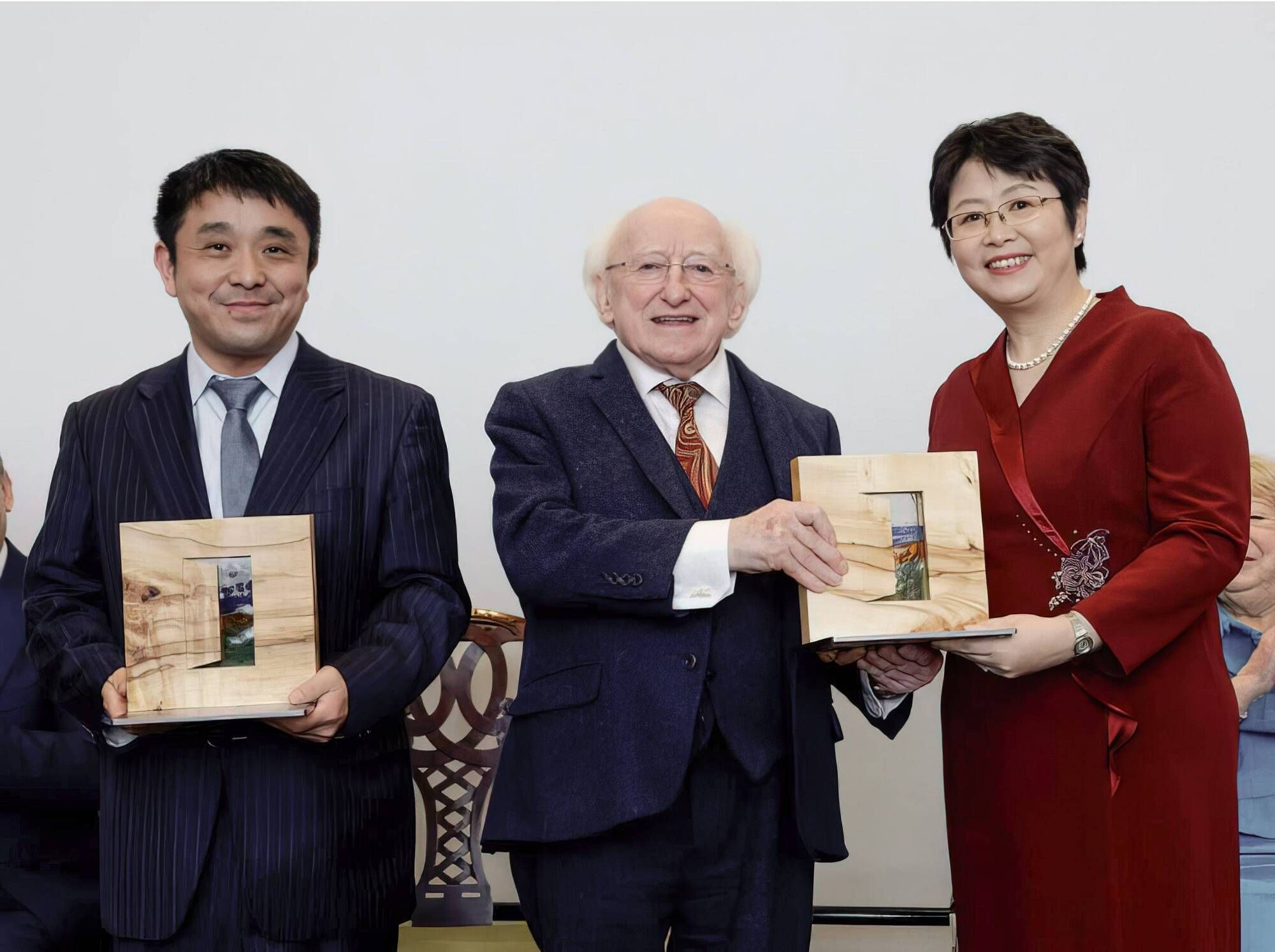
Prof Wang Zhanpeng (left) and Prof Chen Li (right), from Beijing Foreign Studies University, received 2022 Presidential Distinguished Service Award for their outstanding contribution to promoting Irish studies in China.
Elegant, serene, composed, Chen Li, Professor at the prestigious Irish Studies Centre in Beijing Foreign Studies University, laughs when I ask why Irish studies and Irish language, Irish literature called to her., what first sent her in that direction?
“This question has been put to me several times, since I am not of Irish descent. If I were, my interest in Irish Studies might be much easier to understand! Well, the reason is still very simple: When I was an MA student, the mainstream research field for the English language literature in China was still limited to British and American writing. I followed suit, and chose to write my MA thesis on the American writer Eudora Welty, with her short story collection The Gold Apples as a central text. Now you see the connection: the title is a quotation from W. B. Yeats’ poem, The Song of Wandering Aengus, in which he vows to 'pluck till time and times are done / The silver apples of the moon / The golden apples of the sun.’

“That was the irst time I encountered Yeats (and Irish writers). Before this, my impression of Ireland came mainly from news reports about the ongoing Northern Ireland troubles. I happened to be at the right age, so that I was immediately fascinated by this poem infused with romantic imagination, and this led me to more poems by Yeats. Later on, more research showed Eudora’s friendship with Elizabeth Bowen, which led me to read Bowen’s A World of Love. Till now, both Yeats and Bowen remain my favorite writers.
“I spent the four years following my MA graduation reading Yeats and Bowen, and then decided to push myself to get a doctoral degree on them. The final result is a monograph on the popularity of the Big House novels in the mid-20th century (besides Bowen, there are also John Banville, William Trevor, Jennifer Johnston and Aidan Higgins) and how those writers react to Yeats’ Revival legacies. This book is arguably the first in China to extensively explore contemporary Irish literature.”
Chen Li emphasizes that until then, Irish literary studies in China used to mean only researches on such major writers as Yeats, Wilde, Shaw, Joyce and Beckett, and Swift.
“My book is possibly the first lengthy effort to introduce contemporary Irish writers, or Irish writers other than the above-listed six giants. I was thus invited to attend the inaugural conference of the Irish Studies Center at BFSU in March 2007, and graduated one year later. From then on, contemporary Irish literature has remained a focus of my research interest. I am proud to say that the scene has been much changed nowadays due to my and my colleagues’ efforts. While the major giants still remain well-known and well-researched (Yeats in particular remains at the top of the list of most popular Irish writers in China, with his reputation reaching a new high when the Chinese adaptation of his poem, When You are Old, was sung in the 2015 Spring Festival Gala), more and more contemporary Irish writers are introduced and translated.
"For example, John Banville, Colm Toibin, Sebastian Barry, Seamus Heaney, Eilean Ni Chuileanain, Donal Ryan, Sally Rooney, to name just a few, claim Chinese translations of their works. Many books are quickly translated, with the Chinese version published within one year of the English original. Literature Ireland led by Sinéad Mac Aodha and Chinese publishers like Mr PENG Lun and his Archipel Press have played a major role. And I am proud to say that I also contribute a little by serving as a reader for Literature Ireland on the Chinese translations.
“Since 2016, I have managed to publish a lengthy essay every year to give an overview of the latest Irish literary publications in the previous year. And my recent two major research projects also focus on the contemporary era too: one is a thematic research of spatiality in contemporary novels and the other a chronicle of contemporary Irish literature in five broad genres: fiction, poetry, drama, nonfiction and literary criticism. I personally feel most proud of my work in the contemporary field though I sometimes also venture to other periods.
“As I say repeatedly to my Chinese readers, contemporary Irish literature is remarkably different from the Revival period which used to be the most familiar era for us. Contemporary literature in the 21st century is flowering with new writers and experimental spirit. It has long transcended the great tradition as represented by such towering influences as Yeats and Joyce. Its dynamic vitality deserves more attention.”
She is also very much attracted to our legends and folklore.

“I loved reading Chinese mythologies from a very young age. That explains part of my initial interest in Yeats, who enlightens me a lot in the so-called Celtic Twilight folklore. Even nowadays I still feel much excited when I encounter Irish legends, particularly in places that I do not expect to see them, like the myth of mad Sweeney in The America Gods. Personally, I think Irish mythical figures (ghosts, fairies, the supernatural) tend to be more ethereal, with their spirituality and non-human features foregrounded, while Chinese counterparts are usually portrayed in a more “down to earth” way — they bow to the same social regulations, moral obligations and relationships that bound human beings, so much so that they appear almost to be alternative beings living in parallel universes.
"That’s enough about me," she says firmly. “This is about our Irish Studies Centre of which we are justly proud. We are the only one in China to offer multidisciplinary courses, including literature, linguistics, history and the Irish language. We used to be like just others, offering only literary courses. Back in the early 1980s, the late Professor Wang Zuoliang established a Celtic literature section at the BFSU Institute of Foreign Literature, which is the precursor of the present centre.
"However, when we were formally established in March 2007, we were designed to be multidisciplinary. It was hard for us to have proper teachers in the very beginning, but thanks to the support of the Irish Embassy in Beijing, we first solved this problem by inviting foreign teachers from Maynooth, UCD and UCC. Visiting professors such as Jerusha McCormack, Dermot Keogh and Margaret Kelleher have given us enormous help in shaping the center to what it is nowadays.
"Later on, we sent two young teachers, Mr Zhang Fang and Ms Zhang Junhan, to UCD School of Irish, Celtic Studies and Folklore to get trained in the Irish language. That’s how we are able to have our own Irish-language teachers now. You may read more details in their own writing, elsewhere in this publication. We enrol 8-9 MA students biennially. They spend three years here, pursuing MA degrees in Irish Studies. Some of our courses are also open to the whole university for students at both undergraduate and postgraduate levels."
Does Chen Li see any similarities between Irish and Chinese literature?
“Well, that is really hard to answer in a few sentences! Actually, I don’t want to compare them at all as I believe that the charm of literature lies in their uniqueness. For example, James Joyce and Lu Xun are frequently compared in China. I do agree that they have something in common, particularly in the fact that they were both eager to ‘forge in the smithy of my soul the uncreated conscience of my race’ in a time of great turmoil and uncertainty. Yet besides that, it’s difficult to draw any conclusion from the comparison. I mean they both wrote for their own purposes or their target readers. Even if they share something in common while doing this, we cannot go too far in comparing their similarities.”
However, she has recently finished a research essay in English on how Oscar Wilde's play Salome influenced Chinese modern literature.
She does feel that literature functions as an important cultural force to examine and even influence society in general.
“One good example is the literary effort in the early twentieth century to revive people’s interest in Celtic language and culture. No matter whether it is to revive the Irish language and literature as promoted by Douglas Hyde and the Gaelic League, or to revive a Celtic consciousness in the English language as advocated by Yeats and the Dramatic movement, literature definitely offers a useful platform to debate urgent questions concerning Irishness and nationalist consciousness.
"Contemporary Irish literature offers another example to showcase literature’s powerful role in shaping people’s views on questions like gender equality, abortion, domestic violence, corruption and same-sex marriages. Even to individuals, literature has a lot to give. My favorite quotation concerning literature’s role is what David Foster Wallace once said: “Good fiction’s job is to comfort the disturbed and disturb the comfortable.”
"I guess the Pandemic experience must have taught us how valuable literature can be in offering us the necessary spiritual comfort.”