Mutual love of plants translates across continents
Professor Hu Xiaojiang recalls the unique ties between her grandfather, botanist Hu Hsen-Hsu, at the gardens in Birr Castle
Mutual love of plants translates across continents

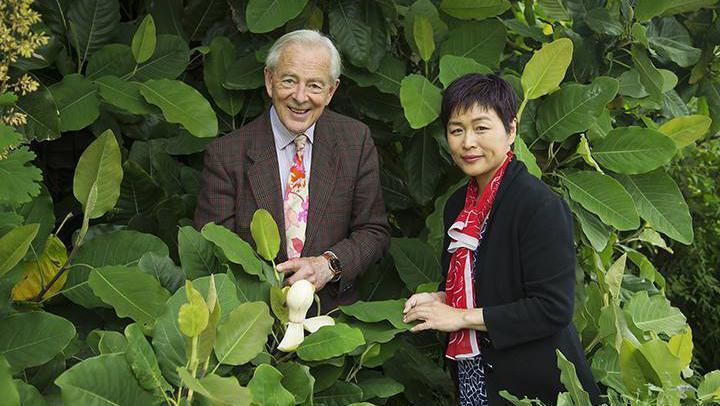
Hu Xiajing and Lord Rosse (Brendan Parson) pictured in 2016 at Birr Castle.  Photos: Redmond Photography, Roscrea

Hu Hsen-Hsu, better known as H. H. Hu in the field of botany, is the founder of modern plant taxonomy in China. Contributing greatly to the establishment of modern botany in China, Hu founded the first biological research institute in China, the first biology department in China’s national universities, the famous Fan Memorial Institute of Biology, in which he served as long term director, and established the Lushan Botanical Garden and the Yunnan Botanical Institute.

A native of Jiangxi province, Hu received a classical education in China before earning a bachelor’s degree in botany from the University of California, Berkeley, in 1916, as well as a doctoral degree of applied biology from Harvard University in 1925. He made a distinguished scientific career in botany, described many new taxa, most importantly by the discovery of the living fossil Metasequoia.

A view of the beautiful gardens at Birr Castle, Co Offaly. Picture: Paul Moore

Birr Castle, Co Offaly, houses many precious plant specimens, and formed a lifelong connection between Dr Hu Hsen-Hsu and Michael Parsons, the sixth Earl of Rosse. The Hon. Desmond Parsons was the younger brother of Michael, the 6th Earl. Born in 1910, he studied at Oxford, and was a brilliant linguist. In 1934 he went to China where his friend Harold Acton was lecturing at Peking National University.

His stay was the start of a great intercultural collaboration between Birr Castle and China. With Desmond in China, his brother Michael decided to visit with his new bride, Anne, on their honeymoon. They had a wonderful time in Beijing and Michael, with his interest in plants and trees at Birr, began his friendship and collaboration with Professor Hu from the Fan Memorial Institute of Biology in Beijing.

Chinese seeds began to make their way back to Birr — now many of which are large trees and can be found in Yunnan area of the demesne. The two continued to correspond for 30 years.

In 2016, Prof Hu Xiaojiang visited Birr Castle and met Brendan Parsons, 7th earl of Rosse, to seek clues of her grandfather’s work. In 2023, Prof Xiaojiang published a complete collection of Dr. Hu Hsen-Hsu’s writings.

Hu Hsen-Hsu, known as H. H. Hu in the field of botany, is the founder of modern plant taxonomy in China.

“From the 1920s onward, Hu corresponded extensively with scientists in Europe and in particular with the 6th Lord Rosse, but he actually never went to Europe,” Professor Xiaojiang said. “Four times he made plans to go to Europe for conferences and travel, but all failed to materialize. Twice because of shortage of funding, once stopped by war, and once stopped by the new government of China.”

So she became the first Hu to visit Birr Castle. “2016 was my first-time in Ireland, and it was all very new to me. In Birr, I saw my grandfather’s letters, all perfectly preserved, in an old European castle. I also saw many Chinese trees grown from seeds sent by my grandfather, alive and healthy, in a European garden. It was surreal. I wondered how I was seeing a connection bloom that was sown for me, 80 years ago, by people I never met.”

A professor of sociology in Beijing Normal University, with a PhD of sociology from Harvard University, she recalled how her grandfather belonged to the first generation of Chinese students who studied botany in the West.

“He was not the earliest one per se to study botany, but he was the most energetic and entrepreneurial one. Hu thrived in a time of enormous struggle for China, and was the first Chinese person who discovered a new genus, and later a new taxonomic family in China. Hu’s dissertation was the first systematic investigation of plants in China, and published many research articles, wrote a dozen books and three textbooks,” she added. “Hu was not only a scholar but an institution-builder and team-builder. He was the one who built the first biology department, the first biological research institute in China, and led the Fan Memorial Institute of Biology to become an important research institute with international status.”

In addition, he built the Lushan Botanical Garden and the Yunnan Botanical Garden, in addition to founding the Botanical Association of China and editing several botanical journals. “That’s why he’s widely regarded as the founding-father of botany in China.”

Inside a glass house at Birr Castle, Co Offaly. Picture: Paul Moore

Dr Hu Hsen-Hsu was unique in successfully combining his two great loves — botany and poetry. One of these is dedicated to the metasequoia he helped rediscover.

“Poetry played an important role in classical Chinese education for millennia,” his granddaughter explained. “Hu had a solid foundation of classical education, and also had strong interests in literature, both Chinese and English. Hu was also regarded as a major forerunner of modern literary critique in China. I also have a strong interest in classic poetry.

“It just came naturally to me before I knew about him. It also has wide appeal for Chinese children even today. But for several decades in the early 20th century, a radical social movement advocated for a new vernacular literature. Classic poetry was considered arcane, pretentious and inaccessible for common people. Hu strongly opposed those ideas. Hu actively participated in the debate, which made him famous in literature history. Hu believed that classical poetry is real literature, is accessible and is fully capable to express contemporary events including science. Hu wrote a long poem, ‘On Metasequoia’ in classical Chinese to prove his point.” 

Given how Dr Hu Hsen-Hsu was an individual of very wide-ranging interests, encompassing education, politics and the economy, Professor Xiaojiang has found it very interesting to discover the many different sides of her grandfather.

Hu Xiajiang in the archive room in Birr Castle. Photos: Redmond Photography, Roscrea


“Aware that he had wide range of interests, I was still surprised with new discoveries. Hu translated the classic drama ‘Palace of Longevity’ into English. To help English readers to better understand, Hu wrote a long and detailed introduction of the history of drama in China. This piece, along with the translation, is included in the Complete Works. But even after the Complete Works were already published, an elderly botanist told me that 70 years ago he saw a small book written by Hu, entitled ‘Buddhism and Plants.’ I was in doubt because I never heard of such a book, but this old man told me, “It was definitely by Hu, because no one else could write on such a topic.”

Hu was known as a prodigy and extremely hard working, as his granddaughter discovered: “Hu had immense energy, wide attention span, and amazing memory. It is beyond my comprehension. I can only admire him in awe.”

Professor Xiaojiang has witnessed a renewed interest in her grandfather by Chinese people in recent times, a desire by the public to know more about his remarkable life and achievements.

“The renewed interest is not only about Hu but also about his contemporaries: the first generation of intellectuals in modern China. This generation had a strong foundation in classical education, and also made amazing achievements in modern sciences, social sciences and humanities. Above all, this generation exhibited strong character and integrity during the enormous turbulence of the 20th century. Chinese people nowadays hold a sense of nostalgia toward that generation.”

Because of the wide range of interests of Dr Hu Hsen-Hsu, particularly in the areas of the humanities and natural sciences, she sees his many thoughts as being still valuable and inspiring to people right now.

“China is an ancient country with a long history, and it seems to always face the dilemma of how to find a balance between being an equal member of the world and to value its own historical legacy and heritage. The past debate is still relevant, particularly right now as China has become economically strong.”

Birr Castle, Co Offaly.

Though her grandfather had died before she was born, Professor Xiaojiang can still get a sense of his work and life when visiting places like the Lushan Botanical Garden & Arboretum and the Fan Memorial Institute of Biology.

“The Lushan Botanical Garden is where my grandfather’s tomb is located. I attended his funeral, which was carried out sixteen years after his death during the Cultural Revolution. I knew nothing about him for a very long time, until the last decade when I started to work on his complete works, and also to learn more about both the man and his time. I found out what had really happened in history, and started to have a sense of his life. You may be surprised that even though China had a long history, its recent history is largely forgotten or misunderstood. What I am doing is to discover as much as possible of that vanishing memory.” Given the historic family connection to Birr Castle and the Parsons clan, Professor Xiaojiang does hope to visit Ireland again one day in the future.

“As I just finished the gigantic project, a lot of extra work has grown out of it. So I do not have concrete plans to visit Ireland, but I very much look forward for future opportunities to meet Parsons family again. I hope the younger generation of Ireland is also interested in discovering our past connections and then building new connections for the future.”

x

More in this section

Cookie Policy Privacy Policy Brand Safety FAQ Help Contact Us Terms and Conditions

© Examiner Echo Group Limited