Property porn? Guilty, as charged
Departing Property Editor Tommy Barker signs off on 30 years of property watching and, personally,  a 130-year family connection to the Irish Examiner
Property porn? Guilty, as charged

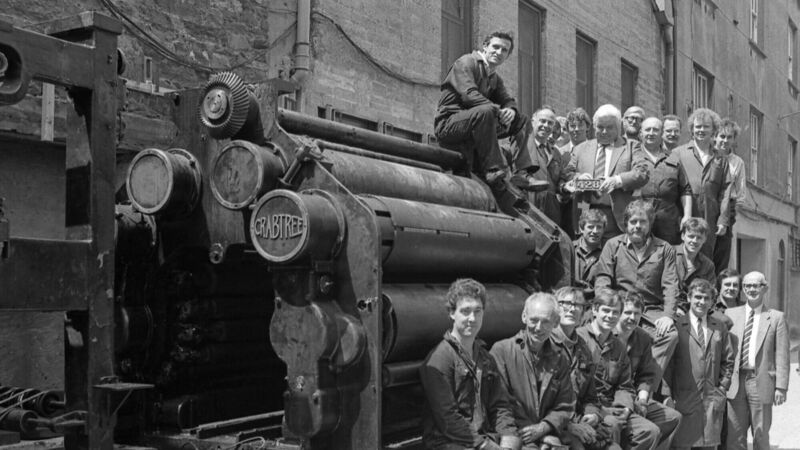
Stop the press: Cork Examiner staff with a defunct printing press in ....1987. Different times


IT’S a truism: Property markets move in cycles, like life itself, from growth to peak to slowdown…or to worse outcomes, but at least markets can come back over time.

Life, and life events, more typically begin afresh, in new generations.

Reflections which just about shy clear of being completely morbid reign on this page, this week, as a new Irish Examiner Property Editor, Catherine Shanahan, takes over after this End of 2025 Review/2026 Preview bumper 52-page Property & Home edition, in Jan ‘26.

Your indulgence is sought, as the occasion prompts this retiring writer with 40 years in media to look back on over 30 years reporting on the Irish, Munster and micro-property markets.

City changes continue

That’s since the more benign 1990s, as Cork, the province, the country, land and the media landscape underwent seismic changes…from this medium-term lens perspective at least.

The most polite or delicate term for the scale of change from 1995 to 2025 would be ‘growing pains’. Our climate-change raddled planet’s population has surged 40%, to 8.25 billion. Ireland’s population growth has outstripped that in percentage terms, up by 50% in that 30 year time span, and our cities have swollen.

In the same interval, median Irish house prices have risen 400%, or to five times where they stood in 1995, from c€76,000 then to €380,000 no, with new city three-bed semi-ds now fetching up to and over €500,000.

That’s half a million euros: it’s not just in 1990s terms does that sort of price for a family’s roof overhead seem vulgar.

Semi-detached....from reality?

If that sees vulgar (and, it is), compare the sums at least to overseas buyers plucking Munster mansions for record prices like €30m and ploughing millions more into personalising them, or spending €5 m on period homes and virtually levelling them….regular readers will know examples of same have been exclusively reported in these P&H pages over the past several years.

In seemingly more innocent days of 1995, a development of 50 houses was big news, a house in Kinsale’s Scilly area being demolished made the front page: now it’s near common-place, and single planning applications for 1,000 or more homes are not uncommon.

The ‘property ladder’ of yore still exists, but the lower rung has been place too high for many, and the catch-up game of social housing provision has barely started to remediate the State’s dereliction of duty in this sector since the 1980s.

This journalist started working in the then-Cork Examiner in June 1985, the day after the Air India disaster off the south coast, when a terrorist bomb killed 329. The Academy Street newsroom hummed, and an international media pack used our ‘wires’ to send heart-wrenching stories worldwide.

No words. Pic: Denis Minihane

Into this maelstrom, I nervously arrived with a weighty student days’ 1940s Royal typewriter in my arms. “Aha, they’ve found the ‘Black Box!’ shouted an Evening Echo sub-editor. Hacks’ ability to leaven tragedy with dark wit landed, day one: “I’ve found my tribe,” I thought.

Small confession: the Cork Examiner was known, eh, some nepotism, not surprisingly perhaps it was a family/dynastic owned title (see 1987 image above).

My own grandfather (Thomas) had been employed here from the late 1800s as a photographer, had been on the ill-fated Titanic in 1912 when it came to Cork, and his images of the Lusitania survivors and mass graves helped bring the US in World War One.

My father Tom had a 48-year reporting career, which included the 1979 Betelgeuse tanker explosion in Bantry.

Bantry
Bantry

I followed, from 1985’s tragic Air India maelstrom; later, Jonah-like, I was wrapped up in the run up to and the aftermath of the Irish property and international economic crash…

Peak madness: Dublin's Walford made €58m

Since taking up this paper’s property reporter/editor mantle in the mid-1990s, to to today, some 1,500 editions later, key facets of the job have changed (whose hasn’t?)

Phone books went the way of carbon copy (google them), as mobile phones became ubiquitous.

The internet changed everything, just as AI continues to do today at a vastly accelerated pace.

Irish property websites like Daft (1997) and Myhome (2001) came and changed ‘the game.’ In the mid-2000s market peak, Myhome, and estate agency (Hamilton Osborne King) and a Dublin home called Walford all sold for c €50m+ sums.

Phew.

Late in the day, the Property Price Register came along in 2012, backdated to 2010, and was a gamechanger in terms of transparency.

Building Energy Rating (BERs) came in 2007, and only lately have made their impacts vitally felt in terms of buyer’s intentions and preferences.

Quays development  HQ apartments under construction by Kent Station Oct 2025.  Pic: Larry Cummins

Property Tax (LPT) came in 2012; tax breaks for developers (common in the 1980s and 1990s) are now deemed necessary again in some market sectors to maintain supply and underpin construction confidence. Evidence of their crucial role via the likes of Croí Cónaithe are seen today in apartment delivery in the likes of Cork city’s north and south quays… ‘new city downriver schemes which seemed aspirational in the 1990s, and temporarily doomed in the post-crash late 2000s.

Since, the country has mopped up the blight of ghost-estates, and just this month the 2009-established ‘bad bank’ Nama has finalised its wind-down, returning a total of €5.6 billion to the State.

In the face of a housing crisis, Government housing plans ranged from 2014 Social Housing Strategy to Rebuilding Ireland; Housing for All; the First Home Scheme; Help to Buy, along with Housing Assistance Payments (HAP), plus an array of supports and grants for energy upgrades and rescuing vacant and derelict properties.

Online bidding and auctions are increasingly common; blockchain is part of the new transactional future, with e-conveyancing (gratis of Tailte Éireann,) promising swifter transactions.

Eircodes, now a decade in use, Google maps, virtual imagery, chatbots and GPT now feed into how Irish people interact with home hunting, as well as the legacy media of news sites and – thankfully - publications such as this. As the Examiner moved from typewriters to ‘new technology/direct inputting’ in 1986, I heard an old school editor ask the newsroom PA (how quaint!) to put a story on a fluffy (sic) disc.

Fluffy disc? How we young things laughed!.

Now I realise, the man was a visionary. As retirement beckons, everything in the world is up in the cloud, be they fluffy or energy guzzling, and who’s laughing now?

Not me, anyway. Thank you, readers.

x

More in this section

Revoiced

Newsletter

Sign up to the best reads of the week from irishexaminer.com selected just for you.

Cookie Policy Privacy Policy Brand Safety FAQ Help Contact Us Terms and Conditions

© Examiner Echo Group Limited