Your complete guide to today's Irish mortgage market

With an annuity mortgage, the borrower commits to making a series of monthly repayments over an agreed time period, typically 25 to 30 years.
answers all of the key questions that new home buyers need to ask themselves before they invest

For most people taking out a mortgage, there is only one type – the Annuity Mortgage.
This is the standard arrangement with which just about everyone will be familiar: it begins when the mortgage company, bank or lender advances the borrower a large sum of money that allows the borrower to buy their own home. For his/her part, the borrower commits to making a series of monthly repayments over an agreed time period (defined as the “term” of the mortgage), which will typically be between 25 and 30 years.
The amount of interest you pay every month as a borrower is calculated to work out as even repayments, so that the amount of interest that makes up your monthly repayment amount diminishes as the years go on.
In the first year or two of the term of the mortgage, for example, interest will make up the vast majority of the amount you’re paying to the bank, with only a small proportion of the money you’re paying chipping away at the principal (the original sum that was advanced to you). As time goes on, however, more and more of what you pay will go towards paying off the principal, so that by the final years of the mortgage term, almost all of your payments are going towards the principal and the amount left to pay on your mortgage loan decreases at an exponential rate.
Aside from the Annuity Mortgage, there are some other types which are far less common. The Endowment Mortgage is an arrangement where payments to an endowment fund are made in tandem with regular payments against the principal. At the end of the term, the amount gathered in the endowment fund should be more than enough to pay the interest bill with (hopefully) money to spare. The Pension Mortgage is similar to the Endowment Mortgage, with the payments going into a pension fund instead of an endowment policy. The Current Account Mortgage or Offset Mortgage works along similar lines.

In Ireland, the Central Bank sets the rules in this regard and the current rule stipulates that you can borrow no more than 3.5 times your gross salary. For example, if you earn €50,000 before taxation, then you can borrow no more than €175,000 (3.5 x €50,000).
There are some exceptions to this rule, however. To start with, those that are defined as being in the “high-earning” bracket are considered to have additional disposable income that allows them some leeway. As things stand at present, an individual who earns more than €50,000 per annum or a couple earning a combined annual income of more than €70,000 would be classed as “high-earning”.
The decision is left up to the bank in such circumstances and every lender will have their own policies in this regard. Factors such as your savings record and your borrowing track record will come into play. In fact, factors such as these may (in some exceptional circumstances) allow a lender to use their discretion and allow you to exceed the 3.5-times rule. Be warned, however, that this will only be a very exceptional occurrence and lenders have a limited number of times in a calendar year where they can use this discretion, with the only window of possibility being open earlier in the year.
The maximum LTV (Loan-to-Value) ratio set by the Central Bank is 90%. This means that no bank will be able to give you a mortgage for the entire cost of a home and can advance you no more than 90% of the cost.
You therefore need a deposit of at least 10% of the purchase price when buying a home. If you can provide a deposit higher than this, then you normally get an even better interest rate from lenders.
With the Help-to-Buy (HTB) scheme, borrowers can effectively reduce the minimum deposit figure – something very useful in the current climate when saving for deposits while paying high monthly rents has been very difficult for many first-time buyers. Under the HTB scheme, first-time buyers who are looking to buy a new home are entitled to a tax rebate of up to 10% of the purchase price up to a maximum amount of €30,000. Most financial institutions facilitate this effective reduction of the deposit amount and lenders should double-check and discuss it with the bank.
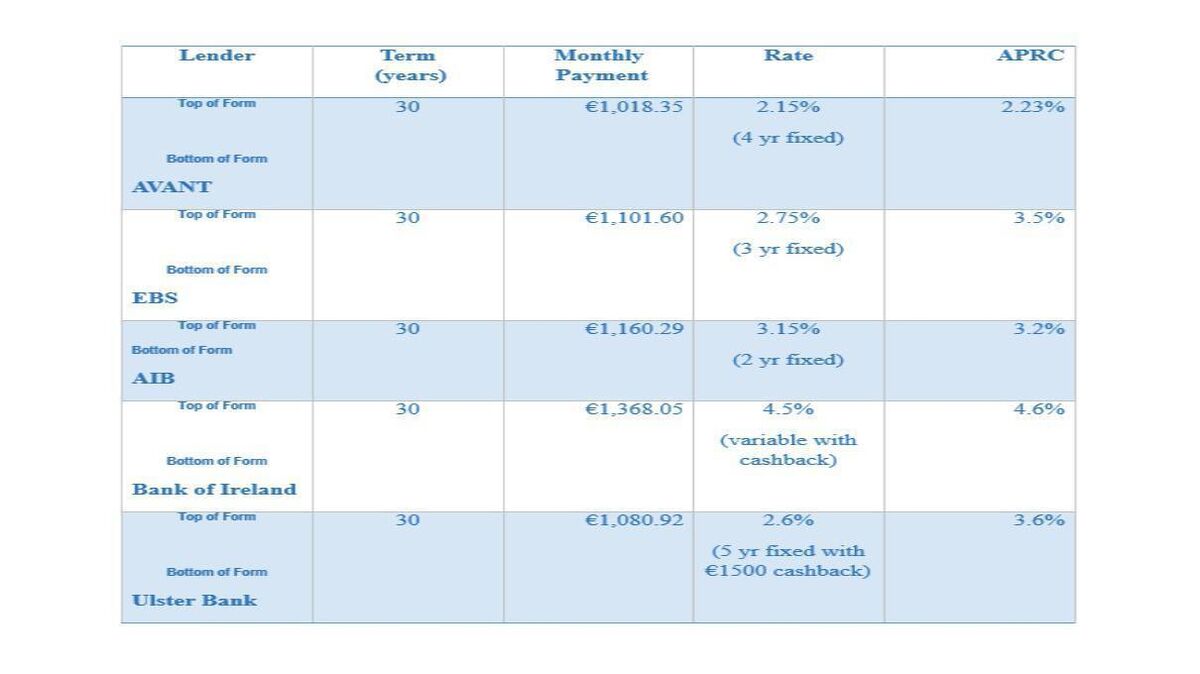
The table below shows examples of various rates and the monthly repayments from some of the most active lenders in the Irish homeloan market. The figures are based on a first-time buyer purchasing a home for a figure of €300,000 and with a 10% deposit of €30,000. Some institutions will offer better rates than those quoted if the borrower opens a current account with the bank and/or comes with a higher deposit and various banks offer cashback on the loan.

In short, the best rate for anyone is the lowest one. This is the one which involves the least amount of money paid out of your pocket.
After that, it is a matter of philosophy in a sense. One can broadly divide interest rates into two categories – the variable rate and the fixed rate. The variable rate has the advantage of you being able to pay off the mortgage at any point without incurring penalties, but the fixed rate has the advantage of you knowing precisely what you will have to pay each month for the fixed time period of that fixed rate.
Traditionally, the variable rate was a lower one than the fixed rate. By taking a fixed rate, you took the chance that it wouldn’t go up for the foreseeable future, so you got it at a cheaper rate. Nowadays, however, we live in a period of extremely low interest rates and in this topsy-turvy world, the fixed rates are lower than the variable rates.
In spite of rising inflation, this situation shows absolutely no signs of changing. You can tell that by looking at just what good rates you can get in a fixed-rate situation. As things stand in the market at the moment, therefore, the fixed rate is the better option, unless you’re planning to come into a windfall in the coming years.
The following is a list of additional costs for which you need to make provision:
- In the not-too-distant past, Stamp Duty represented a very hefty tax bill. Now, however, you pay only 1% of the price of your property up to the value of €1,000,000. Thereafter, you are liable to pay 2% of the amount by which your property price exceeds €1 million.
- Hiring the services of a solicitor will be a brand-new experience for many first-time buyers but it’s unlikely to be the last time you’ll need legal counsel. The most important consideration when doing so is that of trust (rather than price) and it’s important for one’s own sanity and peace of mind to have someone on board who you can trust and with whom you can work well. Conveyancing (the legal business of the purchase/sale of a house) is straightforward enough in most circumstances but it can be fraught with frustration if you don’t have someone who will do the work thoroughly and efficiently. All told, your budget for this part of the journey should be in the region of €2,000.
- From a legal point of view, this fee can be avoided altogether but your solicitor will advise you to get a structural assessment carried out on your new home and it’s the normal practice to do so for a fee that will probably come in around €300.
- This is a necessary part of the picture as your lender won’t release the loan cheque until an independent valuation of your home is carried out. The cost will be approximately €180.
- This one is required from a legal standpoint. The basic requirement is that of a policy which will pay the remaining balance of your mortgage in the event of your or your spouse/partner’s demise. It might also be worth considering augmenting the policy to add Income Protection or Serious Illness Protection. What is important is to shop around as quotations can vary wildly. You should be paying around the €260 per annum mark.
- This one is also important and well worth shopping around for, with all kinds of figures being quoted. It depends on the cost and the location of your home but a rough estimate would be about €270 per month.

CONNECT WITH US TODAY



Be the first to know the latest news and updates