Islands of Ireland: Clare's Inishmacnaghton brings tranquility and tragedy
Islands of Ireland: Clare's Inishmacnaghton brings tranquility and tragedy

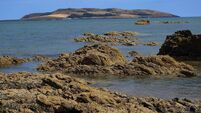
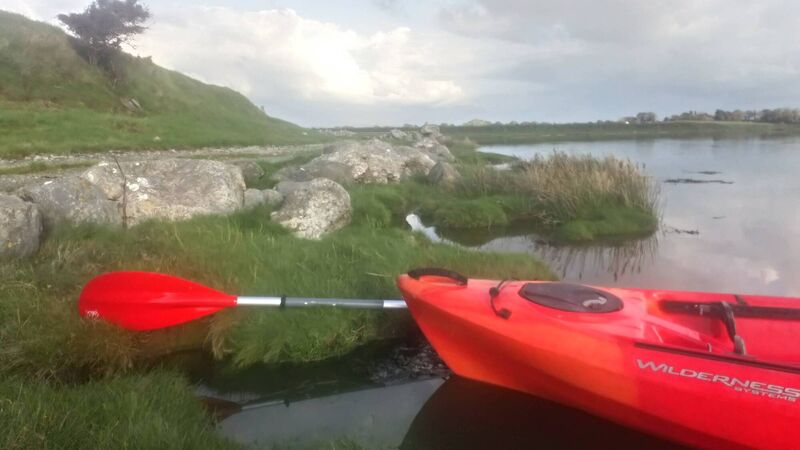
Inishmacnaghton, Fergus Estuary, Co Clare, which is about 2km west of Shannon Airport. Picture: Dan MacCarthy

Bar the consistent boom of transatlantic jets passing overhead from Shannon Airport, which is just up the road, the rural area of Ballycalla, Co Clare, is as peaceful a place as you would fine anywhere in this country. The occasional tractor rumbles along, cows loll in the fields, and the River Fergus sweeps past to merge with the Shannon. Social life centres around St Conaire’s Church and the Honk Bar.

Inishmacnaghton is one of several spellings for this 285-acre Co Clare island, which has had numerous variations including Inchevicknaghten, Enishmcnaghten, and Inish Mhéic Neachtain. It is a flat island, exclusively farmland, and rich in alluvial soils from the river. A short causeway connects it to the mainland, but is only accessible at low tide. A solitary house stands on it today, like the little house on the prairie. However, the population was 12 in 1841.

Into this tranquility on December 28, 1946, burst the worst nightmare of every airline passenger: a fatal crash. It is now 75 years since that evening when the TWA flight from Paris to New York crashed very near Shannon Airport.

People walk among the wreckage of the stricken TWA flight 'Star of Cairo ' near Shannon Airport in December 1946.

On its approach to the airport, The Star of Cairo overshot the runway and circled for a second attempt, but a faulty altimeter saw it fly drastically low. The wing touched the ground at Inishmacnaghton and the plane broke up on impact. Of the 23 people on board, 13 were killed. There were 14 passengers: nine French, four Americans, and a Pole. The pilot, Herbert W Tansey, survived but lost a leg.

One report stated: “The impact was so violent that the back of the plane was broken and dead and survivors and pieces of the dead were hurled through the rupture.”

It went on to say there was a thunderous explosion, which shook the windows of the airport, and flames roared 50ft into the air.

Ballycalla man Mike Mulvihill says there are still local people alive who remember the awful night. Bodies were brought across the narrow channel of the Fergus to the morgue in Shannon. Survivors were rushed to hospital in Ennis.

The central section of the plane fared worst, with the rear and cockpit both having survivors.

It took rescuers over two hours to reach the injured in the middle of the winter night, as Inishmacnaghton is flanked along one side by a moat-like river channel thick with mud.

“The manner in which the dead and injured were all got out of the island in the darkness is the finest tribute to the noble and self-sacrificing work of all the voluntary helpers,” said a Dr O’Keeffe who attended the scene.

The dead included Peter Dreyfuss, whose father Alfred was the French artillery officer at the centre of the infamous scandal in 1894 that inspired novelist Emile Zola to write his famous article ‘J’Accuse’, pointing the finger at the deep anti-Semitism within the French army. Alfred was transported to Devil’s Island in French Guiana, where he was incarcerated for five years.

The officer who had passed on confidential French military information to the German embassy, Esterhazy, was exonerated. Peter had collected all of his father’s papers with a view to publishing them.

One of the survivors was schoolboy
Jean Claude Zelaznegora, whose mother perished in the disaster. “The next thing I knew was to be surrounded by flames. I found my mother and she knew she was doomed,” the child told a newspaper.

Unable to speak English, Jean was cared for by a local nurse, who became a lifelong friend of the family.

When Mike Mulvihill visited him in New York in 2016, the by now elderly Jean told him it was his first contact with anyone about the crash. He told Mike that he had built a new life for himself and erased from his memory all that had gone before.

The stewardess, Kay Ferguson of New York, was credited with preventing a greater loss of life. “Thanks to her we were ready for the worst when the worst came,” said a survivor.

Unlike other air disasters in Ireland, there is no memorial to the TWA Flight 6963 that crashed at Inishmacnaghton.

How to get there: 2km west of Shannon Airport, but privately owned.

Other: logainm.ie; ‘An Officer and a Spy’, Robert Harris, Arrow Books, 2014.

x

More in this section

Revoiced

Newsletter

Sign up to the best reads of the week from irishexaminer.com selected just for you.

Cookie Policy Privacy Policy Brand Safety FAQ Help Contact Us Terms and Conditions

© Examiner Echo Group Limited