Richard Collins: Flamingos get the cuckoo treatment
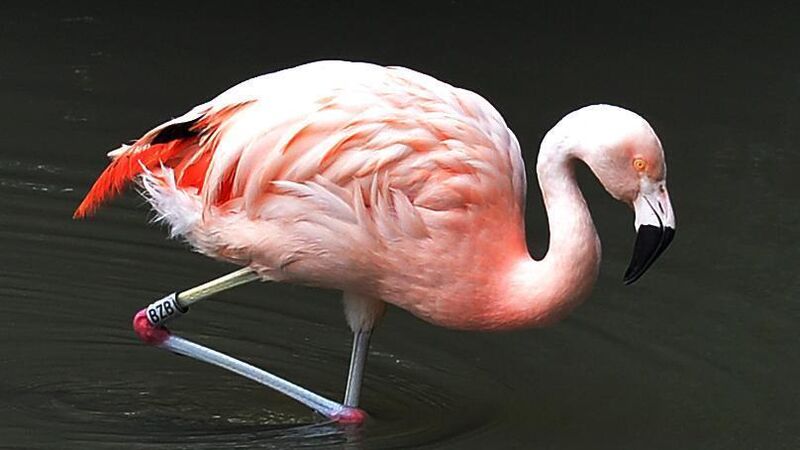
A Chilean flamingo at Fota Wildlife Park in Co. Cork. Picture Denis Minihane.
THE cuckoos arriving now in Ireland will lay their eggs in the nests of ‘banaltra na cuaice’ (the cuckoo’s nurse), known in English as the meadow pipit. In Britain, the reed warbler is the species of choice.
Hyper-vigilant at this time of year, small birds will mob an approaching cuckoo. Adept at spotting an alien egg, they may desert the nest if they notice anything suspicious.
Contrary to popular belief, birds don’t seem to know the colour and size of their own eggs; what they notice is an odd one out in the clutch. When all but one of the eggs in a reed-warbler’s nest were replaced with ‘wrongly’ coloured ones, the parents threw out their own egg and incubated the aliens.
It seems odd, therefore, that duped parents don’t recognise a cuckoo chick in their nest. The pair will exhaust themselves feeding a monster growing to six times their own combined weights. The cuckoo is exploiting a weakness — the host species’ poor recognition of nestlings. Songbirds will sometimes feed the begging chick of a neighbour, even when the youngster is of a different species.
The opposite is the case with waterfowl. Whereas songbird clutches are at risk of being parasitised, those of ducks are less so; a mallard won’t reject an egg added to her clutch. However, she will drive off an alien chick that approaches her brood. Attempts by rescuers to add a lost duckling to another family usually fail.

Surrogacy and its possible effects were studied recently at Slimbridge Wetland Centre in Gloucestershire. The Andean flamingo flock there is one of only two captive ones worldwide. The species is listed as "vulnerable" by the International Union for Conservation of Nature (IUCN), so getting the Andeans to breed is important.
The Slimbridge ones, however, had not done so for many years but, in the warm summer of 2018, pairs nested. The eggs, alas, proved to be infertile. Perhaps the prospective parents were too old? One flamingo was nearing its 60th birthday.
Slimbridge also has a flock of Chilean flamingos. To encourage the Andeans to breed, keepers put some Chilean eggs into Andean nests. Six chicks hatched successfully and were reared by the surrogate parents. In due course, the youngsters were returned to the Chilean flock.
Although Andean and Chilean flamingos have similar lifestyles, being raised by the ‘wrong’ parents might have impaired the youngsters’ social development. To investigate this, Peter Kidd and Paul Rose of Exeter University studied the Slimbridge birds. The results are documented in a paper just published.
The six fostered chicks spent less time feeding than those reared by natural parents. They "were more likely to occupy the nesting area of the enclosure", the researchers noted. Although they had "fewer significant preferred associations than parent-reared chicks", their "preferred social bonds were equally strong and durable".
Fostering is not a technique used only by cuckoos. It is widely deployed in captive breeding programmes for endangered species. In Chilean flamingos at least, the researchers conclude, it "is associated with limited differences in behavioural and social development".
- Peter Kidd and Paul Rose, Influences of rearing environment on behaviour and welfare of captive Chilean flamingos, 'Journal of Zoological and Botanical Gardens' 2021.


CONNECT WITH US TODAY



Be the first to know the latest news and updates