Peter Dowdall: Why August is the month to divide and conquer
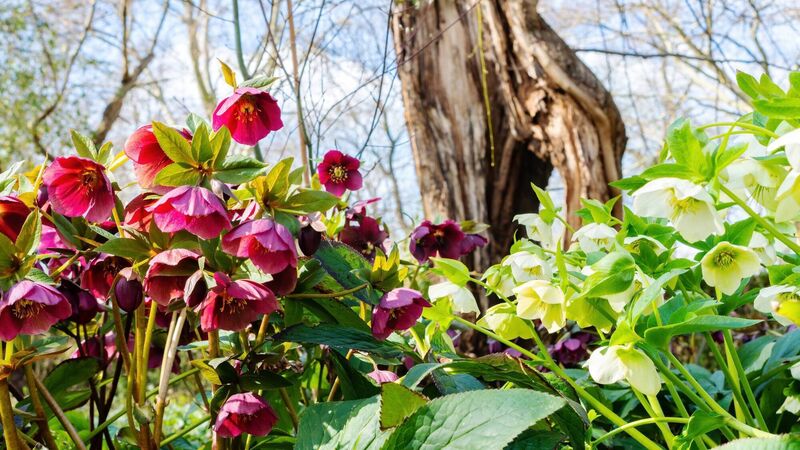
Helleborus orientalis or the Lenten rose can be divided now before flowering in late winter. Picture: iStock

IT IS now mid-August, whether we like it or not — no more waiting for the summer to come, we are heading towards the autumn, and like every season in the garden, if we don’t do certain jobs now, it will be too late and we will have to wait another year.
Many of our garden plants can be grown very easily from cuttings. Propagation by semi-ripe, nodal cuttings is very straightforward and a very successful way to grow new plants.
So many of the plants that we grow in our gardens can be grown in this way, and it is very easy. If you have yet to try out those green fingers at the end of your hands, then do it this month. Take a cutting between two to six inches in length, depending on the species. The base of the cutting should be at a node which is that swollen part of the stem where the leaves join.
Remove all but one or two leaves at the top of the cutting, taking care to remove the growing tip or any flower buds. Insert the cutting into a pot or seed tray filled with compost mixed with grit or perlite for drainage.
Hebe, canothus, abelia, daphne, and even roses can all be grown from cuttings like this taken at this time of the year. If you have a greenhouse or a polytunnel, then you can keep the cuttings indoors, but at this time of the year, you don’t need a greenhouse, as they can also be left outside and you should expect to see roots in a few short weeks.
It’s important to keep the soil around the cuttings damp, but certainly not excessively wet, as this will lead to the cuttings rotting.
Perhaps the easiest of all forms of propagation is by division. This method is only suitable for perennial plants and not shrubs or trees.
It is too early to divide most plants, as they prefer to be done later in the autumn and winter. However, spring-flowering perennials such as Iris can be lifted now in late summer and early autumn. Flowering is finished and new roots are emerging, thus it is a great time to divide.
The Lenten rose, Helleborus orientalis, can also be divided now as it gives the plants time to settle in and develop roots before winter arrives and flower buds emerge for opening early in the new year.
If, however, we get an Indian summer and some longed-for sunshine now or during September and October, then avoid dividing hellebores, as this can stress the plants and make it harder for them to recover. If this happens, then leave it until after flowering in the spring.
Dividing them will not only give you extra plants for free but will also help to maintain their health and vigour.
Before you lift a Hellebore to divide it, make sure that it is healthy and well-watered. If the plant is showing signs of stress, then dividing it will only exacerbate the problem and you could kill the entire plant. If the plant has been growing in a shaded and humus-rich soil and is well watered then, it should be in good condition. Lift the plant from the ground, taking care to keep root damage to a minimum and shake off excess soil before dividing. If it’s been growing in a pot, watering is even more important. It will slide easily out of the pot with no root damage.
YOU should choose a cool, cloudy day to reduce stress on the plant — ideally in the early morning.
Use a sharp, clean knife or garden spade to divide the plant.
A quick search in your local garden centre or online will find you spades designed specifically for dividing perennials, and they are worth investing in.
Think about the money that you are saving by creating plants for free, to justify the expense of the new tool.
Look for natural divisions in the plant, such as separate crowns or clusters of stems and use your knife or spade to very carefully separate these divisions, ensuring that each division has its own set of roots.
That’s it — each division is a new plant, ready to thrive and flourish.
Dig a hole in the new planting position that is slightly larger than the root ball of the division and place the new plant in the hole, making sure the roots are spread out and not crowded.
Backfill the hole with soil and water thoroughly to help them settle into their new homes.
Whether you are dividing and planting new hellebores, irises or any perennial, it’s important to mulch around the crown of the plant when planted.
This will help to maintain moisture around the roots as well as prevent weed growth, protecting the roots from frost and, vitally, improving the humus and
nutrient content in the soil.

Continue reading for €5
Unlock unlimited access and exclusive benefits
Already a subscriber? Sign in
Cancel anytime
CONNECT WITH US TODAY
Be the first to know the latest news and updates