Interiors: Why we love the Wishbone chair and all things Scandinavian

Frugal in line and comfortable in classic or contemporary settings - a CH24 is an heirloom buy and the woven seat should survive at least 50 years with reasonable use.
When it comes to lovely bones, no diner has survived intact from the mid-century right through our obsession with all things Scandinavian and 1950s with no loss of pluck, like the Wishbone Chair. Technically CH24, it’s a stunning, well made and surprisingly modest design by Hans J. Wegner (1914-2007) for Carl Hansen & Søn of Denmark released in 1949.
Riding on our loose copyright protections for vintage design, this iconic perch is still heavily replicated by the awkward flock, with laughingly small tweaks to its airy familiarity. The Japanese are the second greatest buying market for Wishbones, and looking at its lines, it’s little wonder that it would engage Asian collectors as easily as does European and American homemakers.
As a piece, it’s rounded, organic, celebrates honest natural materials and it looks fantastic in both period and contemporary rooms with its Oriental design chops. The back and the armrest are closely aligned as one embracing element.
The Wishbone was Wegner’s first factory-made, commercial venture, and he was suitably nervous. In 1947, Holger Hansen, son of Carl Hansen, had been introduced to Wegner at the Copenhagen Cabinetmakers’ Guild exhibition in 1947, and he was soon working with chief cabinetmaker Johannes Hansen who was determined on developing brave new modernist furnishings for the firm.
He had already been working with Arne Jacobsen and Erik Moller since 1938 on various commissions. A modest man with a fascination for pure construction, Wegner was drawn to the chair shapes from the Ming Dynasty — skeletal throne forms that were often as wide as they were high.
He delivered the design for our chair within three weeks of joining the firm. Impressive. The forked back-splat which recalls the wishbone of a bird, gave it its casual name. Light on the eye, it was effortless to shuffle around compared to something classic like a Victorian balloon back.

There was a lot of deep, interior rumination around design in the 50s that fed into joinery techniques and the look of domestic furniture. Wegner reflected on the challenge of chair design - ‘The chair does not exist. The good chair is a task one is never completely done with — a chair isn’t finished until someone sits in it”.
This human-centred approach over stylistic formality for its own sake is something we enjoy in all our home furnishings today, and Wegner worked to the end of “purifying” and “simplifying all his pieces to cut down to the simplest possible design of four legs, a seat, and a combined back- and armrest.”
He would go on to create over 500 chairs during his lifetime. When his first Wishbone’s were being assembled, Wegner insisted on moving in with the Hansen family on the island of Funen near the factory to keep an eagle eye on the joiners’ work.
CH24 had a lot in common with the Thonet bentwood chair in terms of production, including a steaming process, and the Wishbone was seen by the Hansens as a direct challenge to the Thonet bentwood first produced in 1859 (Chair #14). It was an exercise in elegance and frugality, demanding just a few members and seat in 120m of spun sisal made to look like rope (the firm had perfected this technique to answer the shortage of materials inevitable during World War II).
How can you spot great bones from knock-off poultry? These are hand-made chairs, which take three weeks to make, entailing 100 processes from sanding to chiselling — that’s quickly apparent when you see a cheaper pretender.
First of all the seat can tell you a lot. It should be paper-cord or leather, not nylon, and the work will be taut with perfect 45° angles. They were made to last, and even a 30-year-old seat should be in good repair. The wood of the chair will be silken smooth and all joints will carry an obvious quality.
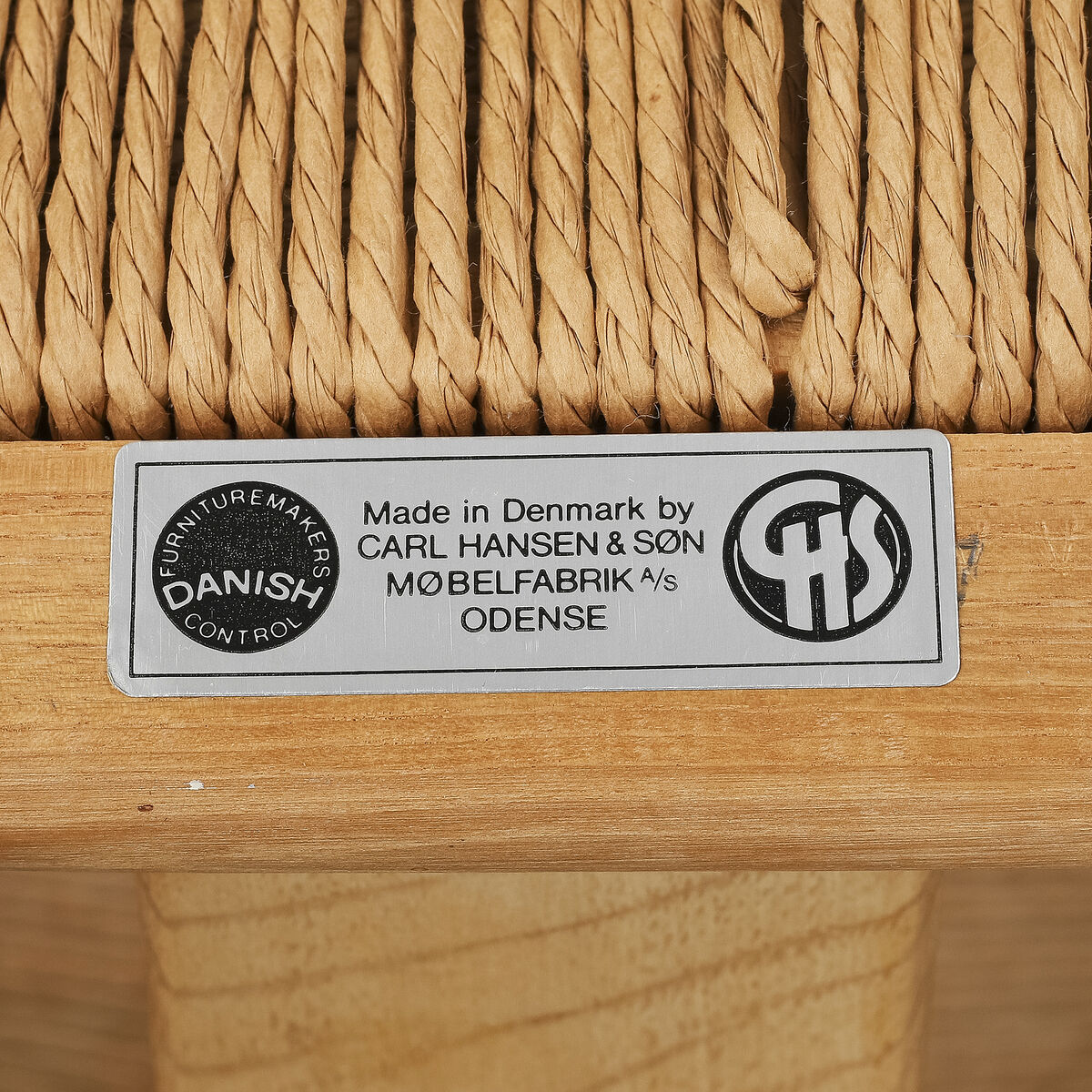
The back will be 73cm-75cm high, and 40cm high at the front point of the seat (2cm lower on the back rail for older examples). Both vintage and current versions carry a label on the underside of the frame to the back.
A recent piece will have a label that displays the Carl Hansen & Søn logo, Hans J. Wegner’s facsimile signature, and a serial number. There are older chairs with a simple branded mark right on the wood.
Putting the chair together, there are 150 combinations of beech, oak, ash, maple, walnut and cherry. If you want authenticity, go for the paper-cord version. There are seat pads in both wool and leather available in a range of colours for your Wishbone.

Prices range from €567 depending on timber, seat material and colour, and you can find an Irish dealer at the Carl Hansen website — carlhansen.com. If you are buying vintage, be wary. The Wishbone does catch the back low down despite being raised a crucial 4cm in the 1990s, so do sit in one before you buy.
That said, you can drop your arms forward off the chair arms and into your lap without shuffling forward and it is very receptive to a flat small bolster for longer dinner parties. The seat provides a wide comfy flexible hammock for the most commodious bottom.
If the Wishbone attracts you but doesn’t completely suit — take a look at the other close companions in Wegner’s seating opus for Hansen, CH22, CH23, CH25 and CH26, all released between 1950 to 1968, and all of which are still produced today in Gelsted in Denmark.
Limited edition painted colours (most recently the Studioisle collaboration between Isle Crawford and Carl Hanse in 2020) do appear from time to time, but jump into these musical chairs if you like them, as they sell out fast. See Carlhansen.com

CONNECT WITH US TODAY



Be the first to know the latest news and updates