Damien Enright: Reforestation would give new hope for continuance of our species
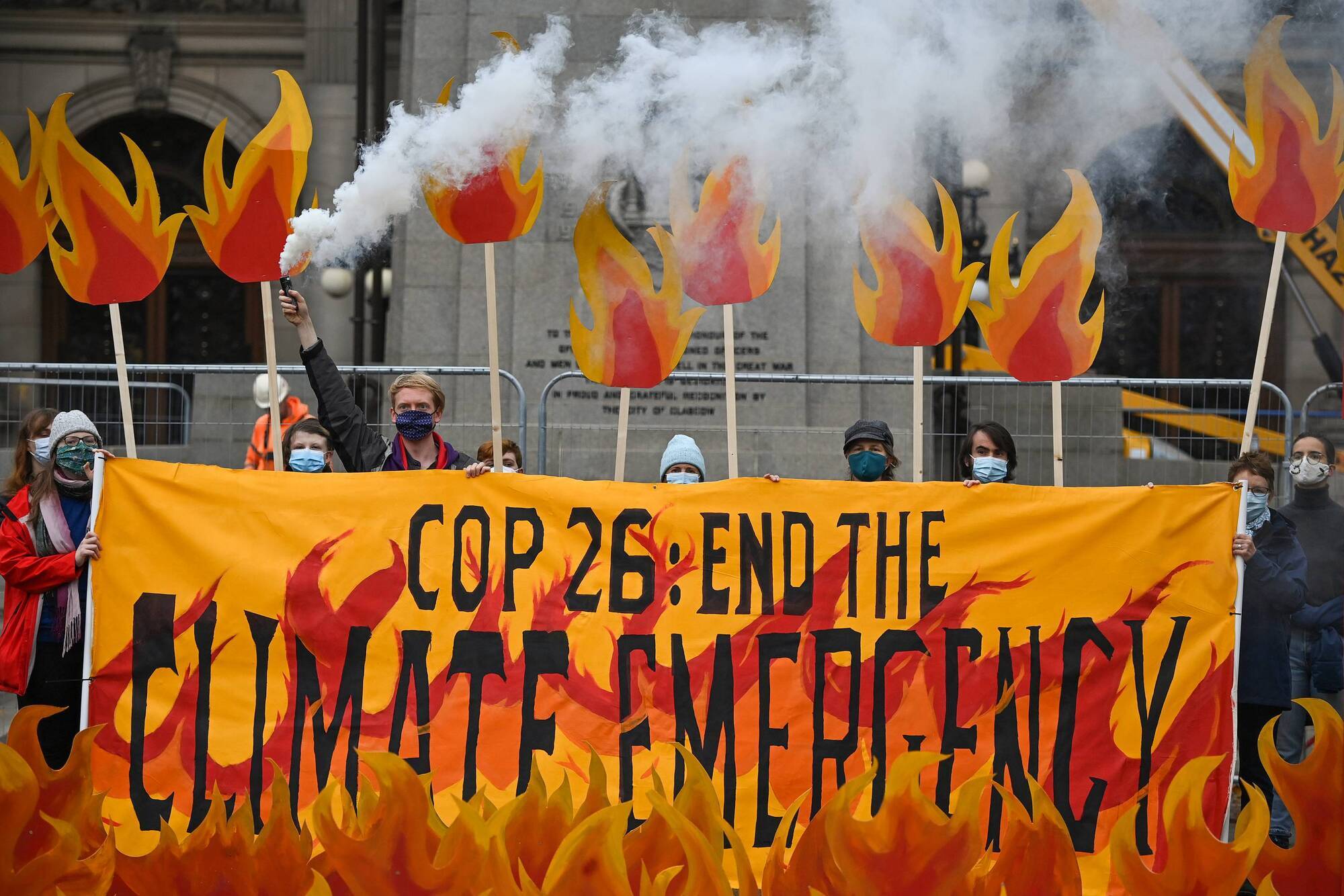
Activists welcomed world leaders to COP26 with a field of climate fire in George Square in Glasgow, Scotland. Picture: Jeff J Mitchell/Getty Images)
In all fairness, I must admit that, in my many years of writing a weekly column for this paper, environmental news has never been so urgent that I needed a hotline to the editorial desk.
Still, I remember being a tad miffed when I missed the chance of a ‘scoop’ after being the first environmental correspondent to hear that a Fin whale was to be seen lying stranded on the floor of ebbed Courtmacsherry Bay one dawn morning in 2014. Or to tell the world that a Bearded Seal from the Arctic Ocean was relaxing on a sandbank in the same bay when, in 2017, an observant farmer phoned to tell me the news as I was getting out of bed.
The opportunity to file ‘exclusives’, in each case, was frustrated because both creatures appeared midweek, and my column wouldn’t appear until the Monday following. Meanwhile, interlopers from other media arrived to post the tidings on the six o’clock television news and, as for print publication, the weekend newspaper beat me to it by two days.
While the unprecedented appearances of 20-metre-long beached whales, confused auks, disorientated walruses, and wandering snow-white seals weren’t of urgent or global import, well may we hope that such ‘trivia’ aren’t henceforth increasingly eclipsed by overnight wildfires, floods, heatwaves, and tsunamis occurring in every corner of the world.
Which brings me to Glasgow COP26. Boris Johnson, hosting the event, the attendees of which are charged with saving the globe from burning, drowning, baking, suffocating or starving, has declared that the Heads of State of the 100-plus nations holding 85% of the world’s forests will sign The Glasgow Leaders’ Declaration on Forest and Land Use committing them to halt and reverse deforestation and land degradation by 2030.
Forests cover 31% of the Earth’s land area. The forests controlled by these 100+ leaders total more than 33 million square kilometres (13 million square miles) of surviving, sustainable carbon sinks. Pledges were made by 12 countries, including the UK, to provide £8.75 billion of public funding with a further £5.3 billion in private investment to assist developing countries, reward indigenous forest guardians and to extend sustainable agricultural land.
The reforestation and concomitant regeneration of some one third of the earth’s surface would be a mighty achievement if brought to fruition in the space of the next nine years. It would give new hope for the continuance of nature and of our species. But the provision of secure carbon sinks should not slow ongoing attempts to radically reduce the burning of fossil fuels. So far, the business of achieving credible and binding pledges from national leaders and Big Business to reduce carbon emissions has not topped the agenda. It will: and let us hope we see the same ratio of commitment to this.
As mentioned in previous articles, Sir David Attenborough has said that by conserving 1/3 of the land, the forests and the seas we would save the planet for our children. Conservation of the seas must be on the agenda of the summit. But only so much can be done. China, which is not attending the summit, accounts for nearly half of the world’s fishing, including the 17,000 Chinese ships comprising the largest distant-water fishing fleet in the world, and operating in all the world’s oceans. Any one of these ships can scoop up in a week what a local boat would catch in a year. Such harvesting is unsustainable.
In Czech – where I am presently visiting family – following a week of warm sunshine the winter is “icumen in”.
Yesterday, I found a peacock butterfly seeking a hibernation site on the stairwell to my son’s flat. It wasn’t a safe location, so I cupped it gently between my palms and transferred it to an open cellar in the basement. There, central heating wouldn’t wake it in midwinter when it would find no nectar and starve, but it could escape when the weather naturally warmed in spring.
The Czech Republic has six nuclear reactors generating about one-third of its electricity. Apparently, small scale nuclear power sources are the optimum solution for the country. The building of a new nuclear power unit has substantial public support.
A team of scientists has recently found a radical way to heat cities using spent nuclear rods, which they say is cost-effective and greener than natural gas. As the EU moves away from coal, this development has been widely studied. Nuclear power reactors don’t create carbon dioxide emissions or air pollution. However, mining and refining uranium ore and making reactor fuel requires large amounts of energy.
Energy, energy! May the Great Creator of energy endow the Glasgow gathering with workable ideas to create it without global burn-out!
CONNECT WITH US TODAY



Be the first to know the latest news and updates