The dark secret of a great songbird
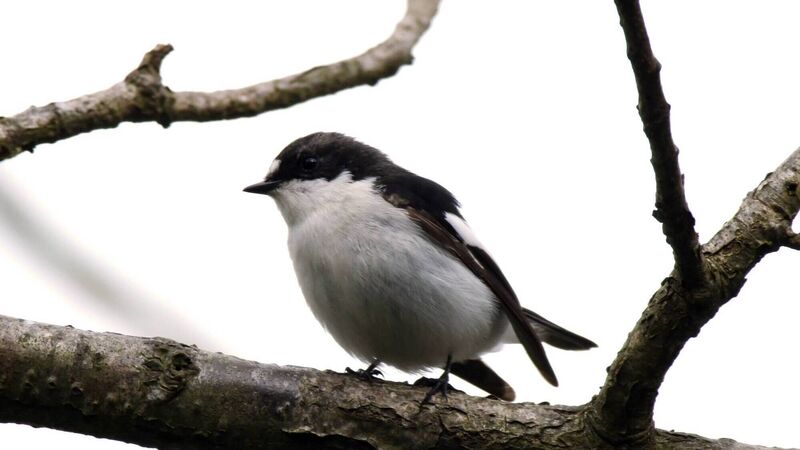
In a month or so, pied flycatchers willl migrate to Britain from Africa.
Migrant songbirds will arrive soon from Africa. The first martins and swallows are expected in mid-March, with chiffchaffs and willow warblers following a little later. In a month or two, sparrow-sized pied flycatchers will settle in Wales, having spent the winter just north of the Gulf of Guinea. A few pairs may cross the Irish Sea to nest in the oak-woods of Co Wicklow.
The aptly named pied flycatcher sallies forth from a hunting perch to catch insects on the wing. Males have tuxedo-like black-and-white plumage. Females are brown and white. The nest locations of choice are tree holes, but flycatchers take readily to artificial nest-boxes.

As a result, they were among the first songbirds whose breeding behaviour was studied intensively. That led to their being 'outed'.
The male's dark secret is that he cheats on his partner. Once her clutch is completed, he sometimes moves away, courts a second female, and nests bigamously with her. He doesn't desert his lawful wife, however, but returns when her chicks have hatched to help feed them. The unfortunate mistress receives no such support. Duped by his 'male-deception polygamy', she must raise her brood alone.
Songbirds were thought to be models of marital fidelity, an example to us all, until Nick Davies's pioneering research on dunnocks, during the 1980s, put paid to that delusion.
Now, the flycatcher's visibility during nesting is helping scientists study one of the effects of climate change. As temperatures rise, spring starts earlier in the northern hemisphere. Plants, and the insects that depend on them, come into season more quickly, which often means that 'the best-laid schemes o' mice an' men gang aft agley'. Long-distance migrant birds are among the 'timrous beasties' at a particular disadvantage. Their plans can be thrown into disarray.
Nesting birds must get their act together sooner in a global-warming world, if they are to make best use of available resources. Doing so isn't a problem for residents; they respond directly to changing conditions. But migrants spending the winter in Africa can't detect changes taking place in faraway Europe. Having arrived here, following an exhausting journey, a bird must develop into breeding condition, stake out a territory, and nest at shorter notice than in the past. Getting its act together can be a challenge. Do birds such as flycatchers become short-taken and lose out?
British Trust for Ornithology scientists, using data from Birdtrack and the Nest Records Scheme, compared the arrival and laying dates of pied flycatchers. For once, the news is good. While there is greater variation in arrival than breeding dates, the birds manage to nest sooner when local conditions require it. Nor do they breed less successfully; the production of eggs and young is not reduced. The researchers still think, however, that "there is a limit to how much birds could adapt to a changing climate". So, there may be trouble ahead. As with so many things in life, timing is all.
- PG Nicolau et al, 'Latitudinal variation in arrival and breeding phenology of the pied flycatcher using large-scale citizen science data', 'Journal of Avian Biology', 2021.


CONNECT WITH US TODAY



Be the first to know the latest news and updates