Meet the man giving basket making a modern lease of life
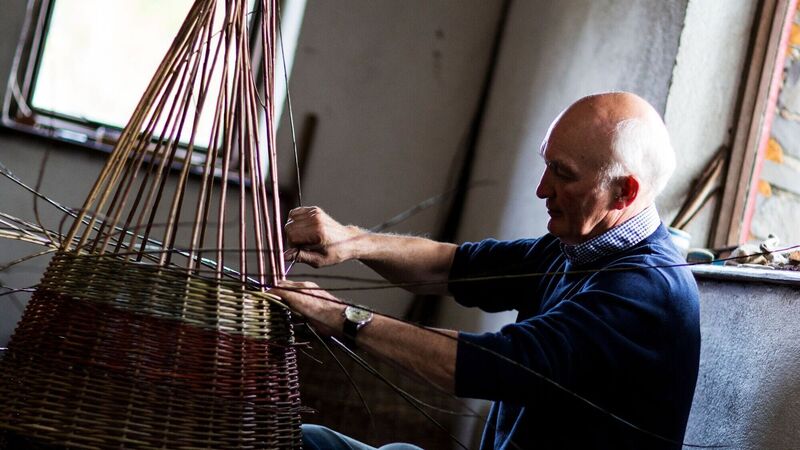
Basket maker Joe Hogan at work in his Galway studio.
CAST an eye around the house and notice just how many baskets you have from the small to large to hold everything from bathroom detritus to logs for the fire.
They’re very much in fashion right now to contain our possessions, especially when we’re trying to reduce our plastic consumption, and, of course, they look better.

But it’s easy to forget in an automated world that someone actually sat down to craft these practical containers and, typically, made them with local materials.
At the forefront of basket making in Ireland is Galway-based Joe Hogan who started making back in the 1970s.

It was a decision prompted by his and his wife Dolores’ wish to live in the countryside and earn their living there.
“It was 1976,” Joe recalls, “and I had an apprenticeship arranged in Mallow, Co Cork, but it was just making lampshades.
"I spent a year there but I had visits to Michael and Tom Quinlan in Tallow Hill, Co Waterford who were still making baskets.
"I met another maker who made creels which are donkey panniers, and I found that all around the Blackwater Valley there was basket making.”
Taking the time to acquire these traditional skills, he and Dolores then settled in Loch na Fooey, Co Galway in 1978.
“For the first 20 years I was making baskets for craft shops,” he explains.
“Things like log baskets, then skibs which are traditional Irish baskets for gathering potatoes and serving them.”
What’s astonishing as Joe chats is to learn he uses 20 varieties of willow, all indigenous, which he grows himself, harvesting from November to March.
The willow is then dried and soaked in a process which can take more than two weeks before the rods are malleable enough to weave.
“I have about five to six days to work with the rods before they dry out, so the days can be long,” he says.
“It’s a very tactile thing if you close your eyes and it gives me great pleasure to earn a living out of something I enjoy.”

Things started to shift significantly in a new direction, however, when in 2005 he was awarded a bursary from the Design and Crafts Council of Ireland.
“It gave me time to make things that weren’t commercial, more experimental; making things I didn’t know if people wanted,” Joe explains.
“Later I started adding pieces of wood to my work from my walks, thousands of years old.”
As it happens, people did want his experimental work with its organic shapes and found objects included as Joe’s artistic basketry started to garner a reputation which now sees it sold to art collectors through galleries in the UK, France, Germany and Switzerland, as well as exhibiting in Italy and Japan.
Such appreciation has even come from surprising places such as the world of fashion design when a series of organic pod-like forms he made measuring one metre in diameter were the basis of a commission by Spanish fashion house Loewe last year.
Forming the centrepiece of its spring/summer 2019 fashion show in the UNESCO building in Paris, there were six large pods in total with 20 smaller versions.
Arresting to the eye, they may well have stolen the show.
Meanwhile, we’re also seeing a growing appreciation of the artistic basket at home where Joe’s work now forms part of the National Museum of Ireland’s collection, and has been chosen for the Design and Crafts Council of Ireland’s Portfolio programme.

But with the artistic basket emerging as a desirable collectible, where does that leave its practical, plainer relative?
Reassuringly, Joe has been passing on the skills he’s acquired over four decades.
“My son Kieran is a basket maker in Spiddal Craft Village,” he says.
Based in the heart of Connemara, Kieran also teaches the craft so the skills are retained and shared with both the general public and would-be professional basket makers, using locally grown materials.
At a time where we are all more environmentally aware, Joe adds, “Today we’re seeing mass-produced imports. Indigenous baskets are beautiful.....a well-made log basket should last 20 years. It’s very sustainable.
“There’s room for all of it, practical and sculptural,” says Joe.
“It’s important to make the necessary beautiful and the beautiful necessary.”