Islands of Ireland - Haulbowline: A name with a slippery past?
THE signpost at the village of Ringaskiddy, Co Cork, points in the direction of Inis Sionnach, which is more popularly known as Haulbowline. However, it is a long time since Haulbowline was thus known. Several other islands around the country have a vulpine influence in their name; chiefly, Shennick Island, Co Dublin. Haulbowline is one of the more curious island names in Ireland and has nothing to do with 'hauling the bow line', despite its military history.
'Haulbowline' is thought to derive from the Norse word 'aalebolig', comprised of 'aal' (eel) and 'bolig' (dwelling place). In his history of the island, Niall Brunicardi explains that 'Haulbowline' crops up in one other place in Ireland: At the mouth of Carlingford Lough (also Norse), in Co Down, a lighthouse bears that name. And it is also an area where eels gather. Brunicardi has also identified a historic version of Haulbowline, known as Inis Eidhneach (Ivy Island).
Towards the end of the Nine Years' War, in 1602, Haulbowline was established as a fortified military site, when Lord Mountjoy, fresh from his success at the Battle of Kinsale, decided Cork Harbour needed to be defended from attack. He installed president of Munster, George Carew, as commander of the site. Carew would distinguish himself six months later as the architect of the Dursey Island massacre, when 300 of Donal Cam O'Sullivan Beare’s clan were thrown to their deaths in the sea.
After a lull of a few decades, Haulbowline was once more in the spotlight and variously fell into the hands of the Parliamentarians and Royalists, as the English Civil War played out here.
In 1806, the island was split between a naval base and an ordnance/supply base. And it was extended by 35 acres, to 64 acres, in the 1860s, when a dockyard and other features were added to its status as a Royal Navy dockyard. The island’s population peaked at 559, in 1901. Haulbowline was ceded to the Irish Free State in 1923.
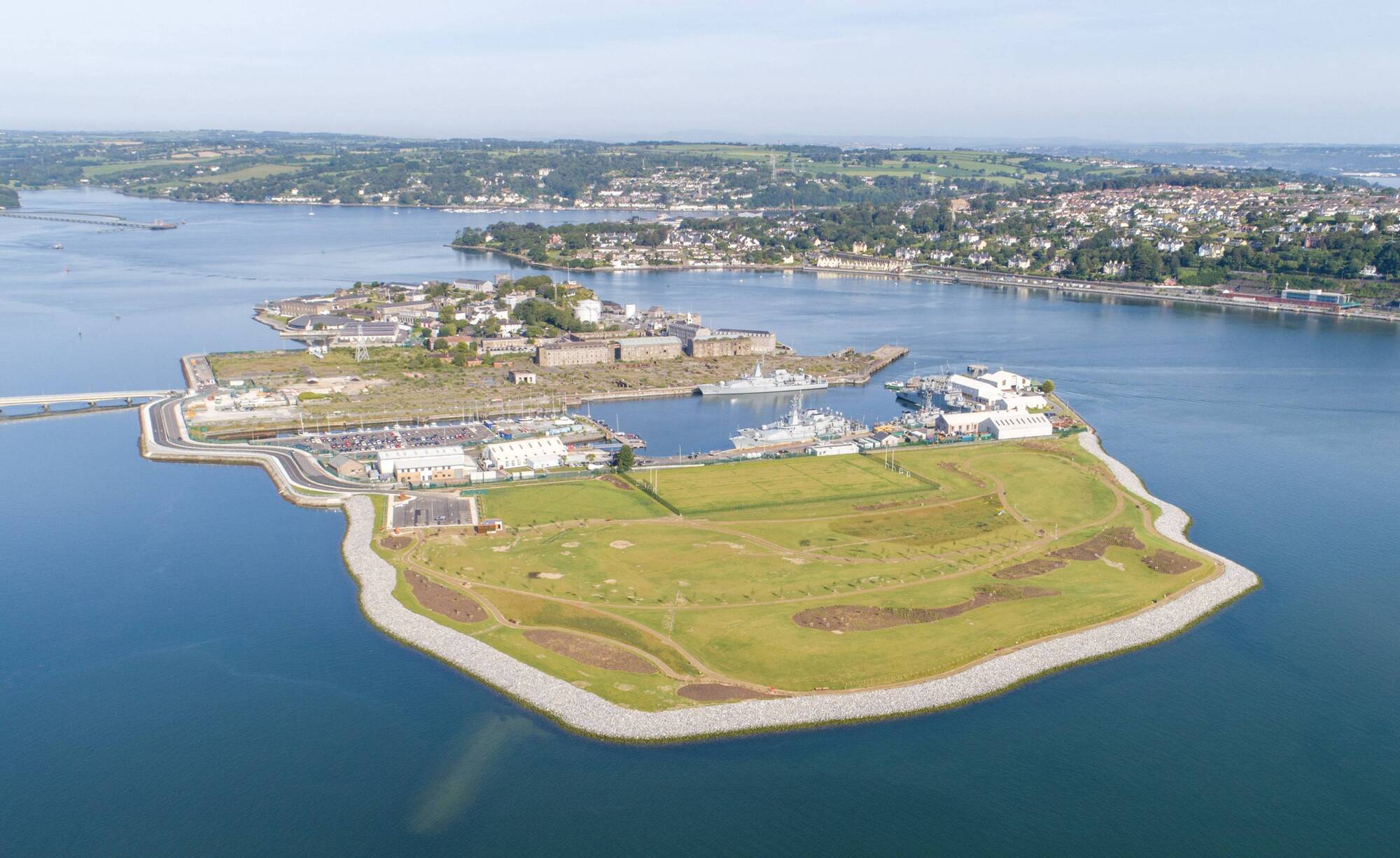
Today, Haulbowline has a split personality, with the western two-thirds occupied by the Irish naval base and the eastern one-third occupied by a public park that has been under construction for the last few years, but which has yet to open.
Haulbowline’s character was more of the Jekyll and Hyde variety when the Ispat steel plant was in operation, between 1938 and 2002, and ugly slag heaps dominated the foreshore at an area known as the East Tip. The park now presents a much more benign aspect, but some have expressed doubt as to the safety of the site, with concerns over air quality. These claims were refuted by Cork County Council, which stated that the report it commissioned referred to "the 11-hectare former steel works (factory) site only and not to the nine-hectare, remediated Haulbowline Island Recreational Park. This 11-hectare site is fully secured, in a different location away from the remediated park, and is not accessible to the public. The report does not specify any risk to future users of Haulbowline Island Recreational Park." When it does open, the park will have 4km of walkways, as well as a 1km jogging circuit and a football pitch. It promises to be a major civic amenity, amid the spectacular backdrop of Cobh and Spike Island.
Haulbowline is the base for the Irish Naval Service and has a capacity for 1,144 personnel and a flotilla of eight ships. One of its key functions is as a rapid-reaction force, but the service is chronically undermanned, as has been reported in these pages regularly. Haulbowline Naval Base was also the command centre for the heroic rescue mission of refugees in the Mediterranean in the last few years. The national Fisheries Monitoring Centre is also based there and is tasked with monitoring vessels in the Irish Exclusive Economic Zone.
Haulbowline was also the site, in 1720, of the first yacht club in the world. The Water Club was later to become the Royal Cork Yacht Club, in Crosshaven.
- Take the N28 south to Ringaskiddy. It is possible to cross the bridge to the island, but entry is not permitted to the public.
- 'Haulbowline, Spike, and Rocky Islands'; Niall Brunicardi, Éigse Books; www.corkcoco.ie/en/haulbowline-island-remediation-project; www.nmci.ie/irishnavalservice1; www.safari.ie.

CONNECT WITH US TODAY



Be the first to know the latest news and updates