They swan about but can be aggressive and territorial
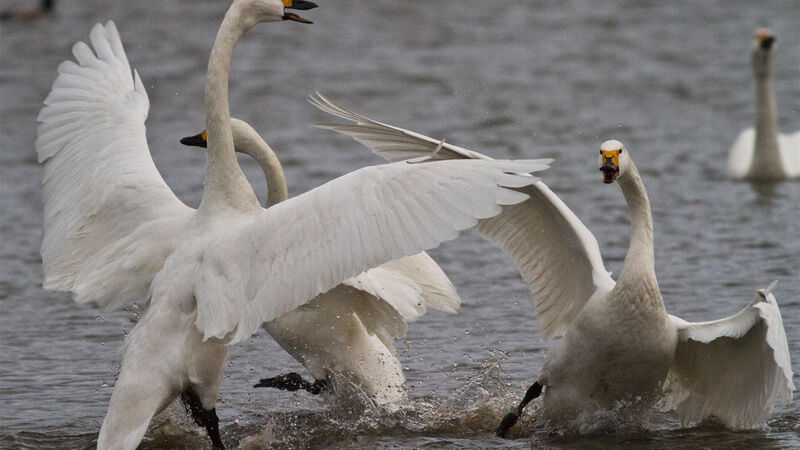
SWANS have a fearsome reputation. They can, it is often said, break a person’s arm with a blow of the wing.
Having caught and ringed over 1,500 of them, I can confirm that a close encounter of the swan kind is unlikely to lead to more than a few bruises on arms and thighs.
Most male swans, which are known as ‘cobs’, will defend their nests and young.
To catch and ring these daddies, I used to let them attack me; under licence, of course. Only once in 11 swan-catching years did I end up in the emergency department. A Meath hospital doctor, examining X-rays of my rib-cage, asked how I became injured. On hearing of my altercation with the swan, he suggested I see a psychiatrist; the myth of the dangerous swan persists.
Finding your neighbour’s cat lying on your doorstep will scarcely cause you grief, but if you found your neighbour lying there, how would you react?
Likewise, a cock robin drives robins from his territory, but takes no notice of other intruders.
This makes good sense: Other robins are competitors for food and nesting sites; allowing every Tom, Dick, and Harry robin into his demesne would lead to rack and ruin.
Like robins and ourselves, swans have a 'trespassers will be prosecuted' attitude toward their own kind and will resort to violence to drive intruders from their patch.
Combat is risky, even for the victors: 2% of known-cause deaths among mute swans in County Dublin and County Wicklow during the 1980s were the result of fights.
Having tracked individual swans for years, I got to know their personalities. All were territorial, but some cobs were so bad-tempered they attacked even harmless ducklings and coots. Most, however, had a more benign 'live and let live' attitude towards smaller birds.
Medieval military campaigns were suspended during winter. Likewise, avian hostilities cease during the lean months, which swans spend mostly in flocks. Violence may be acceptable in 'love or war', but there is little justification for it in winter. Research, just published by scientists in Britain, however, shows that quarrels do take place between swans in flocks and between them and other water birds.
We have three species of swan in our part of the world. The familiar mute swan is sedentary, while the whooper and Bewick species are migrants.
All three will stand up for themselves, if the need arises.
Flocks at the Slimbridge and Caerlaverock wildfowl reserves were studied, during two winters, by graduate students using live-streaming webcams to log incidents of aggressive behaviour.
Swans, the study showed, can be intolerant of other birds. "We observed aggression by the three swan species towards nine of the 11 water-bird species, whilst, in turn, swans received aggression from eight of the 11 species," the researchers wrote. Why? Ducks and coots don’t target the same resources, so there should be no need for swans to harass them.
Swans were much more antagonistic towards other swans.
Between 59% and 80% of hostile encounters recorded at the two reserves were between members of the same swan species.
This makes survival sense: Birds in flocks compete for access to food.
- Kevin Wood et al, 'Aggressive behavioural interactions between swans and other water-birds during winter: A webcam-based study', 2020.


CONNECT WITH US TODAY



Be the first to know the latest news and updates