Polar bears venturing far for their food
The Soviet War Memorial in Berlin’s Tiergarten commemorates Russian soldiers killed during the assault on the city in 1945. About 2,000 of the fallen are buried beneath it. Two tanks stand sentry on plinths in front of a columned walkway topped by a huge statue.
However, these are no ordinary tanks. They are T-34s, which German general, Paul von Kleist, considered “the finest tanks in the world”. Military historians agree. The 80,000 of them, turned out by soviet factories, helped shape the course of history.
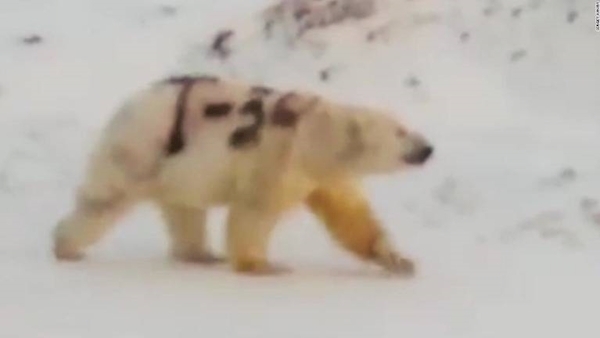
The famous tank is back in the news: a video clip, circulating on social media, shows a polar bear with ‘T-34’ scrawled in large black characters on its fur. It might seem an appropriate choice of graffito for the world’s largest land predator; both the tank and the bear have fearsome reputations.
However, marking an animal in this way is surely an act of environmental vandalism, so who would have done it? Given the remoteness of Novaya Zemlya, it’s unlikely that drunken hooligans were responsible. The characters, though crudely drawn, are clearly legible; the perpetrators meant them to be readable in the wild.
The bear would have had to have been shot with a tranquilliser dart and sedated. ‘Knowhow’, and access to specialist equipment, would be needed. So were scientists involved? They normally fit numbered collars on animals they study. If spraying were used as an alternative, perhaps because no collar was available, the bear would have been marked more discretely and not have paint daubed over so much of its pelage.
Polar bears are ambush predators. They lie in weight on the ice for a potential victim to surface or stray to within pouncing distance. The white coats provide camouflage against snowy backgrounds. Black markings on the fur would blow an animal’s cover and damage its hunting prospects.
Until comparatively recently, polar bears kept to the frozen wastes, causing few problems for local people.
Not any more. The icesheets, on which they hunt seals, are melting in a rapidly changing climate. Starving bears, heading for ice shelves, are faced with exhaustingly long swims.
Many are forced to scavenge instead, invading rubbish dumps on the outskirts of settlements. Some have taken to visiting dwellings, raiding bins and food-stores, placing people at risk.
In Alaska and Canada, troublesome bears are tranquillised and incarcerated in ‘bear-jails’, before being airlifted ‘home’ by helicopter in spring.
The Siberian Times managed to solve the riddle. Andrei Umnikov, director of the Centre for Arctic Exploration, told the paper that T-34 was a “nuisance” bear venturing too close to dwellings, a threat to people. A team was despatched to capture the delinquent and move it to a safer location.
The animal was marked with an inscription which the locals, not just scientists, could read with the naked eye. Sightings would alert the authorities that the animal had returned to civilisation. Nor was the paint a serious hunting impairment; once the bear re-entered the sea, the stain should wash off in about two weeks.
Was the team commemorating the famous tank when choosing the label ‘T-34’?
Apparently not; this, it seems, was just the grid reference of the location to which the animal was moved.

CONNECT WITH US TODAY



Be the first to know the latest news and updates