So cats really do bond with humans after all
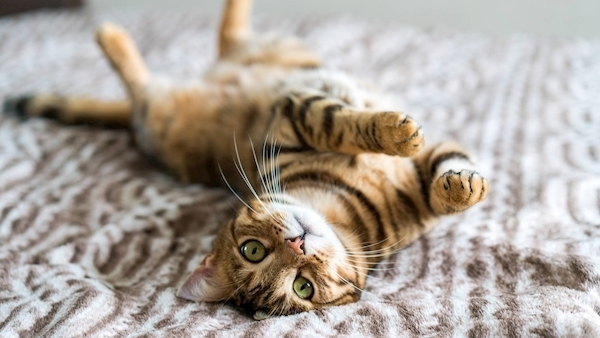
A pet dog is always ‘in your face’, whereas a house cat remains detached and aloof at all times. Lassie wants to accompany you everywhere, but Pussy stays with the house.
She will prevent the mice from raiding your bread bin and keep them from peeing in the cereal, but you don’t own her. She lives with you on her terms.
‘Ar mhaithe leis féin a dheineann an cat crónan’. Do cats only ‘look after No. 1’? Kristyn Vitale of Oregon State University doesn’t think so. She and colleagues carried out a series of ‘strange situation tests’ on cathuman bonding, the results of which have just been published.
These show, she claims, that cats are much more ‘socially flexible’ that we think and capable of forming deep bonds with people.
According to ‘attachment theory’, young children adopt one of several ‘relationship styles’ in response to those who care for them. Some youngsters find the presence of a care-giver comforting. Others don’t; they either shun such contact or become over-dependent and attention-seeking. Infants, placed with their mothers experimentally in unfamiliar situations, vary in their responses when left alone for a few minutes.
‘Emotionally secure’ youngsters return to a normal relaxed state soon after the parent returns but ‘individuals with an insecure attachment’ remain stressed for longer periods following separation.
Vitale and her colleagues carried out similar ‘secure base tests’ on 79 kittens aged three to eight months. Each kitten and its owner were placed in an unfamiliar room for twominutes, during which the carer sat motionless and avoided eye contact with the pet.
The owner then left the room, leaving the cat alone for a further two minutes before returning.
The behaviour of each kitten was monitored before, during, and after, the owner’s absence.
Seventy of the kittens exhibited a particular ‘attachment style’. Nine others could not be classified. About 64%, of those which were classified, responded positively to the return of their carer. Playfulness, curiosity about their surroundings and a desire for physical contact, were considered to be evidence of a bond with their owner.
Such cats were deemed to be ‘securely attached’. Around 30% of the group were classified as ‘insecurely attached’; their behaviour was ‘avoidant’ ‘ambivalent’ or ‘disorganised’. Shunning physical contact, some kittens would run away or try to hide. Follow-up tests two months later showed that the traits remained intact.
To see if attachment towards carers persists into adulthood, 38 cats over one year old also participated in ‘secure base’ tests. A similar division into secure and insecure attachment styles was found among them; 25 cats had formed secure bonds with their owners.
To be sure that the insecurity observed resulted from the absence of the carer, rather than some other factor, the number of meows uttered with the carer present was compared with the number recorded whenthe carer was absent.
These cat results are remarkably similar to those found in tests with human babies and dogs. It seems therefore that the tendency to form attachments develops in kittens and persists into adulthood, just as it does in humans and dogs.
Perhaps we have been wrong about cats; they are not totally self-absorbed after all!
CONNECT WITH US TODAY



Be the first to know the latest news and updates