Importing apples highlights damage to our environment
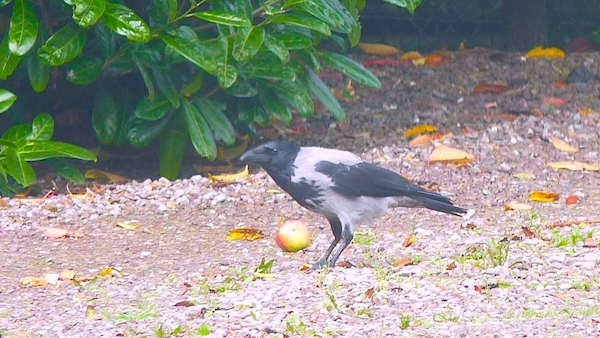
I've been watching the antics of three grey crows that form a small gang hereabouts. Last night, in the near darkness and drizzle, when I was walking by the sea, I saw them in formation pecking their way across a swathe of village greenery because, perhaps, the worms were out.
Then this morning I looked out my work room window to see them striding up the gravelled driveway to my house, then flying into a low apple tree that grows alongside.
A second later, one swooped out following a sweet red apple it had plucked from the tree, and proceed to take it to pieces with its formidable beak.
I could hardly begrudge the bird. There are far more apples on the tree than we can possibly eat and it was quite attractive to watch with its black head, bib and cowl.
We have no small birds coming to the peanut feeders which I filled last week for the first time after the summer; perhaps the grey crow trio and the garden magpies are responsible.
The only birds I see regularly around our patch now are a pair of woodpigeons and the new juvenile heron which has moved in and is getting through the bags of sprat still in the freezer after the demise of the famous
heron, Ron.
A farmer friend of the waste-not want- not vintage always carries a few boxes of apples in his car to give to people he knows.
Fine apples, but not everybody wants them, he says.
Convenience and marketing wins. In local supermarkets, Chinese Gala apples (travelling 8,000 km by air); Pink Ladys from Australasia (17,000 km), and Golden Delicious from California (8,000 km as the crow flies) dominate the shelves even when local apple trees are almost falling over with the weight on their branches.
We consume €100m worth of apples annually, 95% imported. In winter, it’s understandable but while thousands are rotting for want of harvesting in Ireland, why do we burn fossil fuels and further warm our atmosphere to fly in apples across the globe? Is it less expensive?
It costs us dear environmentally. But we don’t seem to be able to get our heads around that. Perhaps we’ve signed contracts to take these overseas apples all year and let our own rot?
That’s international trade, however obscene and dangerous to our future it may be.
This brings me to Greta, the small Swedish girl again, she who has inspired the latter-day Children’s Crusade.
Media comment, internationally, acknowledged the phenomena and universally welcomed it. Even the world’s top financial news sheets supported her.
Bloomberg Businessweek said “World leaders and chief executives of global corporations gathered [...] to say the 16-year-old climate activist is right. They are failing”
Forbes magazine, under the headline:
“The one science lesson every American adult can learn from Greta Thunberg” says: “Her starting point (is) a position of scientific consensus.” They say “Trump’s tweet [...] was an insult”
Despite international media approval and the long-term warnings of scientists and environmentalists like Sir David Attenborough, global warning deniers continue to distract with such waffle as spouted by our own Ryan Tubridy on his morning programme on RTÉ. Tubridy voiced concern for the girl, not the issue. “Is she being minded?” he asked.
Were she his daughter, and said she wanted to speak out publicly against climate breakdown would he say “I won’t let you” and tell her, as he did Thunberg, “You need to be brought home and watch a movie”? Jeremy Clarkson, columnist in The Sun was another self-appointed ersatz analyst, suggesting Ms Thunberg should go back to school and study science, “.... you stand there and lecture us, you spoilt brat”, etcetera. This was rich, indeed.
He condescended that climate change might be caused by humans. “I agree that the world is heating up. You (Thunberg) may even be right that man has something to do with it.” Really? Surely, it’s he who should go back to school.
The UN Intergovernmental Panel on Climate Change (IPCC) on October 8, 2018, prepared by 91 authors from 40 countries reported: “Warming of the climate system is unequivocal. [...] Human influence on the climate system is clear, and recent anthropogenic emissions of greenhouse gases are the highest in history.
Recent climate changes have had widespread impacts on human and natural systems.” According to a NASA, multiple studies published in peer-reviewed scientific journals show that 97% or more of actively publishing climate scientists agree with the above.
“As for the future, it is not a question of predicting it, but of making it possible," said Antoine de Saint Exupéry, author of the beloved children’s book, The Little Prince, in 1948.
This is what the educated Ms Thunberg is about.

CONNECT WITH US TODAY



Be the first to know the latest news and updates