Newsview: Books shows how to find storage in small places
Small spaces can be maximised for artful storage, says
If your utility room/storage space is the physical manifestation of a nervous breakdown and you can never seem to get a handle on its contents, or its layout, then a new book may have the answer to your ergonomic woes.
The title, Home Work, implies a place where you go to work at home. However, home can also be taken to mean a place where you work (back to the ‘machine for living’ concept of architecture), a place where the right structures, combined with the right design, offer the domestic equivalent of a blissful, smooth-running Nirvana or put more simple, a plain-old efficient layout.
So, this diary-sized, Thames & Hudson hardback, by Anna Yudina, not only deals with work space within the habitational structure, it offers an entry into a thoroughly thought-through world, with uber-designed, workable, free-flowing spaces that could easily translate to any part of your own house, or to your house as whole.
In a time when high-earning professionals can only afford the average shoebox, there is a wealth of ideas here for the optimistic buyer of that two-up-two-down or cupboard apartment.
Yes, you can get more into less and this image-rich book is a show-and-tell on how to achieve that most valuable commodity — space — while at the same time, having a place for everything and everything in its place.
Take a look at page 16, for instance — a tiny, Taiwanese, 22sq m apartment that somehow manages to squeeze two floors into one by using a mezzanine bedroom, (with office desk) slung over a kitchen and bathroom, freeing up the rest of the space for living/eating and creating.
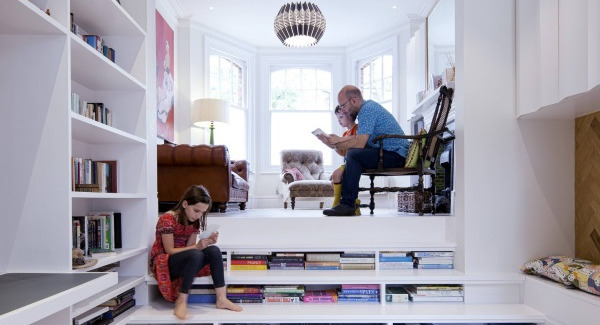
Or the image above, where every vacant element is used as storage for a family and the steps not only work as a bookcase, but provide seating, too.

Or top right, where the over desk storage space functions as a stairs to a snugly-fitted mezzanine offers a guest bedroom. Meanwhile, this whole ‘pod’ structure can be taken down and the room remade at any time. In this sense, the vacant, concrete box is just a stage for the creative configuration of interior space — a house working for its living and as a living space.
There are some elegant and handsome spaces here and decorative and lovely designers draped over impossible spaces in ultra-urban locations, but look closely and it’s all just material and placement and, in a way, that’s what we all seek when we attempt to create a home.
The subtitle is ‘design solutions for working from home’, but the arrangement of space has a universal theme and can apply to anywhere. And there’s more than a whiff of the Tiny House Movement in this collection of designs, too, as the invention here is of necessity— a lot of plans are in confined, expensive city spaces and the sheer genius, in many cases, with which they are transformed to multi-functional living, is a wonder to behold.

The simpler the plan, the better — and with minimal skills and a trip to Ikea or by roping in a good carpenter/joiner, any of the storage and transformational ideas on show will translate to your walls or floors.
The response to a lack of affordable housing, and as a poke in the eye to unsustainability and McMansion-itis, the Tiny House movement is part of a millennial push to save the world before it’s too late.
It has a fundamentalist approach to living that might be paraphrased as: stuff takes up space; stuff takes up the planet’s resources; we don’t need stuff — so why do we stuff our homes?And should houses be the ultimate social barometer? Not so, the Tiny house Movement says, as it looks to condense the qualities of a great house into a small space. Wait til the kids come, I say...
In Ireland, an early proponent of the movement was Dominic Stevens, who, in the height of the boom, created the €25k house and open-sourced the plans online — they’re still there, under http://www.dominicstevensarchitect.net/25k-house-prototype/ and, one boom and crash later, wasn’t he right?
Home Work, by Anna Yudina; T&H; €18.95