Damien Enright: Super-abundant life on the seashore endlessly fascinating
Twenty eight years ago, returning to Ireland after 32 years abroad, I found a house facing the sea with the garden wall no more than 6m from the high tide mark.
I would have had nothing else but a house in near reach of the sea.
In taking ourselves away from London, my wife and I wanted our sons to grow up with nature and community around them, and north London, for all the culture at our doorstep, could not supply that.
We found a large, lone house on the Kilbrittain side of Courtmacsherry Bay.
We loved the come and go of the tides, the changing sandbanks and the huge strand down the road.
I became even more deeply immersed in the bay life when, having written an article about my father’s tending the sub-office of the Munster and Leinster bank at Timoleague once weekly in the 1940s, Sean Dunne, the Examiner editor who read it, invited me to contribute regularly.
“On what subject?” I asked. “Whatever interests you.” he answered. “I’m looking out at a big, rich Irish slob...” I told him.”
“Write about that then...” he said; and thus began my years of intimacy with the bay.
I bought a big glass tank, and state-of-the-art water filters. My youngest son was four years old, a sturdy lad, not yet at school.
Together, we set out to make a collection of flora and fauna of the inter-tidal zone, a high-falutin’ name for the aquarium collections made by self-taught marine biologists of yore.
We’d learn all about the life cycles of everything that lived within our reach in the bay.
Our rule was that we would install the creatures we collected in the tank for a few days of study and return them, alive and no worse for the experience, to the sea.
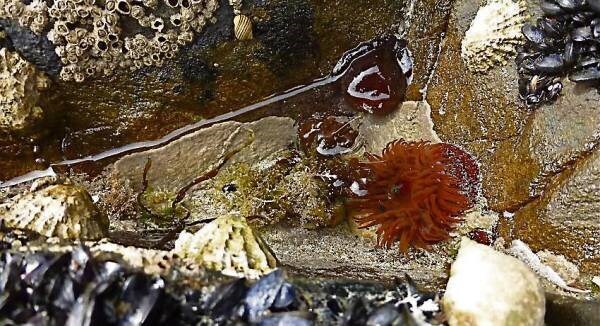
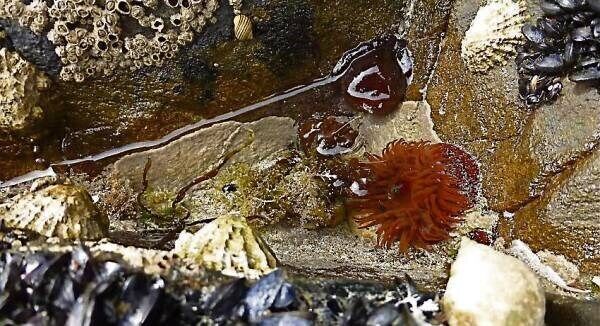
We housed a baby octopus, among other creatures. From weed-covered rocks we made natural reefs with nooks and crannies where fish could hide and where sea anemones, urchins, and shellfish were already at home.
From the tank, we learned a great deal about the creatures and flora of the rock pools. They lived in water from the sea, 350 litres per fill.
Keeping it fresh was a lot like work, and collecting and releasing, we were to be seen out on the bay at ebbed tides in the wildest of weather.
Hand-netting enough tiny, brackish-water shrimps to daily feed the aquarium took an hour of me standing in thigh-high waders in a saltmarsh pool where they gathered in clouds. Happily, my “day work” was at night, and we could enjoy every minute.
On a learning curve myself, I had more material for articles on inshore marine life than I could use.
We thought we knew it all but, now, a pocket book called Ireland’s Seashore, a Field Guide, published by Collins Press of Cork, reveals our ignorance.
It’s a timely publication. In these days so often perfect for the seaside, anyone who fears the kids being bored when they tire of sand castles, pucking a ball or slinging a frisbee, should buy this book and bring it with them.
Crab hunting is fun. Besides, it educates young and old about the fascinating creatures and plants that inhabit our shores.
‘Alien’ life is there in legion: It has colonised every rock platform, every rock pool, every sandy littoral above the tide mark, and beneath the sand, if you care to dig.
In a book A Place Near Heaven, A Year in West Cork, I quoted Edmund Spenser, the Elizabethan poet (and post-Desmond-rebellion planter in north Cork) famous for his epic allegory ‘The Faerie Queene’.
In Book IV, he wrote of the seas: “Oh, what an endless work have I in hand, To count the Sea’s abundant progeny!”
Today, the progeny is seriously less abundant, but the inshore life too insignificant, in most cases but not all, to be of commercial value (vide seaweeds, shellfish, and sea snails) is still legion.
Two young women, Lucy Taylor and Emma Nickelsen, graduates in marine and environmental studies, compiled the book.
It is a credit to them, the first such Irish guide, a valuable source. I’m educated by its pages, which I consume with fascination.
Not only are familiar creatures treated and accurately photographed but also grasses, coastal wildflowers, lichens, green, red and brown seaweeds (edible and not), mermaids’ purses, sea hares, crabs, barnacles, snails and mussels, limpets and bivalves, squirts, urchins, stars and anemones and, of course, the small, darting rock pool fish of so many shapes and colours.
CONNECT WITH US TODAY



Be the first to know the latest news and updates