Vintage View: Past and present of the Lichtenberg figure
Kya deLongchamps is electrified by the past and present of the Lichtenberg figure.

Vintage View: Past and present of the Lichtenberg figure

Kya deLongchamps is electrified by the past and present of the Lichtenberg figure.

Lightning fossils — yes, I know, I was intrigued too. A seriously dire romantic comedy from 2002, Sweet Home Alabama (it was a fallow afternoon), alerted me to the procedure of making lightening sculptures.

The obligatory undervalued hunk in the story, was seen trotting around a marshy beach during a storm conducting forks of God’s wrath directly into sea-sand with lengths of steel rebar. The results following strikes (the film suggested), were bold clear branches of glass.

Enthused to frolic down to Ballymacoda with erect knitting needles, I thought I should get better illuminated on nature’s brightest stuff.

This amped-up weirdness led me to the world of Lichtenberg figures, first witnessed in 2D by German physicist Georg Christoph Lichtenberg (1742-1799) in 1777. Oh, therabbit hole, that is the internet.

Lichtenberg figures take the random occurrence of real lightning hitting and transforming natural substances like sand, to the craft bench under tight scientific conditions.

Georg found interesting dust bunnies, formed on flat insulated surfaces near his equipment as he played around with his 18th century Electrophore (don’t ask).

Having failed to scrub the glowing images off with a rabbit’s foot (I presume a live, confused rabbit was not attached), Lichtenberg took imprints of random creeping star forms and forwarded them to the RoyalSociety. He found that positively-charged high-voltage terminals yielded delicate, frondy results.

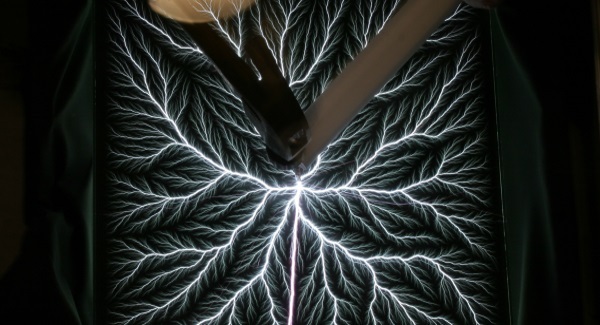
Lichtenberg is credited as the father of laser printing. Incidental to that, he started the journey in ‘fractal’ experiments towards what became known as the Lichtenbergfigure — 3D crystalline forms struck by high voltage within a clear insulating material — ‘beam trees’ as some fans describe them.

Plasma physics is exciting stuff. Today, the process is ignited inside clear acrylic (polymethyl methacrylate) by sending five million volts into the receiving material with a 150 kW commercial particle accelerator called a Dynamitron.

The material taking and fractured by the charge is termed the dielectric, and like sand it’s an inert, insulator — holding the moment.

The pioneers of recent work are crunchy-haired American, Bert Hickman and his colleague physicist Todd Johnson of ‘Captured Lightning’ in the United States.

Together they conjured unique, breath-taking, tree-shaped discharges of managed lightning trapped in acrylic. Hollow tubes fan out in conchoidal (shell-shaped) fractures and delicate hairs that are said to continue to a molecular level.

Rather like fan coral or river tributaries seen from the air, the fractures are highlighted by what is termed ‘solarisation’ which slightly chars and colours the clear resin. Over years, this solarisation will fade from amber to invisibility. Back-lit, Lichtenberg figures are completely fascinating.

This is a form of irradiation and is difficult and intrinsically hazardous — the instant that creates the frozen ‘space cloud’ is 11 billionths of a second — close to the speed of light.

Specialised metals tools are used to ‘poke’ the charge into determined plasma channels within the Perspex to the point that the material is in danger of shattering. You can watch the over-excited scientist ‘spark whisperers’ of Captured Lightning carrying out the process in a piece from 2010 here: tinyurl.com/yayespra.

Some utter madmen (and they are largely men), carry out Lichtenberg figure-making using vandalised domestic microwave ovens and electrical transformers. Generous to a misguided volt, they offer DIY instructions. Do not be encouraged to fry your brains and blow up your kitchen — this is lethal,lunatic fringe stuff.

Spend your time reading through the passionate Joe 90 accounts of cyclotron electromagnets, dielectric breakdown and discharge speeds and watching discharge videos here instead: capturedlightning.com/frames/lichtenbergs.html#How

Prices for Lichtenberg figures today are very low, starting at about €30 for a nice specimen piece, in chaotic and dendritic patterns.

Fractal burning can be committed to wet wood too, but it’s so dangerous (at least one known death of a carpenter and dozens of electrocutions), the American Association for Wood Workers banned fractal burning in their chapters.

Try the High Voltage collection of cutting boards by Canadian Woodworks from €66, canadian-woodworks.myshopify.com.

And so — what about the lightning glass, twisty beautiful boughs of the stuff muscled out of the ground by heroic Josh Lucas in Sweet Home Alabama?

Well, a real fulgerite formed by lightening hitting sand actually looks short, brittle, opaque — bloody awful actually. Pure Hollywood hoax. Thanks Touchstone Pictures.

That’s not to say a piece of petrified lightning is not an exciting find. If you find a length of unexplained clumpy debris, it could be fused silica glass. Hang onto it.

Fulgurites were valued in ancient cultures and are hotly collected by amateur geologists — but it’s probably worth less than a fiver.

Sorry to shatter any illusions.

More in this section

Revoiced

Newsletter

Sign up to the best reads of the week from irishexaminer.com selected just for you.

Cookie Policy Privacy Policy Brand Safety FAQ Help Contact Us Terms and Conditions

© Examiner Echo Group Limited