Richard Collins: Waiting for the next deadly eruption
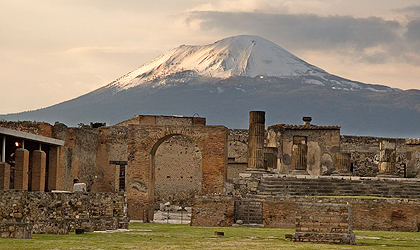
Mount Vesuvius erupted on St Patrick’s Day 1944, destroying several villages and damaging US air force bombers on the tarmac at a nearby airfield. The funicular, celebrated in the popular Neapolitan song ‘Funiculi Funicula’, was another victim; it used take sight-seers up the volcano. A previous eruption, in 1906, killed over a hundred people. The next blast from this unpredictable monster is long overdue. Will locals have enough warning to leave the area?
Having entered the world myself just three weeks after the 1944 eruption, I have a morbid fascination with Vesuvius. On a birthday visit to the sleeping giant this month, all was calm in the huge caldera. Puffs of blue smoke and hot gas emerged from cracks here and there.

Vesuvius’ most famous victim was Gaius Plinius Secundus, known to posterity as Pliny the Elder. The stoic philosophy, which he espoused, extolled the importance of living virtuously. To do so, Pliny believed, one had to understand both the human and natural worlds thoroughly. Research and study, therefore, were moral obligations.
His uncle’s appetite for knowledge, according to the nephew Pliny the Younger, knew no bounds. He read everything he could get his hands on and never took ‘time out’. Books were read to him in the bath, so that time spent washing wouldn’t be wasted.
The fruit of his lifelong endeavours, the Historia Naturalis, is one of the earliest works which might loosely be deemed a ‘natural history’. This ten-volume encyclopaedic tome also covers subjects as diverse as mining, ancient art, and the problem of aquarium owners becoming too attached to their fish. Its list of references has proved invaluable to classical scholars.
Despite his contempt for superstition, Pliny included much nonsense in his text. Disease, he thought, turns wheat into oats and porcupines fire their quills, like arrows, at enemies. Strange races of people included the ‘dog-heads’ and the Sciapodae, whose enormous single feet served as sun-shades. Frogs dissolve into mud in the autumn and are reborn in spring. However, he also recognised that amber is solidified tree resin.
Pliny and his nephew, then 17 years old, were staying at their villa north of Naples on August 24, AD79, when Vesuvius’ most notorious eruption began. It would destroy Pompeii Herculaneum and Stabiae. Pliny couldn’t resist taking a closer look at the emerging cataclysm and tried to rescue trapped people, so he took boats across the bay towards the volcano. It was a fateful decision; an asthmatic, he was overcome by fumes from the eruption and died.
Pliny the Younger would go on to describe the eruption in letters to his friend, the historian Tacitus. His account led to the term ‘Plinian’ being applied to this type of volcano worldwide. However, the youth’s description of the sequence of events was dismissed as impossible by volcanologists. Then, in 1980, Mount St Helens erupted in the US. It behaved just as Pliny said Vesuvius did almost two thousand years previously.
The 135km2 area around the 1,281m high Vesuvius is now a national park, home to 612 plant species, including 23 orchids. Up to 230 different minerals have been identified. The rich soil of the lower slopes produces
delicious food and famous wines. The crater rim can be reached on foot from a car park at the end of a winding road. The views of Naples and its bay are stunning. The thought that a pyroclastic flow of rock and scorching ash might, some night, surge down the slope towards three million sleeping people, is truly apocalyptic.