Lettuce alone with all this talk of slugs and snails
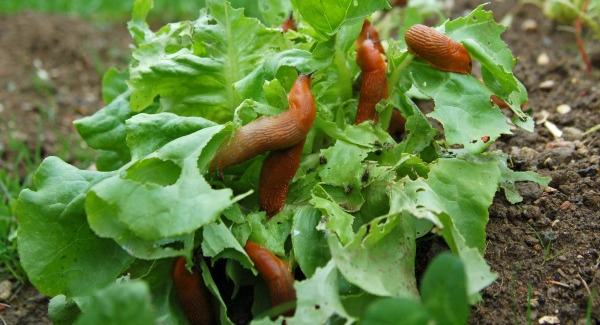
says let’s face it — slugs and snails are the bad guys in your garden.
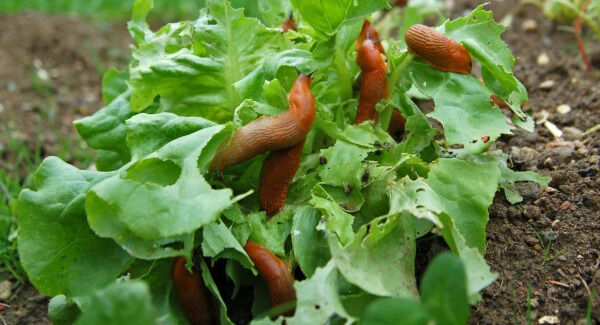
The rise in temperatures and the temptation to get planting out an abundance of crops always makes me a little cautious to not rush in too soon; slugs and snail are waiting in the long grass and the threat of a late frost lurks around a few corners yet.
Slugs and snails I can try to pre-empt with some beer traps and I can harness some cloches and fleece to keep a shelter belt of warmth until May. Is that really enough when it comes to these pests?
In terms of know thine enemy, slugs evolved from snails and there is more than one variety of either, but we gardeners tend to treat them all equally as the bad guys.
Snails have a little more confidence because of their shell — no chance to dry out or be instantly picked off by birds — and so that sees them about in the shade during daylight. Slugs, however, are predominantly nocturnal, unless underside a leaf in some well-shaded moistness.
With snails you can go about the garden picking them off your crops at will, (and dropping them into a bucket with a reservoir of beer or hot water in the bottom to kill them off), but finding slugs needs more dedication and perhaps, a hunt at night with a torch.
The beer trap and bucket will anaesthetise them and they will drown, the hot water is supposedly, a quick death, I know which I’d prefer and I don’t even drink.
The idea is, that you can use the harvest of dead pests on the compost heap to add back to the soil. If dropped into a container with salt or salted water as some ‘experts’ still recommend, then the heap is ruled out and it’s the bin for the saline mess.
The garden slug (Arion hortensis), feeds above and below ground, it is pigmented in the range of charcoal to black, about 4cm long.
There is the more round-backed slug (Arion ater) which feeds off rotting vegetation and is beneficial to compost heaps. Some gardeners don’t kill, but just throw the catch onto the heap to act like tiger worms: Caveat, they can escape and are not as efficient, but do do a job until they decide to venture elsewhere. The roundies can be in the range of black, dark brown and brown.
Then there are field slugs (Deroceras reticulatum) which feed predominately above ground on vegetation, they are generally 3cm to 4cm long, in the colour palette of grey to fawn. They are no longer rural cousins, and you won’t need a field or meadow to tempt them in. Some Giyers will be very familiar with Budapest slugs (Tandonia budapestensis) a keeled slug, grey-brown to black, with dark spots sometimes. It is easily recognisable as it is often encountered curled up in U-shape, it is a pest of root crops and potatoes in particular.
With the snails, there is the common snail (Cornu aspersum formerly Helix aspersa) which typically inhabits a greyish-brown shell with darker bands.
The strawberry snail (Trochulus striolatus) which is dark or reddish brown with a flattened shell that distinctively displays six convex whorls — if you have nothing better to do than count snail rings. (On second thoughts that might take over from mindfulness colouring books — Dragon’s Den here I come.)
There are many many more but those you may find with more vibrant shell types are generally grove snails aka white and brown-lipped snails (Cepaea hortensis and C nemoralis). They all munch your seedlings and foliage crops and even venture onto forming fruits.
The veg patch is different to the garden because we eat from it, so conventional slug and snail baits are a no-no in my book. For the same reason, I don’t advise salt, copper rings, or the oft-recommended ferrous phosphate. I like my soil healthy and with low salinity and I prefer my food without excess metal ions or toxic residue.
I have never been a fan of the majority of commercially available baits — which can use pheromones to attract the mollusc in the first place (and so have a bit of a Lynx-effect on the neighbour’s slugs too), or contain molluscicides toxic to wildlife and pets.
In recent years there are more options and even organic pellets and powders on the market. I do recommend beer traps and coffee traps to lure them with scents similar to mollusc pheromones or placing melon or grapefruit husks as a lure to catch them under and also the judicious applications of wood ash, sharp sand, horticultural grit and crushed eggshells as physical barriers.
I find it is best within the cultivation areas, to limit mulches and also rocks and other daytime refuges for them to hide under — even though such environments encourage predating beetles and centipedes.
If you are no-dig and reliant on top dressing and mulches, be extra liberal with beer traps, if you are a digger or forker-over, then cultivating between rows this weekend will expose slug and snail eggs to predation by some very hungry birds, still trying to get over storm Emma and frost damage to their normal forage.
I do like commercially available nematodes (Phasmarhabditis hermaphrodita), and they are very effective against slugs, but less so against snails.
There are plants that slugs and snails don’t like to eat. ‘Yeah the weeds,’ says you. Apart from those, there are plants with a fragrance that deters, or whose foliage is too hairy or too leathery or too bitter to munch upon. Even the old Berlin wall was surmountable and the Great Wall of China only worked for a few centuries, so no barrier is ever 100% impenetrable, but a barrier of these plants is another obstacle to those pests getting to your good crops with ease.
Some are companion plants that will bring in pollinators and beneficial insects; some are medicinal and make great herbal teas or skin care treatments, and some are even edible.
I will look more closely at these in context, in future articles, but for now here is a sample list for consideration as a slug/snail barrier. A slug in dire need will try anything so don’t abandon if you find one hanging on a leaf in week one of planting, give it time.
- Alchemilla mollis — Lady’s mantle
- Allium schoenoprasum — chives
- Anthriscus cerefolium — chervil
- Armeria spp — thrift
- Chamaemelum nobile — Roman chamomile
- Dianthus spp — Carnations, Pinks
- Geranium spp — Hardy geranium; Cranesbill
- Iberis sempervirens — Candy tuft
- Lamium spp — Dead nettle
- Lavandula spp — lavender
- Lobularia maritima — sweet alyssum
- Phlox paniculata — Garden phlox
- Pulmonaria spp — Lungwort
- Tanacetum parthenium — feverfew
- Thymus spp — thyme


CONNECT WITH US TODAY



Be the first to know the latest news and updates