Is it time to stop crabbing about crabs?
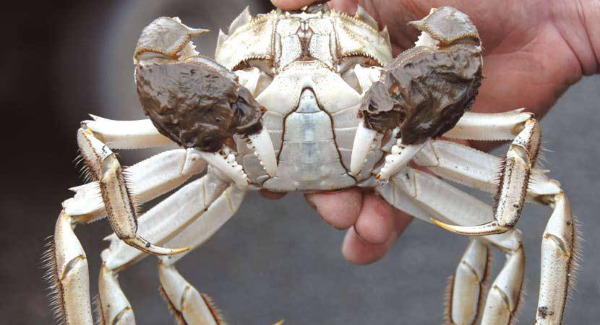
Crabs, the armoured personnel carriers of the creepy-crawly world, fascinate children, writes
No visit to a beach, or exploration of a rock-pool, would be complete without a close encounter with one of these slightly-ghoulish creatures.
Crab Watch, an initiative of the EUâs Sea Change project, wants us to become children again and go âcrabbingâ.
The volunteer crab-twitchers, visiting coasts and estuaries, will spread âocean literacyâ among the public and provide valuable data on our rapidly-changing marine environment.
Crabs have âprofileâ. Carcinus, the giant crab of Greek mythology, was killed by Heracles. In response, Juno placed the creature among the stars and a sign of the Zodiac bears its name.
In 1840, William Parsons, third Earl of Rosse, discovered a nebula, which, we know now, is the remnant of a supernova explosion.
Resembling the shell of a crab, it became the second astronomical object named after the humble crustacean. There are moves afoot to designate an annual international âcrab dayâ.
Not all the associations of the worldâs best-known creepy-crawly are positive.
A crew-member who puts his oar into the water at the wrong moment is said to âcatch a crabâ, an unforgivable rowing offence.
Tiny insects which infest pubic hair, causing intense itching, are known as crab lice, while the characteristic shape of many tumours spawned the name âcancerâ.
In 1958, a naval diver went missing, while examining the hull of a Russian warship on a goodwill visit to Portsmouth; Commander Crabb triggered a Cold War incident.
Crabs are found throughout the world in coastal waters and some freshwater ones. There are even some land-based species.
Their lifestyles render crabs conspicuous; sharp claws are used in hunting and defence.
Soft body parts are tucked inside a hard protective shell, the âcarapaceâ. As it grows, a crab must shed carapaces, from time to time, and develop new ones.
These crustaceans need our help. Rising sea temperatures and excessive harvesting are threatening them.
The Chinese mitten crab, which arrived in Germany on the hulls of ships a century ago, is on the IUCNâs list of the worldâs â100 Worst Invasive Speciesâ.
A mitten crab was caught by an angler in Co Waterford in 2006, but, as yet, the Central Fisheries Board has âfound no evidence of an established populationâ here.
Other undesirables, Asian shore crabs native to the Pacific coasts of China and Japan, were found in South Wales and Kent in 2014.
Invasions are not all one way; our familiar European shore crab, that great entertainer of childhood seaside visits, also appears on the list of a hundred baddies.
It turned up on the Massachusetts coast in 1817. Recorded in San Francisco Bay in 1993, it colonised 750km of the US and Canadian Pacific coast. By 2003, it had spread southwards, as far as Patagonia.
The Crab Watch project will provide early-warnings of alien invaders and gauge the impact they have on native ecosystems.
Volunteers will search the shoreline for crabs and for the remains of deeper-water ones washed up on the tide. Fishing lines and crab-nets can be used off piers and rocky coastlines.
The Sea Change website features an app to help new participants.
This includes a field-identification guide to the 32 crab species known to occur in European waters.
Each is illustrated by photographs, with distinguishing field marks indicated. Size details and âinteresting facts about the speciesâ are given.
There is even a ruler with which to measure the dimensions of specimens found.