Choosing a sheltered spot for Maples is vital
Ialways look forward to September in Ireland as it’s nearly always a month of guaranteed sunshine and fine weather, but not so during 2016.
No, September last year was a bit of a washout, but as a result we got to enjoy a beautiful autumn in October which extended right into November.
This year, September was once more well below average and October hasn’t been superb either — hurricanes — the lot.
My birthday falls in October and I remember playing outside during this month in my childhood, and, as is the way with memory, it was always sunny and I never remember a rainy birthday party.
October this year has been not been good.
We have had several pet days, where we could get out and enjoy the falling leaves in the lovely October sunshine, but so too, the wind and rain has made its presence felt during the last few weeks.
It’s the wind that really ruins the autumnal display for we gardeners. The last of the ephemeral foliage is hanging on to the stems and branches as the colours change with old age. Strong wind is the final nail in the coffin. The more wind we have the shorter the seasonal display and this is why last year was so good for autumn colour, as we didn’t have any until much later in the winter.
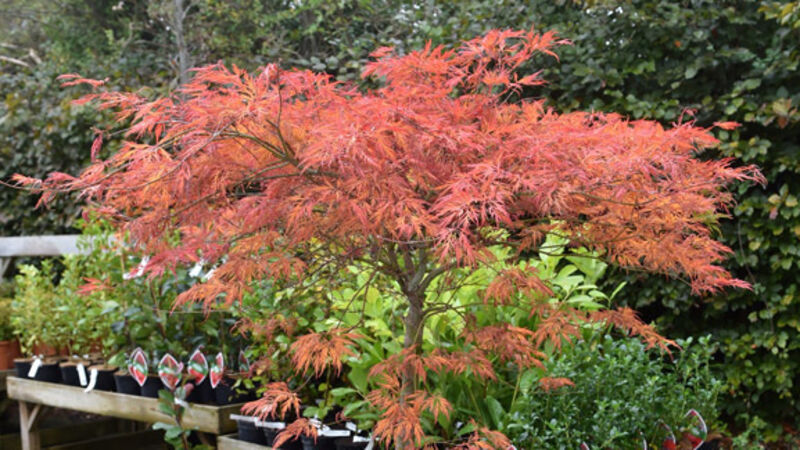
One of my absolute favourite groups of plants in the garden is also one that gives possibly the best autumnal display of all and these are the Japanese Maples. First and foremost, they will only tolerate a position that is sheltered from wind. Their delicate stems, growing tips and intricate foliage will shrivel up at even the suggestion of a breeze. So, the siting of a Japanese Maple is of the utmost importance because, if they’re sheltered, the colour during this season will last so much longer.
They also like a slightly acidic and free-draining soil, and will tolerate a slightly wrong pH and soil type, but they won’t even consider growing in a windy position. There are now so many different varieties and cultivars available to choose from, to grow in your garden — but they all trace their origins to the original species, Acer palmatum.
Native, obviously enough to Japan and also China and other countries in that
region, the first Acer palmatum landed in the UK as recently as 1820. The species
palmatum and most of the taller growing varieties, create a lovely-shaped, small tree ranging in height from 4m -6m. It’s that classic, round shape which is synonymous with oriental gardening.
It’s impossible not to fall in love with these Acers as their mere presence in the garden offers a calmness and stillness that I don’t get from any other tree. I don’t know if it’s their shape, intricate stem structure, or the intensely detailed leaves that appeal most — but like everything, it’s probably a combination of all of these. It’s a plant that I could not be without.
The most popular forms are the purple leaved varieties and of these, two great varieties are Acer palmatum Atropurperuem and ‘Bloodgood’. They have the larger palmate leaves, while many cultivars have been developed specifically for their very dissected foliage, like the lacey, Acer ‘Inaba Shidare’ and ‘Garnet’. Again, these have the traditional hummock shape seen in these maples.
The purple foliage varieties offer a particular interest when in leaf, but what they lack is that fantastic autumn colour bonanza which the green-leaved forms will bring. Acer p ‘Dissectum Viridis’ shouldn’t be overlooked because it is green in colour.
Don’t think that the purple offers more in the garden, the green of ‘Viridis’ is vibrant, fresh and beautiful in the spring and then calming during the summer months, when there is colour all about the garden — but it is during the autumn that this beauty absolutely steals the show.
It comes alive when it is dying off, when the leaves are coming to the end of their life and the plant lights up with yellow, orange and bronze, creating one of the highlights of the gardening year.
Interestingly, it’s hard to give general advice on the overall height and spread of different varieties as these dimensions aren’t determined so much by the variety name, but more by the way in which they have been grown. Most of these particular cultivars are grafted onto the original species plant, Acer palmatum, which has been grown from seed and the overall size of the resulting grafted plant, depends at what height it was grafted at.
If a plant is referred to as ‘top worked’ then it means it was grafted on top of a tall stem and thus will be a bigger plant than something which was grafted at ground level. So be careful which one you choose depending on your individual needs in terms of size as these plants shouldn’t need to be pruned except for ornamental reasons.


CONNECT WITH US TODAY



Be the first to know the latest news and updates