Beekeepers are vital to the success of a hive
efore I took up the hobby of beekeeping nearly 28 years ago, I used to read a beekeeping column in the Cork Examiner as it was then known, by Michael Woulfe, an established and successful beekeeper of many years, who continues to tend to his bees even in his older years. One of the things that used to fascinate me was, when he wrote about looking for the queen, I remember thinking to myself ‘imagine looking for one particular bee not hugely different from maybe the 40,000 or so other bees’.
It is important for the beekeeper to be able to find the only queen among the other bees. She dictates everything that goes on in a hive and once there is more than one queen in a hive, the beekeeper is going to lose about half of the bees, as one queen will swarm and take a load of bees with her.
By finding the queen and clipping her wings it will prevent the loss of your bees as when she flies off she will fall to the ground and probably die and the swarm that is with her will return to the mother hive, so saving your hive from depleting its numbers.
One day last week I found myself for some reason thinking of Michael’s “finding the queen” column when I was standing at a huge colony of honeybees looking for her ladyship. She had eluded us the previous week, most times another beekeeper and I work together.
However, I was on my own that day, but I eventually found her, having gone through all the frames in a full box and a half of bees. We have a little prayer which we sometimes say, especially if she is not showing, “Little Jesus lost and found show us where to look around”. However, on occasions even Jesus seems to take a day off.
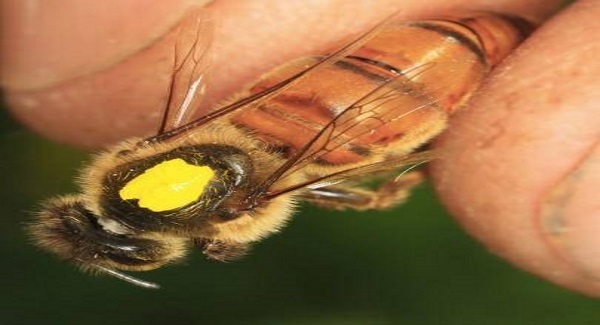
Well, once found I marked her with a luminous white colour (as she was hatched in 2016) on her thorax for easy recognition the next time I come back to the hive, and I also clipped her wings. For people starting off in beekeeping, finding, marking, and clipping the queen is a huge task. If handled poorly there is the danger of damaging or killing the queen. Some beekeeping associations hold outdoor demonstrations for beginners where novice beekeepers are taught how to handle bees, how to smoke the hive to calm the bees and open up a hive. Being faced with tens of thousands of bees can be a very daunting task for a beginner.
A huge population of moving, flying, and noisy bees can challenge the best of beekeepers, but beginners are shown how to manage the bees with smoke and a light spray from a water mister is a great help.
At the demonstration apiaries, beginners are also shown how to catch the queen either by hand or in recent years there are several different types of queen cages on the market for grabbing and holding the queen while you put a bright coloured mark on her thorax. A colour-marked queen is much easier to find in a large population of bees. Beekeepers have a rule about the colours used to mark a queen.
There is a different colour for each year so that we can easily know how old the queen is. There is an acronym used to remember the colours which goes like “Will You Read Good Books”. The colours are white (for years ending with 1 or 6), yellow (for years 2 or 7), red (for years 3 or 8), green (for years 4 or 9), and blue (for years 5 or 0). So yellow is the colour of choice for queens hatched in 2017.
Some beekeepers do not like clipping the queen. They think it is cruel, but if you are careful and smoke her well before putting her back in the hive on the same frame you found her on, there should not be a problem. Clipping saves you the problem of losing a swarm. A clipped queen also allows you greater intervals between visits to the hive.
Great care is taken when clipping as it is very easy to damage the abdomen which is the most vital part of her anatomy. The wing or wings are cut with the blade of the scissors in a position beneath the wings and the beekeeper is careful not to cut off other parts of the queen like one of her legs as well. If this occurs the queen will be rejected.
The queen uses her forelegs as a calliper to measure the diameter of each cell before she lays in it. This determines whether a fertile female egg or an unfertilised male egg is laid, depending on whether the cell is a worker or a drone cell. The early part of the year is the best time to clip queens. It is important of course only to clip laying queens and if there is any doubt as to her being mated, it is safer to just mark her, and leave the clipping for a later date.
This work is one of the main task of beekeepers at this time of year, so it vital we are comfortable doing this meticulous work. Beekeeping associations will help novices and reticent beekeepers become experts in spotting, marking and clipping queens. Make sure to contact your association to find out where and when demonstrations are taking place. In the Cork area, demonstrations take place on Saturdays. Details can be found at www.cocorkbka.org.


CONNECT WITH US TODAY



Be the first to know the latest news and updates