Rolling back the milleniums
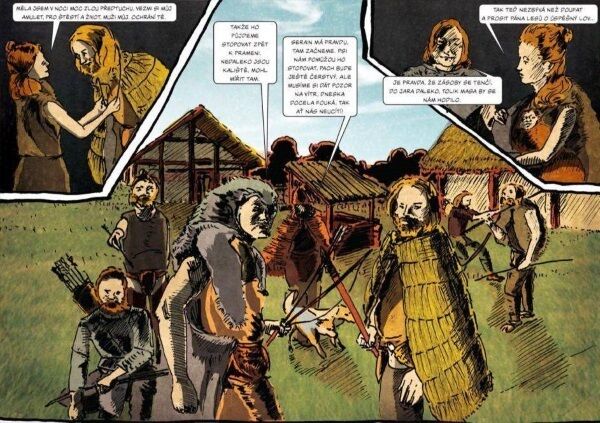
A Day in the Life of a Neolithic Woman is an educational comic-book for children written by archaeologist Veronika Mikešová and illustrated by Michal Puhac.
Based on research carried out at Velim, near Kolin in central Bohemia, and ‘merging fact and fancy’, it tries to convey a sense of what life was like seven thousand years ago. This is not a new concept. Noune, Child of Prehistory, in a similar vein, first appeared in 1992 and is still available. Author Michael Valdis and illustrator Gemma Sales set their tale in Palaeolithic times, 10,000 years earlier.
Noune is a little boy who watches his elders hunting fishing and lighting fires. He visits caves in which the first paintings of Western art are being created.
Ideal for small children, this is a sunny sanitised evocation of Stone Age life.
Mikešová’s account is more realistic. She doesn’t airbrush out the existential angst dread and constant danger, which must have been the backdrop to life in places such as the Céide Fields and the Boyne Valley long ago.
Velim was inhabited by 5,000 BC, almost 2,000 years earlier than equivalent settlements in Ireland. The heroine of Mikešová’s tale is Brentina, whose name translates as ‘Fog’.
“All the names we used denote the weather, what the weather was like when these people were born. We consulted a well-known linguist. He suggested we use the Romansh language used in Switzerland, the oldest language we know of in Central Europe. It does not reach back to Neolithic times but it is the oldest we know,” Mikešová told Radio Prague.
Tools and utensils were unearthed at Velim, but how Brentina’s people used them isn’t known exactly.
A piece of rope found at the site had been made from honeysuckle and nettle. There was a well lined with oak-wood. These were farming people who cooked meat and used lots of wheat. The men hunted game. Clothes were made from animal skins and linen but, apart from wearing animal-tooth necklaces and using red ochre make-up, we don’t know what featured on the Neolithic cat-walk.
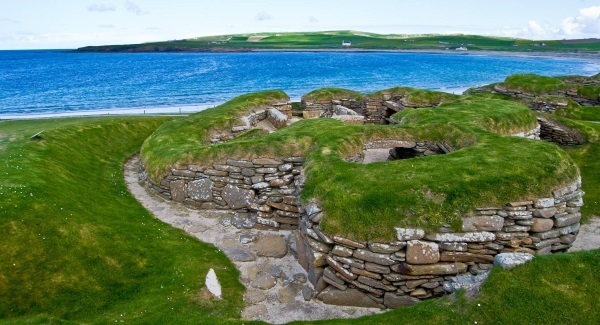
Skara Brae in Orkney has the best-preserved ancient settlement so far discovered. Seven little one-roomed stone dwellings, recessed into the ground, are huddled together and linked by passages in the ‘Scottish Pompeii’. Each home is built around a hearth where driftwood seaweed and dung were burned.
Alcoves in the walls served as presses and dressers. Stone beds were covered by animal skins. There were shelves for vessels and ornaments. Each ‘house’ had its own primitive toilet, an underground water channel serving as a sewer. Skara Brae is the earliest location where traces of the human flea were found. Stone slabs served as doors.
A larger above-ground structure, with walls 2m thick, may have been a workshop. Cattle and sheep were raised, barley was grown, fish molluscs and seaweed were eaten. Visiting the settlement recently, I thought how comfy snug, almost modern, it seemed. Plus ça change!
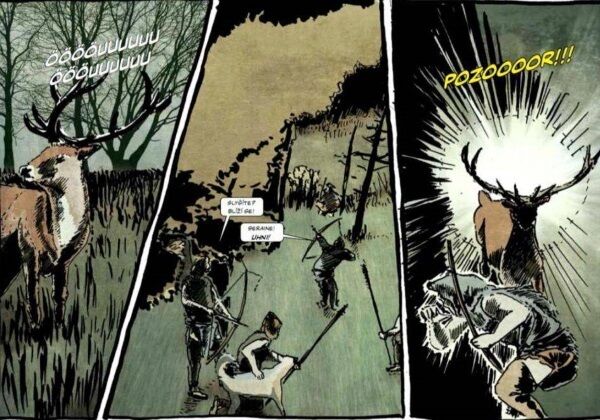
Brentina’s one-day odyssey begins as she wakes from a nightmare in the early morning. We don’t know what Brentina had for breakfast. There is to be a hunt that day but only the men will go forth. Mammoths won’t be the quarry; they are long extinct by this time, but hunting deer and wild boar is dangerous.
As a wife and mother, Brentina must stay at home, looking after the children and maintaining the household. Stones heated in fires are tossed into containers of water. Pieces of meat herbs and roots are added. Bone needles enable animal skins to be stitched together.

CONNECT WITH US TODAY



Be the first to know the latest news and updates