Local but lewd language lurking among the leaves
estering home with a song in the air (it’s a robin doing the singing, not myself) the round-leaved wall pennyworth on the ditch ahead of me gleams like ducats or doubloons in the sun.
Like ducats are the cushiony leaves or sometimes silver dollars, or the golden bottle tops on the milk bottles once upon a time delivered to the door, gold for creamy, silver for less creamy, red for skimmed milk. The blue tits would raid them, especially the gold tops which also signified unhomogenised, farmers’ milk. Clever birds —they knew what was good for them. Or was it?
Probably. I can’t recall ever seeing an obese blue tit.
These days, the woodland floor is sprinkled with the first bluebells; by next weekend, it will be carpeted. However, ramson leaves are so robust this spring that in places, the bluebells are subsumed. Year to year, the pattern changes. Territorial imperative; plants jostle for space. This year, ramsons are the winners.
Ferns, always graceful in springtime, shoot from the green floor, their tips unfurling like ammonites resurrecting after 4.5 million years, give or take a million, buried in the bedrock.
Unusually prolific this year is wild arum, Arum maculatum, plants of shady places with dark-green, heavily-veined, arrow-head-shaped leaves as big as one’s hand. I’ve never seen them in such profusion. I see, also, clumps of their exotic cousins, Arum italicum, the progeny of escapees from gardens. Their leaf veins, rather than being the same dark green as the leaves, are pale yellow. How pretty they are, native or alien. The escapees spread vigorously. Last week, I saw, along the butt of a wall beside Clonakilty Rugby Club, a line of italicums 10m long.
Popularly called lords-and-ladies or cuckoo-pints, our native arums are celebrated as images of fecundity, or stigmatised as symbols of women’s infidelity to their unfortunate husbands. A tall, vulva-like cowl shoots up from among the shiny green leaves, and a slender spike, like a miniature bulrush head, grows up inside it.
This conjunction leads to the cuckoo-pint name, the cuckoo part relating to the plant’s awakening coinciding with the coming of the cuckoo which, incidentally, lends its name to ‘cuckold’, as in a hard-done-by husband. The ‘pint’ refers to the erect spike within the virginal cowl — ‘pint’, rhyming with ‘mint, comes from the Old English vernacular ‘pintle’, meaning ‘penis’. When the spike reaches its full height (up to 30cm), the tip is jacketed in bright red berries. It is a startling sight on the dark forest floor, equalled only by the stinkhorn fungus, a sight fit to make a virgin blush.
In folk myth, wild arums are connected with bawdiness, as in concupiscent bawds. Old Boccaccio, and fellow rustic rhymesters and randy rubes, would have attributed lewd connotations although they are, of course, only innocent plants. I’ve never heard or read of them having aphrodisiacal effects, although in centuries past the roots were boiled to make starch for stiffening ruffs.
I see a large sea beet in glossy good health on our village strand; a few gallons of vitamin C could be extracted. We’ve tried sea beet in the kitchen. It’s strong as kale; in fact, sea kale resembles it and is equally healthy.
All along the hedges, whitethorn has been blooming in gay profusion presaging a bumper autumn for anyone who fancies making sloe poteen. Gin will do, actually. I would not, of course, encourage anyone to break the law by making or buying the moonshine.
The guards have enough to do with breathtesting, without having to chase poteen producers up the hairy mountains and down the rushy glens.
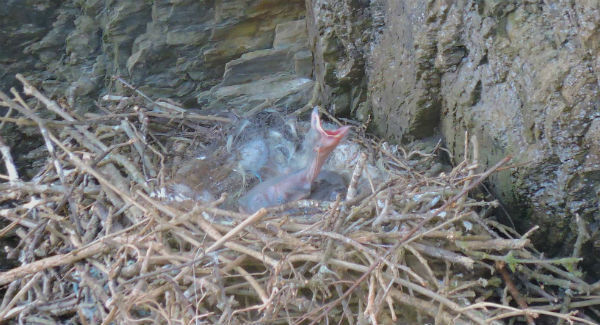
I took a snap of the raven nest on the cliffs at a lucky moment. Holding the camera high over the hem of gorse flowers along the cliff top, I clicked without being able to see very much, and then found I’d caught an image of a single chick, neck stretched and bill gawping, calling for food I suppose, although I couldn’t hear it with the distance and the sea slapping below. Pure luck!
Offshore, a lazy cormorant stood on a rock, yawning, while just beyond, a pair of great northern divers were industriously fishing. The male birds have striking, black-and-white, checkerboard-pattern plumage at this time of year.
Finally, approaching the village beach, I saw, only 20m from the shore, a merganser fishing. Now, there’s a gorgeous bird, with his white collar, black head, red beak and rakish top-knot!
However, as I raised the camera, he dived. He reappeared 30m or 40m off, swimming away from me.
One can’t get lucky every time.
CONNECT WITH US TODAY



Be the first to know the latest news and updates