Vintage view: Pendants and chandeliers
Ceiling mounted lighting is the entry point to 20th century design for many collectors.
The fantastic variation in aesthetic,innovative composition and full surviving function (on RECI re-wiring please), means you can buy something with an impressive creative history for the price of far lesser high street items.
Every week, I find myself stiffened with excitement at yet another stunner from the 1950s and 1960s whose hems, hopes and creativity rode high out of the gloom of the Second World War.
You might not even have heard of some of these brands and makers, but one look online, and I guarantee you’ll be aglow.
Most followers of the modernist design timeline will know the name Poul Henningsen (1894-1967) the Danish architect and author — not least for his stacked dish lighting (PH-lamps and 1958 Artichoke), still in production by Louis Polsen of Copenhagen.

Reproduced, knocked-off and commercially plagiarised in every conceivable material and scale, they are a commonplace and increasingly weary-making sight in airport lounges and restaurants.
Henningsen’s son, Simon P Henningsen, enjoyed a much shorter life, passing away at just 54 in 1974.
Moved by his father’s searing eye, Simon came up with another superb pendant, designed in 1962 for the Divan-2 restaurant at Tivoli in Copenhagen.
The Divan-2 uses architecture-led panels in the shape of razor blades set on their edge, to slice and diffuse light.
The insides of the 30cm panels are faced in polychrome lacquered primaries, while the outside surfaces are finished as highly polished chrome.
As you walk around the piece its silhouette shifts and flashes in colour and line. Prices start around €1,200 for a Divan-2 in good condition without pitting to the chrome.
They are relatively rare, so keep your eyes peeled at online sales and better 20th century design-fed auctions.
Moving into the more deliberate luxury that is now moving the interiors market, Orrefors a Swedish glass house, were established in 1898 and made their name as medal winners for their art glass in the landmark 1925 Exposition Internationale des Arts Décoratifs et Industriels Modernes in Paris which brought Art Deco to the World.

Today, trading as Orrefors Kosta Boda AB, it still produces hefty, sparkling, moulded and blown glass, but reserve its standard lighting work to smaller table pieces.
Karl Lagerfeld is a contributing designer with the company and it has employed a number of now-famed designers in the 50s through to the 70s including Carl Fagerlund.
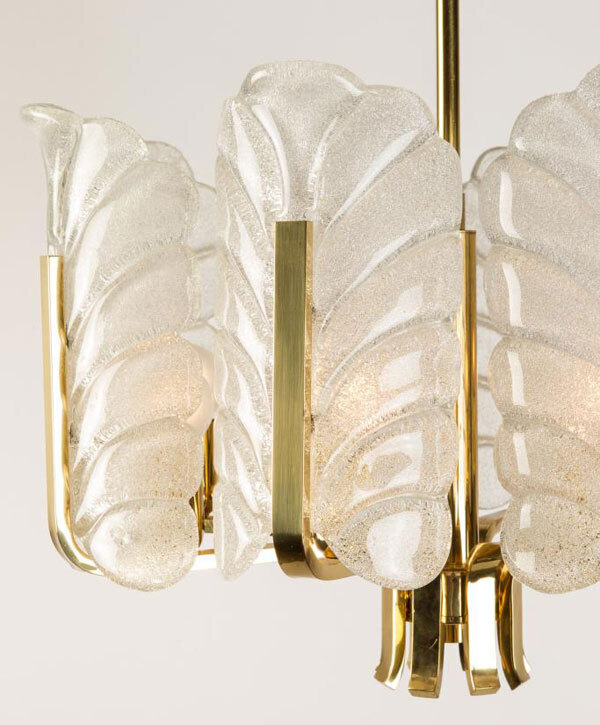
His thick icy, textured glass in moulded parts framed and given depth and luxury with brass fittings and reverse plates, is fabulous, sculptural stuff and still affordable.
If you find his chandelier and wall-light work too Liberace (trawl Ebay), look out for pairs of his fluted, two-layer glass lamp bases with brass collars, also interpreted by Nils Landberg, from the 1970s. Around €2,200 a pair.
For cheaper Scandi’ knobbly crystal and frozen liquid forms, try vintage chandeliers and sconces by Vitrika.
The Steam Punk movement has been a relatively cult happening in interiors and really didn’t come to be more outside of gallery showings and Etsy enthusiasts.
Still, the reinvention of salvage metals and classic forms in weird or exaggerated lighting is everywhere, taking the industrial shift to the level of executive sophistication I don’t think was ever originally intended.
Despite its tender age, there’s nothing now more authentic and British than the 1990s BTC pendant shade from BTC of the Design Centre, Chelsea Harbour, modelled by Peter Bowles on the simple metal housings serving every factory in Europe.
I have to mention its release of the XXL Titan (#5), a mighty half metre across and half a metre high for gentled industrial styling buffs who want to really go large.
From €408, www.originalbtc.com
The bleakly-styled, long fluorescent light is getting another look.
No, I’m not kidding. You can pick up original GEC sponsored lamps and hoods from the 1960s re-wired and supplied with a new 58w T8 fluorescent tube and suspension cables, from around the high hundreds (still not kidding), from specialist outlets including www.train-spotters.co.uk
For various styles in Euro fluorescents from stations, public buildings and street shelters, try pamono.eu, salvage yards and dealers visiting Eastern Bloc countries.
Ensure you fit a new linear T5 35W energy saving fluorescent (20,000 hour average life). Just as off-centre but likely to halt your guests in traffic, American stop lights are being imported, blasted, chromed and used as down facing pendants.
Skinflint Design of Penryn in Cornwall, have delivered some of the best in vintage staging for some years now, and I have to say, this is one of my favourites.
Around €1,400 gets you a set of three real 1950s American traffic lights by manufacturer Crouse Hinds.
Converted into a suspended pendant with a polished aluminium enclosure that features the original cast manufacturer’s branding and Art Deco details, they are fitted with three new glass screens etched to provide a striking diffusion.
You can choose your colour in cables if you don’t like elephant grey.
www.skinflintdesign.co.uk