Advice on how to find attractive, efficient radiators to warm your home
Kya deLongchamps looks at fusing aesthetics with the necessary engineering for beautiful and comfortable living spaces.

Advice on how to find attractive, efficient radiators to warm your home

Insulation levels are up in Ireland, delivering building ‘envelopes’ that now hold the heat so much better.

In the case of certified Passive and Passive Plus housing (where more energy is produced than is used), traditional heating systems are already all but redundant.

But for the standard Irish renovation, extension or new build, these improvements don’t automatically mean significantly smaller or even fewer radiators.

New standards, better systems

The business of quickly heating up a room remains the same, and it’s this cold-start reactivity, where radiators beat under-floor-heating (UFH) hands down.

Improvements to Part L of the regulations means less expense to heat up your system with the modern efficient combi-boiler in gas or oil, and shorter running times, as the house walls, roof, floors and windows hold the heat.

Outrageous with luxury, the Makura radiators feature removable cushions filled with cherry stones which both retain and radiate heat. Take them down off the wall for a snuggle on a cold winter’s night. €2,436.50, www.theradiatorcentre.com

Heating, cooking and just inhabiting the house with our warm bodies adds to the overall temperature.

With 300mm of attic insulation, less cold-bridging in new builds, and the beginning of the end of cold masonry walls with inadequate cavity fill — we are winning.

Output

When buying a radiator, you or your heating engineer will calculate the British Thermal Units (BTUs) or watts required to warm the space.

There are online calculators to help you do this, entering the dimensions of the room and the number and size of windows.

The number that comes out will relate directly to the BTUs given with models of radiator either singly or in multiples.

Whether you go for a vertical or horizontal design in radiators, it’s the BTUs that should guide your final choice.

Newer technologies on the Irish market — including geothermal and air source heat pumps — require lower temperatures over longer periods.

If you are mixing up UFH and radiators, this can influence radiator sizing. Get specialist advice, and don’t assume your existing over-sized traditional radiators will manage the final equation.

Finessing with a pro

A professional will help you choose the correct heat output, especially where passive heat gain and heat-producing appliances are on the go.

For example, a south-facing kitchen in a reasonably new home, may require a less energetic radiator to be comfortable, and will certainly be coaxed down with a TVR, or zone controls most of the year.

The material that the radiator is made of counts too, but we are talking about split degrees of perceptible difference here.

Italian Metacrylic radiators from Caleido feature an efficient steel panel overlaid in a range of striking acrylic designs. Available in a range of BTU/watt choices and seven colour options. From €2,384 at www.theradiatorcentre.com

Cast iron is heavy and takes longer to heat up, but once hot, it will radiate heat back to the room for some time.

An aluminium radiator will heat swiftly, convecting heat efficiently into the room (radiators primarily convect rather than radiate heat), but will cool just as quickly.

For fully-restored cast iron, school house originals from about €280 plus VAT, try Wilsons Yard, Hillsborough (online at www.wilsonsyard.com )

The hot spot

We no longer rely on draughty windows to rip convected heat around a room.

Still, radiator placement remains a headache, evicting most standing furniture. Consider every slab of space, including pillars of wall by a door.

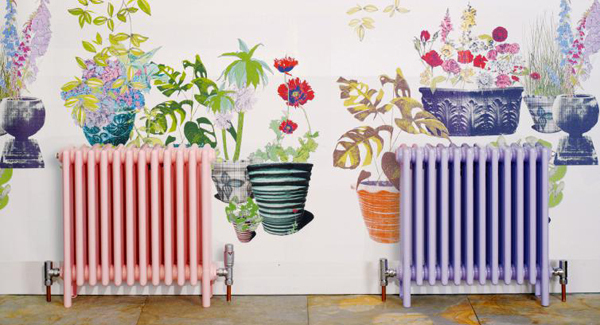
Today’s horizontals are not the grinning fuglies of 30 years ago, cloaked in shame in a timber cabinet. They offer masses of choice in terms of looks and colour and textured finish.

Gentler rounded designs in pale colours, and low relief without deep shadowing (matt or pearl white on white walls), really become all but invisible over time.

Include wall-hungry horizontals in the overall design of the space from the start, slotting them beneath built-in storage and into already redundant walls space below windows.

Our collective memory almost expects a radiator in that otherwise bald territory.

In the bathroom, radiator towel rails remain big news with extra magnetic hanging bars and hooks now entering the market.

Many designs are offered with bars horizontal or vertical. Play around with width-to-height ratios within a suitable BTU range.

Artful dodgers

In terms of styling, the greatest impact from a practical and aesthetic point of view has been the vertical radiator in panels, bars and ladders.

Delivering the same BTU potential, tall verticals shaven to depths of as little as 23mm can take up a third of those walls compared to standard rads.

Styled as anything from Art Deco cast-iron to bold Italian creepers, there really is something for everyone.

But if their lofty confidence still makes you wince, try that modernity in the bathroom or kitchen.

Whatever the toasty description from the maker or supplier, ‘designer’ radiators are not artworks, they are water-filled heating boxes (isn’t everything designed?).

If you’re determined on a brand name, wall dandy in creeping boughs, trellis and even upholstery, prices can top €3,000.

Still today’s bold eccentric could prove tomorrow’s visual static, one you can’t easily pluck off the wall like a painting and easily replace.

Save those four figures for an appreciating piece of Irish art or jump the Brexit shark and lose your mind at outlets like the Radiator Centre in Islington, London, who are online at www.theradiatorcentre.com

A far safer bet is to go for more dilute, broad strokes in styling — industrial, antique, contemporary sleek — something that will still warm up to changes of decor in a decade.

For low-temperature systems, consider beautiful real wood radiators that not only look great in toffee coloured timbers but are safer and softer-edged for hurtling small children.

Available in Ash, Maple, Transversal Beech, Steamed Beech, Beech White, Spruce, Siberian Larch, Birch, Oak. From €990.

My money’s on the Eskimo range of tubular bundle rads inspired by 1950s aircraft styling at the Radiator Shop, from €870, both from www.theradiatorshop.ie

Understanding dual fuel rads

There are places and there are seasons where a standard radiator dependent on a boiler, is simply not convenient or smart.

Stripped down in the bathroom, many of us like a shroud of heat, even in mid-summer, and this is where the dual-fuel radiator can be well worth a little more investment.

In winter, you can run the radiator along with the others, but when needing a rapid response, an electric element takes over, letting it perform as a standalone space heater.

With a quality dual-fuel you can also choose from a range of outputs from say 600 to 1,000 watts, great for drying out multiple towels in a ladder-style unit.

This versatility will add about 15% to 20% to the price, plus the extra installation by f your registered plumbing and electrical contractors.

Look out for continuous tube- style radiators of both varieties for the bathroom, which coiled up, or across the wall, offer an alternative to the standard Italian-style ladder.

More in this section

Revoiced

Newsletter

Sign up to the best reads of the week from irishexaminer.com selected just for you.

Cookie Policy Privacy Policy Brand Safety FAQ Help Contact Us Terms and Conditions

© Examiner Echo Group Limited