Vintage view: Kitchen collectables
I was poking around enjoying a viewing some year’s ago at a local auction house, when a middleaged dealer I knew, slipped eel-like behind me and down the dusty alley between the lots.
She was gripping something in her diamond encrusted talons, held low in the folds of a long camel hair coat.

Pivoting an oily, undetected eye, I saw her bury a straw- coloured Carlton-ware jug beneath the disguising ballast of some truly ragged tat in a box, (referred to as a mixed lot).
I had noticed the highly collectable jug already in another more gentrified crate at the far end of the room — and being the last hours of viewing, chances are that some hapless amateur, who had marked their catalogue earlier in the day, would bid on that box in the expectation of that prized jug being there.
Collected in one swift move at auction’s end, Mrs Killjoy would get clean away. Happily, with pieces now recorded by the auction house in digital photographs for online interest, the hokey-cokey of the unscrupulous is hard to pull off.
Kitchenalia, including stoneware jugs, was a wildly popular market in the 80s and 90s when we still loaded our conspicuous taste out onto shelving and cup-hooks.
Today, there are still rare expensive finds in ceramics and copper, and a dedicated audience for the worthy but middling old culinary thing.
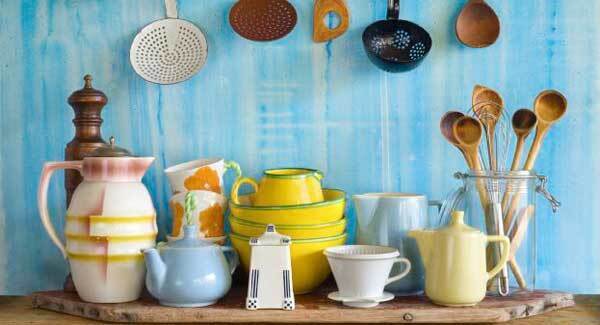
If you’re short on cash, but rich with sentiment, there are great opportunities to not just enjoy a wealth of objects connected with food preparation and dining for their decorative flair, but to kit out an entire kitchen and dining-room with working vintage servants.
So what’s out there for determined car boot safaris’ or an afternoon’s wait at an auction, and two grey cups of tea?
First of all, think about mixing up generational objects bound for the table rather than slavishly recreating a twee museum of the kitsch and ancient.
Great big oval serving and chaffing dishes are always useful, and with beautiful transfer-printed patterns, or even hand painting, they look gorgeous on show and on duty.
Find one with a surviving lid, and you might be in the money. Grey or white new dining ware can make way for some character additions.
Try shuffling place settings together with neutral, new and colourful vintage flatware.
Bone-handled, silver-plated cutlery can be fused into a glamorous harlequin set — just keep the handles out of the soak when washing up, or they will rattle.
Crazing and areas of rubbing are not a bother in old ceramics (this is not polite cabinet ware, but to be used), but steer clear of significant chips and cracks that go through the glaze front to back.
A resonating ‘bong’ with a flicked finger generally signals a bad crack.
Used rather than antique even legendary names like Limoges can be picked up for a tenner and textured ‘cabbage’ plates are a carboot certainty from around €8-€25 for a perfect period example.
If you prefer retro to genuinely old, there are plenty of mid-century names including Meaken, Johnson Bros, Wedgewood and more often teamed to an entire dinner service, listing in towers from as little as €30.
Any painted decoration, or gilding will demand hand washing, but newer sets can often stand up to a gentle frolic in the dishwasher.
Back in the scullery end of entertaining, enamel pieces, with their protective top coat baked onto tin have never gone out of style and for my money it has to be white or that sage green that typifies the 1930s.
Script advertising or descriptive words really add character.
Condition is important if the surface is to come into contact with foodstuffs (colanders have a hard life for example), but honest wear marks tins and breadbins out from new faux buys.
The cone-shaped Tala Cooks Measure in steel, imprinted in red and blue not only works beautifully for throwing together scones, but sits out on a shelf as well today as it did in the 50s.
A classic whisk with its timber handle again, makes a great line, ready for action on hook over your pastry area.
Victorian herb choppers can be sharpened up for lethal new uses and have a riveting Dickensian horror about them wall hung — mind those fingers.
Copper and brass has taken a nose dive on the market for some years now.
Frankly we’re too lazy to clean unsealed pieces without a ‘tweeny maid, and they have been relegated to the lost land of fussy antiques where the brown furniture now also lives.
Here lies plenty of opportunity to pick up collector’s pieces that might have been unaffordable 30 years ago. Do not cook with vintage copper pans or jelly moulds.
You’ll cheerfully poison your guests as they were originally lined with tin and will have degraded over time.
As decorator booty, they are beautifully made, put a glimmer on a kitchen, and with their stamped information (including the initials of the owners to keep them identified at the tin-smith) they remain fascinating survivals. Sets of pans of diminishing sizes have a pleasing rhythm.
European markets and online dealers are good hunting grounds for rustic wood bowls, butter pats, utensils and culinary oddities.
Breadboards from the 19th century are now collected as artwork, and grouped with their ancient stabs and slashes, can inhabit any quiet wall.
If you’re not doing anything on March 12 and 13, the rustic barns at Ballymaloe where the Vintage & Antiques Fair will divvy up plenty of kitchenalia, mid-century and more. Ballymaloe.ie.
Take that love of used kitchen things and ephemera a bold step further and stage the lot.
Vinny Lee’s recent book Kitchenalia: Furnishing and Equipping Your Kitchen with Flea-Market Finds and Period Pieces (Jacqui Small LLP €44.99 Eason) demonstrates the transformation of one very modern kitchen by three designers using vintage pieces.
Lee argues that there are four basics looks that work — the retro kitchen; the collector’s kitchen; the painted kitchen and reclaimed kitchen and the books explore all the elements you might use to bring these styles together.
I would add — remember that anything that goes up on a shelf or wall for sheer looks alone, is a dust hotel — be highly selective.