Vintage View: The Jaguar E-type
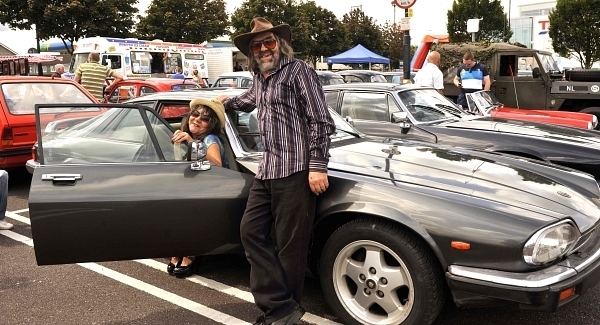
The surreal taper of the back-end is unmistakable even in drizzling, humdrum surroundings. Having roughly dropped an armful of tender shrubs from waist height to the ground beside my grubby Landcruiser, my husband performed the ‘I’m not looking at your car’ stealth-tango between the lesser jalopies.
Core pulled tight, on-point, eyes snapped wide — ‘no-no-no-no’ he yelled wildly on reaching his quarry — loudly enough to alert the female owner of the Jag’ approaching with a trolly of gardening ballast.
Striding back to us, sibilant sounds were fizzing from under the brim of his hat: ‘There’s a feckin’ baby seat on the passenger side.” Happily he was too incensed to look again, and didn’t see the multiple fertiliser bags lifted by the ears and crammed with the heel of a Hunter wellington into the Italian leather interior.
There are some things that, even for a highly evolved man, simply cannot be tolerated. The infant and horticultural abuse of a vintage E-Type Jaguar is right up there with its 2+2 family car conception — cruelty pure and simple.
Introduced at the Geneva Car Show in March 1961, Sir William Lyons’ and Malcolm Sayer’s unearthly, spirited British GT was a heart-stopper, and its emotional impact has never altered. Pulses instantly raced at 0-60 in 7 seconds.
The E-Type didn’t look like anything else, then or now and it commands instant attention wherever it goes. Some see a marked femininity about the line, other’s a groin extension — it’s a deeply sexy car loved by men and women.
Produced between 1961 and 1975, the Jaguar E-Type. (marketed as the XK-E in the US) is believed by many, including Enzo Ferrari, to be the most beautiful expression of a car ever made.
Based on the firm’s racing car, the D-Type which had won the most numerous races across the world in the 1950s, the original price at launch was a hilarious £2,098 (€2,944) half the price of a Ferrari 250GT.
Quite apart from its exotic good looks with a reach of hood that suggested untold power, the E-Type brought engineering formerly reserved for the track, to a domestic car with disc brakes, independent suspension front and back, and rack and pinion steering. Various changes were made to the car over the years, but collectors generally refer to series 1, 2 and 3 E-Type Jaguars.
Series 1 (1961-1967) being the earliest, are not surprisingly, the most desirable with engines in the moderate 3.8l to 4.2l range. Fans are divided between the Roadster and the coupé (hard-top), and the organic line and elastic reach of the bonnet shine — best without the interruption of a button on roof.
In all, 72,500 E-Types were made in a single steel monocoque. A moderately upgraded Series 1 E-type in good condition from the late 1960s is priced anywhere between €50 — €200,000 (price seems to vary wildly with left brain attachment and what’s expected to be recouped from a restoration).
All original ‘unmolested’ cars with matching ID numbers to the engine and body, even with rusted nibbles to floor plans and wheel wells, are increasingly rare. Stories abound of 10-15 year projects sapping the life out of mortgages and marriages. The E-type is a lovely but exacting mistress.
I caught up with an old friend, Lawrence Ulrich, former New York Times chief auto critic and editor of the online car magazine, Drive. He has the coveted job of reviewing some of the world’s most mouth-watering performance cars, rare, new and some beyond price.
‘The E-type was the 20th century’s greatest examples of form following function. Its chief designer, Malcolm Sayer, wasn’t even a car designer per se, but a genius mathematician and aerodynamic expert who worked in the British aviation industry during WWII. He was also a musician, a cartoonist, an artist — a true savant.
“He designed the Jaguar with no thought to beauty, but to its pure aerodynamic function, using principles of lightweight aircraft construction. The E-Type was effectively a computer-aided design before there were computers. And yet, the result was one of the most purely beautiful cars in history.”
The most expensive E-Type ever sold to date, is a very scarce lightweight Series 1 which changed hands in the spring of this year for over £5,000,000 (around €6,937,380). Jaguar, based in Coventry but now owned by Tata (India), were so encouraged by the response to the lightweight models, that they have set out to build the final six of the original 18 racing cars they intended for this series. Lawrence Ulrich has driven one already.
Eagle, a UK company, are licensed to produce a modern, hand-built E-type with 21st century conveniences under and behind the hood, based on the original 1961 car if you have a million euro wedged down the back seat of your Nissan CashCow.
My money, should it ever arrive, still purrs aloud for the old cat.
CONNECT WITH US TODAY



Be the first to know the latest news and updates