Kilmacurragh Arboretum is a Noah’s Ark for our native wild flowers
For those who love their gardens, there is a world of delight to be found on a 20 hectare (49 acres) estate in Kilbride, county Wicklow.
In fact, so special is its plant life, Kilmacurragh Arboretum has become an outpost of the National Botanic Gardens.

It is perhaps, most famous for its rhododendrons, which when they are in full flower from mid-April are a sight to behold as they form a towering avenue 18 metres (60 feet) overhead and carpets of vibrant colours like velvet underfoot.
It is a peaceful place, deep-rooted in the beauty of its hilly, farmland setting. Peaceful as if the chants of the monks who lived here from the 7th to the 16th century reverberate still.

Their old fish ponds are still evident. Or perhaps it is the blessings of the Buddhist prayer flags, a tradition from high up in the Himalayas, remembered here.
It is certainly in the sweep of the wind over the meadow grasses and the shimmer and shiver of the many trees, oaks and redwoods and conifers as they stretch for the skies.
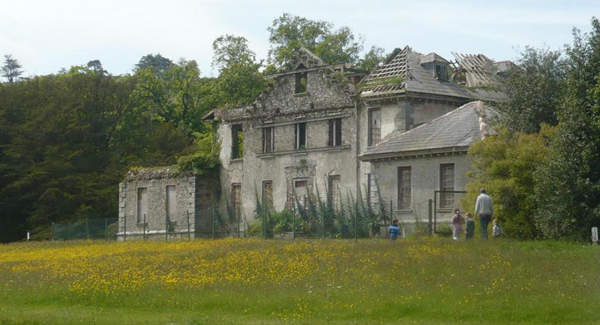
On the top of the hill, on the site of the ancient St Mochorogh Abbey are the ruins of the estate house of the Acton family.
Looking down from here — past the meadows, down over Dunganstown and Brittas Bay, on a very clear day you can see the coast of Wales. The Actons presided here for three centuries.
Their prominence began in September 1649 when Oliver Cromwell was marching down east county Wicklow with his 12,000 men.

One of his high ranking soldiers was Thomas Acton, to whom Cromwell gave extensive lands. At one stage the estate measured 2,160 hectares (5,338 acres).
Generations of Actons invested in the gardens. Features were added and taken away to suit each time and taste — canals, avenues, a Deer Park, Ha-Ha, orangeries, walled garden, orchards.
Plant hunters travelling to the far-flung southern hemisphere countries in the 19th century brought seeds and specimen trees home that have since become rare in their native countries.
Wars and misfortune ravaged family and house, and much of the old demesne — including the house, arboretum, entrance drive and woodlands passed to the care of the State.
The ties with the Botanic Gardens, however, had already begun way back in the 1850s.
Many important plants were brought here because the soil and climate was more favorable than in Glasnevin.

The incredible story of the Arboretum continues, as some of the greatest gardening minds of a generation look to restore glories of gardens past, while at the same time mapping out a new legacy for generations to come.
A century ago, 11 gardeners maintained the grounds, now they are maintained by a heroic team of four. Seamus O’Brien is the head gardener, and he is a national treasure in himself.
He has a world-wide reputation for his knowledge of horticulture, is the author of a superb book In the Footsteps of Augustine Henry and led numerous expeditions to far flung corners of the Earth to bring back thousands of exotic specimens.
Kilmacurragh also champions the exotic plant life of the fields and ditches of our own green isle.
Over the past several years it has been experimenting with a restoration of the indigenous Irish wildflower meadows and hedgerows.

About eight years ago the gardeners decided to allow extensive areas into meadow. To do this, they don’t cut the grass until the first or second week of September.
This allows native species to seed. When you walk across the meadows it will be across thousands of orchids, swathes of hayrattle and oxeye daisies.
In fact, in the past few years they have charted over 130 different wild flowers, many that have not been seen for decades.
O’Brien recounts the delight of older visitors to the garden at seeing meadow flowers such as heath spotted orchids for the first time since their childhood.
O’Brien encourages all gardeners – and farmers where possible – to let their lawns up and let wild flowers grow. “We have lost 90% of our old wild flower meadows.
Over the next 100 years we could lose 50% of our flora due to our land practices.”

He adds that we are very quick to admire the exotic plants from the Southern Hemisphere while forgetting the absolute beauty of what we have right here.
Our own native orchids, for instance, are as spectacular as anything you will find anywhere, O’Brien says, and we need to protect eskers and other orchid habitats. He describes these gardens as a sanctuary – a Noah’s ark for orchids.
In June and July guides at the gardens give talks on how to source native wild flowers and proper meadow management as part of the tour.
Key advice is to collect seed from local stock – as these are best adapted to the area.
You are advised to ask farmers if you want to take samples from their lands - just a few seeds, not the entire plant.
And there is more. Another exciting restoration project on the native Irish hedgerow has also been undertaken with holly, blackthorn, hawthorn, wild cherries, crab apple and even the very rare Killarney strawberry tree as boundary planting on the estate.
Replacing leylandii with a hedge of native Irish plants, most are sourced locally in county Wicklow so they are also genetically Irish, and not imported from foreign stock.
O’Brien explains it will attract in a lot of birds for feeding purposes, but also lots of beetles, moths, butterflies. It is easy to do – and easier to manage.
Of course, after all the trekking and admiring, an appetite will have been built up and to address the issue, a new and delicious café is now up and running on site which was officially opened in May by President Higgins and his wife Sabina.
The gardens are open all year round, so you can come and see the lawn of crocuses in February, or stroll along the Broad Walk (where ladies would step outside to take the air) and the Rhododendrons in March, April and May, the borders and meadows in summer, and much much more.
From the first week in April to October 1 there are guided walks twice a day at noon and at three —– all for free.
Kilmacurragh is a child-friendly place with picnic tables and geocaches, (a GPS amalgam of orienteering and Burn the Biscuit). The guides have all sorts of information to intrigue curious young minds – like the tree with 150 different species of life.
And how best to smell the aromatic laurel. And the names of the butterflies landing on the flowers.
Group tours should be pre-booked. You can find out more by calling 040448844 or visit www.botanicgardens.ie