Perennials are a truly DIY plant
Kitty Scully says these vegetables require little maintenance year-on-year.

Perennials are a truly DIY plant

PERENNIAL vegetables are planted once and harvested year after year.

These captivating crops take some of the hard work out of food-growing and extend the season by providing early, fresh pickings when other food crops are only at the seedling stage.

Unlike shrubs, bulbs, herbaceous perennials and self-seeding annuals, most vegetables are annuals or else biennials treated like annuals, meaning that ground preparation, seeding, weeding and crop-maintenance are required yearly.

People are time-poor, yet have a fresh-food yearning, so a few hardy food crops that can look after themselves and come back year after year are very attractive.

This is as near to low-maintenance gardening as any vegetable-grower could wish.

Perennial vegetables demand to be positioned carefully into a permanent place in the garden. Some will spread and others will occupy a larger area than annuals, so if space is limited, only grow those that you like to eat, to avoid tying up valuable ground.

Some perennial vegetables, such as globe artichokes, do not provide incredible yields in proportion to the area they occupy, but they do make beautiful, structural plants, so if space permits, they are worth including.

If you have an ornamental border, consider integrating some perennial vegetables, or simply create a separate perennial bed along the edge of the garden, assuming growing conditions are right and that this area is not damp or in shade.

From a soil perspective, perennials have perks, as, once planted, they require practically zero soil disturbance. This enables the soil’s natural food web to work undisturbed and encourages an abundance of beneficial micro-organisms, earthworms and other important soil life.

Mulching and perennials go hand in hand, so this in turn will improve the soil’s structure, organic-matter content and water-holding capacity and will boost plant health.

This results in plants more resistant to pests, diseases, drought and weeds.

Once established in an appropriate site and climate, perennial vegetables are pretty much indestructible and can even tolerate some neglect. It is for all these reasons that organic gardeners love them. Here are a few of my favourite perennial vegetable plants:

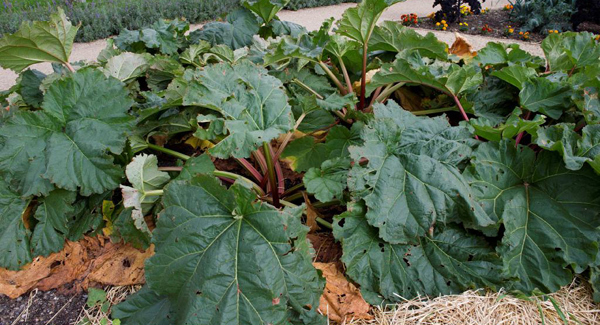
Rhubarb

For a first-time vegetable-grower, there isn’t an easier place to start than with rhubarb. It flourishes in any good garden soil, in full sun or light shade, and demands little attention.

It loves plenty of dung and will give a bumper crop, once established. Rhubarb stools or crowns can be planted now, but refrain from harvesting in the first year, so as to allow crowns to establish.

In winter, give plants a good dressing of straw and manure, and wait to see the green leaves and beautiful, pink stems emerge to herald the arrival of spring. Pull (don’t cut) the pink stems as you need them and always leave a few stalks so as not to rob the plant excessively. ‘Timperley Early’ and ‘Victoria’ are two reliable, tasty varieties.

Globe Artichoke

These thistle-relatives are prized for their large, edible flower buds — considered by many as a gourmet vegetable and are as much at home in an ornamental border as they are in a vegetable garden. Artichokes take up considerable space in the garden and can grow up to two metres, but once they have been established and you know how to harvest and to prepare the flower buds, you will deem them worth every inch of that space.

While they can be started from seed, artichokes can also be propagated by dividing an established plant. It pays to call on a gardening friend, or to check your local garden centre for young plants.

Like other perennial vegetables, the first year will not be the plant’s finest, but, from there on, you can expect a decent amount of flower heads, which should be harvested with a few centimetres of stem attached, before scales start to open.

Varieties worth growing are ‘Green Globe’ or, for a really decorative, tasty flower head, try the purple-flowering ‘Violetta di Chioggia’.

Sea Kale (Crambe maritime)

Despite its name, sea kale does not need to be near the coast to thrive.

This member of the Brassica family is super-easy to grow, but it is a garden vegetable that is mostly unknown to Irish plots or to Irish plates. It is native to the Atlantic coasts of Europe and was wild-harvested for thousands of years, before it was first cultivated.

All parts of this hardy clump-forming perennial plant are edible — roots, shoots (when blanched, they’ve been likened to asparagus), leaves, (similar to kale and cabbage) and flower heads.

These fragrant flowers will also attract beneficial insects, and, when combined with the plant’s large, blue-green leaves, give sea kale a highly ornamental value and make it an attractive addition to any garden or flower border. Sea kale is easily grown from seed and the only variety I have come across, so far, is ‘Lilywhite’, which is available from the Irish Seed Savers’ Association, in Co Clare.

Leaves and flowers can be harvested in the first season, but, as for most perennials, it is best-advised to leave them alone for at least a year before harvesting.

There are many more wonderful perennial vegetables that grow well in Ireland, such as the slow-producing but highly praised asparagus; perennial Alliums, such as Welsh onion and wild garlic; leafy greens, such as sorrel, wild rocket and Daubenton’s kale, and some of the more unusual root crops, such as oca, scoronzera and yacon.

Whatever perennial you plant this year, remember, they will remain in the ground for a long time, so good ground preparation and perennial weed removal are essential. After that, prepare to plant and sit back and enjoy many years of edible returns.

More in this section

Revoiced

Newsletter

Sign up to the best reads of the week from irishexaminer.com selected just for you.

Cookie Policy Privacy Policy Brand Safety FAQ Help Contact Us Terms and Conditions

© Examiner Echo Group Limited