September’s sedums
Waking up and expecting fine weather —it used to be unheard of — but we have become brave enough to expect our days to be fine and full of sunshine.
And that’s normally when the Atlantic takes over and sends in a few months of rain and unsettled weather. Nature teaching us not to be so cocky in future.
Not so this year — I cannot remember a summer which has been so good for so long. The result has been that before we have even had a chance to stop and think — its the last week in August.
Next week, is September, it’s back-to-school time, evenings beginning to close in as we start gathering the nuts before the long period of hibernation.
The weather is still pretty fantastic and whilst the worst thing is the unpredictability, September seems to me to be our most consistently fine month.
Sure the temperatures are dropping, the days are getting shorter and the green of the trees will become infused with yellows and copper.
Clothes shops changeover from the summer wear and sunshine colours to the latest autumn trends and so too in the garden. The summer bedding displays are fading if not already a thing of the past, hanging baskets are getting ready for the winter bedding and in the garden centres chrsysanthemums, and winter pansies have replaced the trailing petunia and lobelia.
Many of the summer flowering perennials and herbaceous plants have given of their best and are now being prepared for winter. Some, like phlox and penstemon will flower again if the good weather continues and you have cut them back after their first flush of bloom.However there is one genus that really only starts to give of its best during this period. Sedums without question come into their own at this time of the year. Sedum ‘Autumn Joy’ which is a variety of the spectabile species is one of the most well known for late summer/autumn colour with coral/red flowers produced over fleshy green leaves on stems that can get up to 50cm high.
Staking is normally required with ‘Autumn Joy’ to prevent the blooms falling over and leaving a big open centre in the plant. Much better to use the metal stakes with loops that are designed for these type of plants than individual bamboos as the result is more successful and the stakes less visible and obtrusive.
‘Brilliant’ is a similar variety but more compact and so there’s less of a need for staking, it’s also more free flowering with blooms which are more red in colour.
These sedums are synonymous with late summer in the garden but for me they actually add to the garden from spring onwards, their fresh foliage emerging from the cold soil in a pale green rosette, bringing a lovely fresh feel and certain texture to the garden.
Also called Ice Plant and Stonecrop, Sedums come in several sizes and colours. From the low growing, ground hugging Sedum spathulifolium and the nearly invasive Sedum spurium to Sedum telephium ‘Matrona’ which produces stems up to 90cm (3’) in height with red/green leaves and pale pink flowers again during August and September.
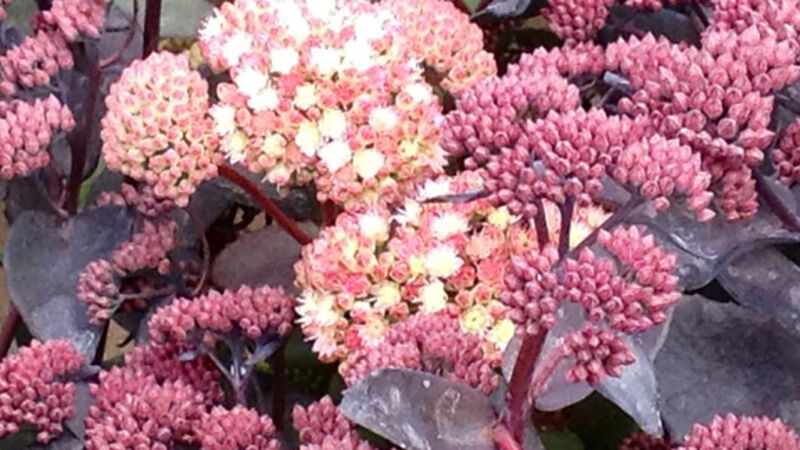
For years I just grew ‘Autumn Joy’ but over the last few years I have discovered some really fabulous varieties, ‘Jose Aubergine’ and ‘Purple Emperor’ both of which are more compact growing to about 30 cm (1’) with rich dark purple fleshy leaves and cerise pink coloured flowers. ‘Stewed Rhubarb Mountain’ is another relatively compact form growing to about 50 cm with dark foliage and creamy dark and light pink flowers.
Loved by bees and butterflies, all sedum need a well drained soil and full sun, simply refusing to grow in a waterlogged or damp soil. When they are happy with their position they will thrive and increase in size freely. They will propagate easily from division during the winter generously offering plenty of material for new plants.
Another plant that is at its best at the moment is the ornamental grass Pennisetum and I have a some Pennisetum ‘Hameln’ growing with Sedum ‘Matrona’ and the contrasting textures and complimenting colours has made it one of my favourite combinations growing in the garden during August and September.
Wisteria has a reputation for being difficult to prune, but really it isn’t — just follow a few simple steps.
Firstly, it needs a summer prune this month and a further prune during February/march.
* For the summer pruning, simply cut back the long wispy green stems that have been produced this year and which may already have produced flowers.
* Reduce these in length to five or six leaves from the main stem.
* In spring reduce this growth further to two or three leaf buds, (there won’t be any leaves at that time), from the main stem.
By doing this you can control the spread of this beautiful but vigorous climber and stop it from twining its way into gutters and loose masonry.
It will also result in better blooms instead of more green growth. I would also recommend removing any growth that is unnecessary, in other words, congested branches.


CONNECT WITH US TODAY



Be the first to know the latest news and updates