Get set, ready, go
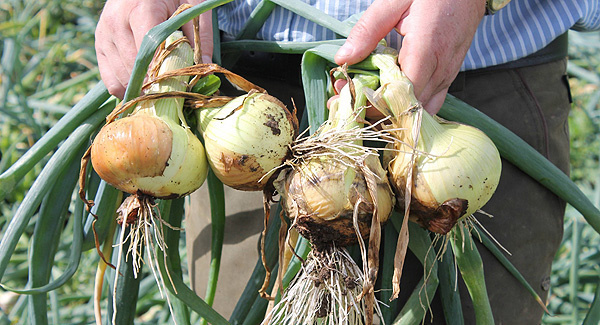
If you plant a variety such as Radar this month, the bulbs will grow slowly over winter to give you a crop of fresh onions with greens attached next May or June. This is perfect timing, as stored onions will have started to sprout or run out at this stage.
Often called ‘Japanese’ onions (because they were first developed in Japan), overwintering onions can be sown outside from mid-August up to late October. The main benefit of growing these onions is that you will have a crop ready for eating about a month before your main crop is ready for harvest next year.
Taste wise, they are every bit as good as main crop onions and they are traditionally harvested with their fresh green leaves intact, which are delicious when used in cooking. Plant your autumn onions as you would normal onion sets and make sure to follow a crop rotation. Plant in free draining, weed-free soil and it could pay to plant through mypex, or use a mulch such as straw to provide ground cover over the harsh winter months.
To prevent birds pulling out your sets, cover them with a fleece, which should be removed when the first shoots appear or use other scare methods, such as cds on a string. Be warned that casualty rates can be high in an exceptionally cold winter. If severe frost is forecast, mulch the bed with a thick layer of straw and remove the mulch next spring once the plants begin actively growing again.
Stay calm if your overwintering onions start to look dishevelled during a cold spell and remember that they will do most of their growing during spring. By sowing spring and autumn varieties of onions in any given year and using good storage techniques, it is possible to enjoy your own supply of organic onions, all year round.
As an unbelievably easy to grow and versatile vegetable, the common onion doesn’t give too many reasons to cry, but why exactly does it reduce us to tears one has to ask? Well, it all boils down to the complex sulphur compounds that onions contain and the chemical reactions that take place when one is cut.
First, when a knife cuts through the cells of an onion, its enzymes release a strong odour and, secondly, the onion releases allicin, a volatile sulphur gas that reacts with the moisture in eyes and creates a mild form of sulphuric acid. Immediately, eyes tear up to flush this irritating substance away.
There are many methods to try to prevent this familiar stinging sensation, some more practical than others. Some advise to cut onions under water, or put them in the refrigerator or freezer an hour before cutting, or to leave cutting the root end of an onion until last. Others suggest holding ones breath, wearing sun-shades or swimming goggles whilst preparing onions.
However, allicin is not all bad and it is the same organosulphur compound obtained from garlic, which is prized for its antibacterial and anti-fungal properties.
Like garlic, onions have an ancient reputation as a curative agent and the Greek physician Hippocrates, (he of the Hippocratic oath), prescribed onions as a diuretic, wound healer and pneumonia fighter and extolled its medicinal properties. The Greeks also used onions to strengthen competitors for the Olympic Games and before competition, athletes would consume pounds of onions, drink onion juice and rub onions on their bodies.
Raw and cooked onions, as well as poultices, syrups and extracts made with onions, are all recommended to aid a plethora of health problems. One old wives’ remedy recommends chopping up a raw onion, covering it with honey and letting it stand for four or five hours to make an effective cough syrup which is also wonderfully soothing for an inflamed throat.
Apart from the medicinal benefits, onions are endlessly versatile and an essential ingredient in countless recipes. They are prized all over the world for the depth and flavour they add to savoury dishes and are an essential ingredient in chutney making. To the surprise of some, onions also make a delicious sweet savoury jam which is the perfect accompaniment for meats and cheeses. Below is a simple recipe to get you started and as always in the kitchen, it pays to experiment.
4 large white onions. (Red onions work too and give a sweeter jam).
4 tablespoons cooking oil
1 /2 cup balsamic vinegar
1 /2 cup brown sugar tightly packed
Finely slice the onions. A food processor will save time and result in even thin slices. Sauté over very low heat in the oil for about 5-10 minutes until onions soften a little.
Add balsamic vinegar and sugar and cook on very low heat stirring occasionally with a wooden spatula for 45 minutes to an hour until all liquid evaporated. Add pepper and salt to taste.
This jam will keep in the fridge for months but be warned, this recipe only makes a small quantity so it more than likely will not last that long. Alternatively, you can add chopped chillies and garlic to the mix, but approach with caution as the end result might be very strong depending on variety of chilli used. Experiment.
CONNECT WITH US TODAY



Be the first to know the latest news and updates