Vintage View: Feminine Pleasures
In centuries past, even in grand families, the hours and years could weigh heavily on a woman’s mind, and most especially her face. In antique and vintage furniture, there are two pieces we most closely associate with women.
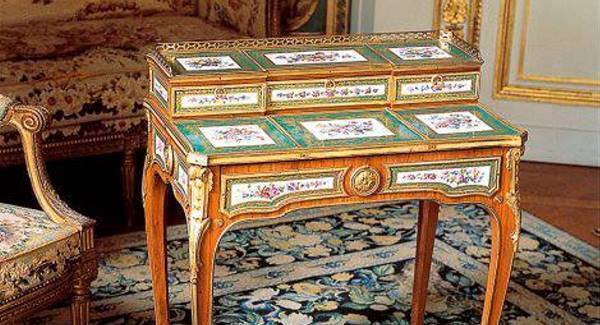
The Bonheur du Jour, or ‘daytime delight’, is a highly feminine genre of furniture, developed in the second half of the 18th century, in Paris. Leggy, graceful, light on its feet and versatile as its user, it was the personal laptop of its day.
The Bonheur was ‘Meuble Volant’ (moving furniture), and contained everything a well-bred, discreet woman would want to while away some precious personal moments. Given that most high-society ladies were consigned to do nothing outside of needlework, filling tortuous gowns and popping out heirs, these desks would have been busy hubs of quiet activity.
Menus would be carefully planned on the integral writing slope, the essential points of the toilette attended to, (applying patches from the patch-pot to disguise scarring on the face), and the tremulous thrill of love letters and other societal intrigues written and secreted.
The top of this hybrid desk has a second stage of drawers and/or cupboards, with fittings, and was decorated on all sides to sit out from the wall, where the light would fall across the work. In the centre of the top tier there were often one or more recesses, a small theatre in which she could place a small ornament, such as a little porcelain cupid or sentimental family heirloom. Dainty decoration in parquetry, ebonising, ormolu and painted porcelain panels stamped these desks as resolutely feminine possessions.
The dressing table, (coiffeuse), as we know today has ancient origins, having grown in stature from the travelling boxes of make-up and medicines carried by women as far back as the time of the Egyptians, Greeks and Romans.
Lowboy was a term for a low dresser with drawers used as needed in the 18th century for dressing or as multi-purpose side-tables. Without a glass, the woman might have a polished piece of steel, or a small hand mirror secreted in a hidden drawer.
A desk dedicated to the war colours and dressing of the hair became popular in the late 19th century, reaching a climax of loveliness in the art deco era. Now that make-up was accepted, even encouraged, women were free to sit and consider themselves for longer periods in their own large mirror, an arsenal of paste and paint readily to hand in slender drawers.
Some tables offer considerable storage in supporting side drawers stacked to the ground. These were used for everything from gloves and ivory pulls to powder boxes and hair pieces, and, in complete sets, with a wardrobe and bed, they are still highly sought-after. The top-of-the-line dresser for a great country house could even be plumbed for hot water. For a man’s table, a slide to accommodate a shaving kit and brushes was vital.
The Victorian Duchess dressing table, with its water-retentive, art nouveau legs, is a lumpen, matronly staple of every country auction. Their top surface would once have flashed with cut-glass perfume bottles, pin trays, silver backed mirrors, and brushes for the hair and clothes. Veneered in walnut and mahogany, they were skipped to the landfill by the thousands, peppered in worm.
Still, even robbed of their mirrors and top-drawer tier, surviving duchesses make wonderful bosomy consoles or hall tables. Dressing tables in Hepplewhite/Sheraton revival shapes, from the Edwardian era, without mirrors, are often indistinguishable from side-tables. Generous vanities are also well able to serve as small writing desks, if not too twee for your surroundings.
Arts-and-crafts-era dressing tables, with integral, tilt mirrors, sometimes appear as part of a complete bedroom set for the same price as a new High Street trio, and in oak are virtually indestructible, once the joints are firm.
Look out for candle holders on hinges moved to illuminate the face while preening after dark. In art-deco pieces, the full, circular, oversized mirror dipping between a horizon of two flanking sets of drawers, is not only pure 1920s jazz, but a stunning light amplifier in any room.
If you find a collapsed piece, see if you can save that wondrous three-piece glass as a wall piece. Hang it just slightly segmented, as a fascinating group, and don’t re-silver a fading mirror. Take a look through its foggy, flattering glass and the years will simply melt away.

CONNECT WITH US TODAY



Be the first to know the latest news and updates