Vintage View: Yixing Teapots
Tea drinking was first documented in China in the late 8th century, but it’s likely to have been brewed in open pans for thousands of years before the hilariously appropriate book Ch’a Ching was penned.
The pot for tea as we know it wasn’t introduced by the Chinese at all, but developed by the British East India Company in the late 1690s. They wanted their fabulously expensive tea strained for polite society before pouring and drinking, and asked that the Chinese teapots being produced for export be made this way.
For the next 300 years, and after the export of Chinese porcelain ceased in 1791, this form of a bellied pot with a lid, spout and strainer, remained the norm for pots in porcelain, silver and earthenware.
The strainer was finally pushed rudely aside by the savage advance of the teabag in the 20th century, but true tea devotees, still lovingly brew and strain with loose leaves.
The first tea pots and cups were diminutive, barely bigger than an orange but as prices fell and manners altered, the teapot became a lively, weightier addition to the household table of every class.
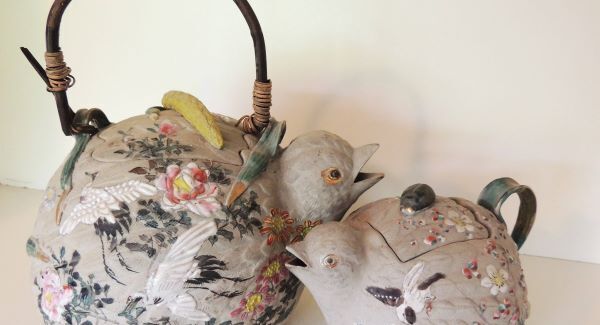
Some of the most affordable and interesting today are the novelty vintage pots made from the 1880s through to the 1980s and they are happily abundant throughout boot sales, auctions and through online vintage dealers. Many were made in a robust earthenware, a superb insulator for tea, and tough enough to stand decades of use.
The Victorians played around with some grotesque forms in majolica, birds, beasts, toby jug forms and vegetables. After WWI, the trend for character pots really took off and followed popular amusements from motoring and aviation to cartoons characters, nursery rhymes, and historical or political celebrities.
Cottage pots were a craze in the 1980s, but there are plenty of other themes to pursue if these twee properties are not your cuppa.
Condition is everything and as character teapots were not always corralled as cabinet pieces, damage to spouts and lids is commonplace.
With a rarer pot, a small hairline crack or some crazing will not destroy the price, but for something more widely available, you’re best bet is to fix on perfect and keep looking. English pots are highly valued for their quality, but the French, Spanish and Italians have some wonderful whimsical pots too in character form.
Look for good painting that appears to be chosen for the perfect colour and carefully applied rather than randomly slopped on. When you decide on a theme, factory or period, join one of the many collectors’ clubs online to get the latest on prices, fakes, and to discover more about the history of your chosen pots.
The design should use the shape of a pot cleverly, while retaining its function, but miniature, ornamental pots do have a following. Many ceramic artists have some interpretative fun with teapots, and are also well worth the investment — many hand thrown pieces are curiously affordable.
A maker’s mark is preferable and if there are paper tags keep them intact. Don’t put old hand painted pots in the dishwasher. If you do use them, wash them gently by hand in a plastic washing up bowl.
Names to look for in 20th century British pots include Wade, (out of business since the 80s), Carlton Ware; Roger Michel Walking Ware from the 1970s; Beswick, (famed for their Beatrix Potter confections and still producing); Tony Wood of Staffordshire, and Richard Parrington, (his Princess Diana, a loud hair flip teapot recently sold for over €1,000 at auction).
From kitsch to object d’art, quality will always brew up the best collectibles, so fight shy of cheap bone china from the Far East and rude reproductions.