There’s gold in them there leaves
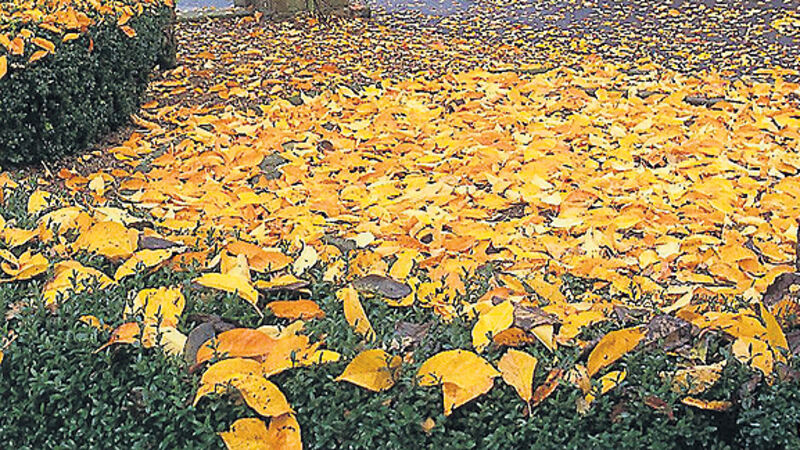
AS autumn gives way to winter, the light fades and temperatures fall, and leaves surrender their green colours to brilliant shades of yellow, orange and red before falling to the ground.
Falling leaves are a survival mechanism for a tree as it slips into dormancy for the winter. They will become a free source of organic matter and mulch for that tree. If these leaves are falling on your driveway, making it slippy, or blanketing your lawn, then leaf mould is the answer for you.

If treated correctly, these leaves can be used to your garden’s advantage and transformed into a salubrious soil conditioner known as leaf mould. For free. It is wise to imitate nature, but I am not encouraging you to plunder woodlands for fallen leaves.
Leaf mould is easy to make, simple to use, and will improve the health of your soil. It is not high in nutrients but makes an excellent soil conditioner. You can dig it into garden beds to boost humus content, which will improve soil structure and water retention.
This water-retaining ability makes it an ideal mix for use in containers. As a mulch or top dressing, leaf mould looks great on perennial and vegetable beds and will release nutrients to the soil over time.
Well-broken down leaf mould (more than two years old) can be sieved and used as seed-sowing compost, or mixed equally with sharp sand, garden compost, and good quality soil for use as potting compost.
One of the only negatives about leaf mould is that you have to wait. Since leaves are mostly made up of carbon, they take much longer to break down than nitrogen-rich materials, such as grass clippings. The decomposition process for leaves takes at least 12 months, but often the best things in life are worth waiting for.
Leaves are broken down by fungi, which is a slower and non-heat dependent process. In a compost heap, it is the heat-generating bacteria that do all the hard work, so, therefore, it is not a good idea to put autumn leaves in your compost heap as it will slow the whole process down.
Instead, keep these fallen leaves in a separate heap or bin to break down. As their decomposition uses a fungal process, the leaves need to stay damp.
All leaves and conifer needles will eventually break down into leaf mould, with different leaves having different qualities and breaking down at different speeds. Some leaves, such as oak, beech and hornbeam, break down with little assistance and make the best leaf mould.
As a rule of thumb, thicker leaves, such as horse chestnut and sycamore, are slower to decay as they have more veins. You could shred these leaves before adding them.
Conifer and pine needles make an acidic leaf mould, which is ideal for mulching ericaceous plants, such as blueberries, azaleas and camellias, and, therefore, should be kept separate from broad leaves, which are richer in potash and phosphorous.
Evergreens with waxy leaves, such as holly and laurel, should not be included. Be careful if you are gathering leaves from public places as, firstly, you may need permission, and, secondly, wear gloves as you may find unwelcome pieces of glass and other refuse mixed through the leaves.
A leaf mould container can be made by simply using four wooden posts and chicken wire. Place the posts approximately 2ft-3ft apart in a square and stretch the chicken wire around them in one, continuous piece, nailing it to each post to make a box shape. You could place this bin under a deciduous tree, as this gives overhead shelter and some leaves will fall into it directly.
You don’t want the pile to get too wet and soggy, but, on the other hand, you don’t want it to dry out, either, as this slows down the breakdown. Fill the bin to the top and if you have more leaves and a large garden to feed, place several bins together, preferably near the garden for easy access.
Pack as many leaves as you can into the container, as the pile will rot down into a much smaller volume. Thoroughly dampen the pile, if necessary, as this encourages fungal breakdown and check the moisture level occasionally during dry periods, adding water if necessary. In addition, you can try turning it regularly to aerate the leaves and speed up the breakdown process.
You could also pile collected leaves into a corner of the garden and leave them to their own devices, but, chances are, they will be blown around.
If you don’t have room in your garden for either of the above, another method is to use black plastic refuse sacks. Stuff the sacks full of moist leaves and then tie them securely. Cut several holes in the bag to allow for aeration and check the bag every month or two for moisture, and add water if the leaves are dry.
Once you have made your pile of leaves, there is nothing much more to be done. Depending on your pile, it should take at least a year, if not longer, to break down, and, when ready, your pile of soggy leaves will have magically transformed into a dark and crumbly, almost peat-like enriching soil conditioner.
¦ Cork Garden Club, Ashton School, will have Carmel Duignan (Dublin) to speak on “My Garden and other Plants” on November 8, at 8pm. All welcome to attend.
¦ East Cork Flower Club will host Orlaith Long of High Society, Midleton, and speak on ‘fashion with flair’ on Monday, Nov 5 in St. John the Baptist national school, Midleton. Also on the night, the club will hold their AGM, commencing at 7.30pm. Refreshments will be served. The club’s gala Christmas demonstration takes place on Thursday, Nov 29 in the Midleton Park Hotel.
¦ Castlelyons Home and Garden Club will host their annual gala evening on Thursday next, at 8pm, in Castlelyons community centre. With the theme ‘all things festive, You and your home’, it will entail demonstrations on hair and beauty, makeovers, art, floral and jewellery. An array of stalls will be present and the proceeds will aid Liam’s Lifts and Cystic Fibrosis. Cheese and wine and refreshments served; also, a raffle. Tickets available on the night or from Anne at 086-2381611, or Bridie at 086-8079612.
¦ Free talks at Griffin’s, Dripsey, on bank holiday Monday (also Wednesday and Friday at noon) on ’bringing colour to you containers for winter’. All welcome.
¦ Hosfords sale continues today, from 10am to 4pm, and tomorrow, Sunday, from 2 to 5pm.
¦ Reminder for the ‘snowdrop gala’ (and other spring treasures), which takes place at Ballykealey Manor, near Altamont, Co Carlow, on Saturday, Feb 2 next, beginning at 9.30am. Early booking essential and the cost, €60, includes lectures, lunch, admission to bulb sale and guided tour of Altamont with the head gardener. Full details in January next, but contact Hester Forde at 086-8654972, or Robert Miller, 087-9822135, for bookings.
¦ Cork GIY (Grow it Yourself) host Tim Rowe’s presentation on ‘bees’ (and why we need to encourage them into our gardens) on Tuesday, Nov 6 in the South Parish Community Centre at 7.30pm. Free admission and all are welcome.
¦ As Halloween dawns, the ‘fireworks’ of the plant world prepare for their annual colour explosion. Many factors affect the quality of autumn colour; weather, temperature, and soil conditions all have a bearing on the depth and brilliance of the colours. Of course, what appears to be a mystical display for our benefit is nature’s way of shutting down deciduous plants for the winter.
When temperatures drop and the days continue to shorten, resources stored within the leaves are slowly withdrawn and conserved for the following year. To best appreciate the displays countrywide, try to visit an arboretum in your area this weekend. In the south, Fota Arboretum is this week quite spectacular and I urge all who appreciate the great outdoors to visit. And to think that this particular venue, and all it contains, is (even in these pinched days) entirely free.