Housing crisis and infrastucture need both public and private entity solutions
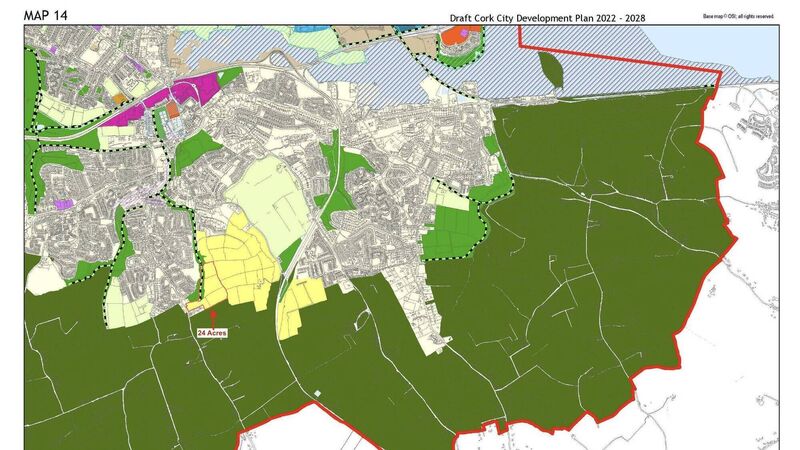
Treasure in them there fields? Zoning map for Castletreasure, Douglas, Cork where a c €10m land deal was in train in 2025. Rezoning submissions totaling over 3,000 acres were made to Cork local authorities last month
— Socrates
IRELAND has arguably gone through the most transformative period in decades in terms of planning and policy reforms that are targeting the residential development sector.
Since its formation in January this year, the Government has placed huge emphasis on increasing the supply of new homes and tackling obstacles impeding delivery. This includes amending housing targets in the revised National Planning Framework and issuing Section 28 ministerial guidelines to local authorities in July to adapt these new targets and significantly increase the quantity of zoned land to enable the delivery of 300,000 homes by 2030.

This means zoning enough land to deliver the revised target of 55,600 units per annum up to 2034, with an additional 50% headroom to ensure there is enough land to provide up to 83,000 homes per annum and to allow for land that may not be activated for various reasons.

Only a handful of local authorities have engaged formally with a process of land capacity review. In a local context, the key dates for submissions to Cork County Council for new applications for zoning land suitable for residential development was October 20 and Cork City Council was November 10.
In our experience, there has been a real appetite from landowners to play their part in attempting to solve the housing crisis. We understand that Cork City Council received over 120 submissions from landowners and Cork County Council received over 200 submissions which totalled approximately 1,240 hectares/3,100 acres. It should be noted that over 70% of these submissions were supported by professionals to include planning consultants and, in some cases, partnerships with developers.
The key consideration for planners and councillors in assessing these submissions will be ‘deliverability’ and we expect that there should be some formal indication as to how much land will actually be rezoned early in the new year.

Because of the period the residential sector now finds itself, there is a comprehensive list of appropriately funded national home builders actively seeking not only to secure short-term development land but who are also now strengthening their medium and long-term land banks to secure future development pipeline for their businesses. This has been evidenced by the significant number of deals that have recently been agreed as subject to rezoning as part of the Section 28 process.
On expiry of the current county development plans the period of the next ones will be extended from six to 10 years. It is likely that the process of preparing for the new 2028-2038 Cork county and city development plans will commence late next year, and again we are likely to witness some more land sales which will include the condition of ‘subject to rezoning’.
In terms of acquisitions, off-market activity has remained buoyant in 2025, with the Land Development Agency (LDA) involved in a number of transactions, including the sale of 47 acres at Baldoyle, with planning permission for 1,931 residential units. The LDA also acquired a further 40 acres at Lehaunstown, Dublin 18, with potential to deliver 350 new homes.
In Cork, one of the most notable transactions in the year was the sale of the 8.4-acre former CMP site at Kinsale Rd to Cairn for approximately €25.6m.

Another notable transaction was the JV between Cairn/the Forrest family and Finbarr O’Leary of Rockfleet Joint Ventures Ltd for lands at Ringwood in Blarney — which could potentially deliver up to 3,000 homes.

Increased infrastructural investment and Government plans to speed up the delivery of key infrastructural projects will be welcomed by all stakeholders. In recent years, planning delays and lack of infrastructure impeded housing delivery, which coupled with elevated borrowing and development costs stalled activity in the market. There are certainly key settlement areas in Cork in which there is sufficient appetite to develop land once infrastructural constraints have been dealt with, such as Ovens (wastewater), Cobh (road infrastructure), and Whitechurch (water).
There are certain areas that prove that, once infrastructural issues are dealt with, houses can be delivered; such as Midleton, where there are over 2,000 commenced, and Ballyvolane, where there are over 1,000 units commenced.
Without infrastructure, housing cannot happen. The long-running challenges at Uisce Éireann and the ESB around planning, funding, and delivery have been widely reported. But there are encouraging signs. The new accelerating infrastructure taskforce has brought fresh urgency and purpose, and there are indications of purposeful new legislation.
Its report is due in the coming weeks and should be a catalyst for change. Projects like the water supply project and greater Dublin drainage are critical.
The Housing Activation Office, last week, has given clarity of alignment between its role and the role of the accelerating infrastructure taskforce, and overlaps with the Department of Public Expenditure, Infrastructure, Public Service Reform, and Digitalisation.
The European Central Bank base rate is now 2.15%, the lowest in three years, which together with Vat measures announced in Budget 2026 aimed at improving the viability of apartment developments, will help strengthen confidence in the market.
Earlier in the year, Property Industry Ireland commissioned a report which highlights the scale of investment required: €140bn over the next decade to fund the eventual ownership of newly built homes. That means approximately €30bn in development capital per year by 2030. Breaking this down, around €51bn is expected from private buyers via mortgage finance, another €30bn from the private rental sector, and €51bn from the State for social and affordable housing.
Government can’t do it alone. It must crowd in private capital by reforming delivery schemes like Croà Cónaithe and Star, and by boosting the capacity of approved housing bodies. It is positive to see the Ireland Strategic Investment Fund committing further for the provision of equity to smaller home builders.
Public and private, not public versus private, and the extended role of the LDA as an enabler beyond the cities and into towns, needs to be carefully considered so as not to cause displacement of private sector actors.
Too often, housing delivery is hampered not by lack of will, but by lack of alignment across government and public and private entities — I believe that is changing. Departments must work in sync: Housing, finance, public expenditure — all pulling together. We also need stronger partnerships between the public and private sectors.