House price inflation returns but Covid has 'disrupted' bubble fears
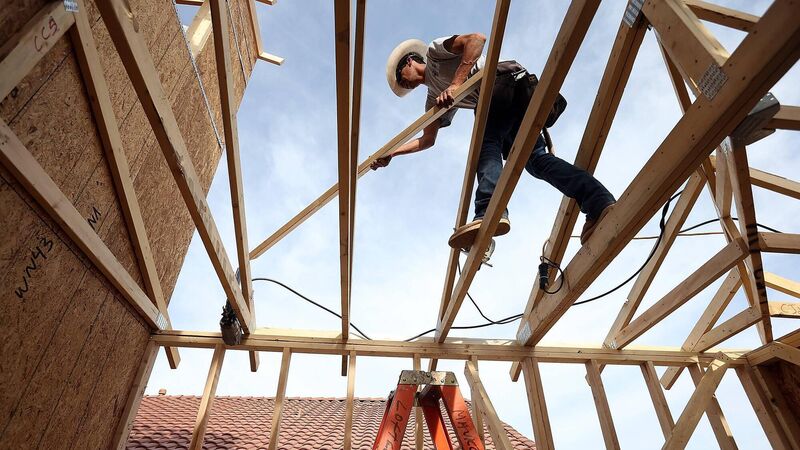
The Society of Chartered Surveyors Ireland says the Government should start 'a large-scale public sector house-building programme via local authorities to take advantage of a likely softening in construction costs in the coming two years'. Picture: Getty
It will be a full and further decade before Ireland’s housing market finds equilibrium between supply and demand, it has been claimed, as the Government prepares its latest housing measures as part of Budget 2021.
The suggestion of continuing imbalance and accommodation shortages up until 2031 comes as a Myhome.ie report today shows house price inflation back again, at 5% by the third quarter of this year, despite Covid-19’s impact on the economy and employment.
In a pre-budget submission this week, a 10-year housing strategy or roadmap across all sectors, including affordable and social housing, is required, argues the Society of Chartered Surveyors Ireland (SCSI).
It says the Government must address affordability issues and the cost of new house building, review the taxation treatment on land and on housing, and leverage the Land Development Agency and local authorities to make more used of compulsory purchase orders for social housing using private sector developers. It adds a need to step-up resources for the Retrofit Plan for 500,000 home in the coming decade.
The SCSI says the Government should start “a large-scale public sector house-building programme via local authorities to take advantage of a likely softening in construction costs in the coming two years", and notes a softening in procurement and tender prices in recent months.
“Following recent difficulties in relation to Brexit and Covid-19, the construction sector is likely to be less active in 2021 compared with 2020. Construction tender inflation is therefore likely to decrease and value for money on construction projects should follow.”
The past several years saw year-on-year house price growth, which “brings confidence to funders to invest in new schemes, which ultimately delivers new homes to the market", says the SCSI. It suggests that “as we enter a period of stagnating house price growth and possible house price deflation, intensified efforts are required to tackle the high costs of delivering new homes to ensure that new product is fit for the market in which it is being sold".
Yet, the expectation of house price falls isn’t yet borne out by the latest figures.
In a third-quarter report issued today, property website Myhome.ie, in conjunction with Davy, notes “a surge in asking price inflation”. It's now at the highest level since the first quarter of 2017, at 5.1% nationally to €282,000, and by just half that in Dublin, at 2.7% to a mix-adjusted Dublin average of €386,000, due to continuing demand, and supply shortages, exacerbated by the effect on supply by the spring lockdown.
Davy chief economist Conall MacCoille said despite this, we are not facing another property bubble, as Covid-19 “has disrupted the usual seasonal pattern of the housing market and may have flattered the annual comparison".
“Just as we thought the minus-3% inflation reading in Q2 2020 was an aberration, the same is likely true for the plus-5% recorded here. The truth probably lies close to the middle of these two readings.
Angela Keegan, managing director of MyHome.ie, said its busiest ever month for website traffic was July, and, quoting a recent August sentiment survey, said 71% of prospective buyers expected to buy in the next year.
“This shows that buyers appear to have largely been unaffected by Covid-19’s economic impact. On the supply side, meanwhile, stock levels are down 25% compared with this time last year. This combination has led to asking prices being driven upwards.”
Read More


CONNECT WITH US TODAY



Be the first to know the latest news and updates