Operation Transformation: How Cork City Council is helping to tackle dereliction and vacancy in the city centre
Anyone interested in building conservation is programmed to look up as well as look around — and Ciara O’Flynn recalls her experience as she walked along streets in Cork City’s historic centre ‘round about the time she was set to take up a role with Cork City Council.
”I remember walking along Barrack Street and Douglas Street and looking up and wondering why there were no lights on in some of the buildings.
“When I started with Cork City Council I asked what the story was and they said, ‘We know, we want to change things too.’ In fact the council has been working hard to unlock the problem of vacancy and dereliction in the city’s historic core for a number of years.

To this end it either operates or implements a variety of schemes that provide financial assistance/incentives to owners of buildings to carry out repairs, maintenance, and refurbishments. As Ciara, the council’s assistant conservation officer, points out: “The best way to keep buildings safe and structurally sound is have them occupied and used.”
Not keeping buildings safe and structurally sound gives rise to situations such as the partial collapse of 63 North Main Street last year, one of four adjoining properties registered derelict in 2015.
More recently, part of a building collapsed at 38/39 Washington Street and although that was attributed to a construction issue, it brought to mind the tragic death of student Aoife Bell, who was killed when part of a building collapsed on the same street in 1999.
“The City Council would like to encourage better building stewardship in the city and prevent any further dangerous collapses onto the streets,” says Ciara.

To this end, the council organised a seminar last year, Unlocking Upstairs, which looked at the problems of vacancy and dereliction and at trying to identify why upper floors of buildings lie vacant in the city despite the housing crisis.
Gwen Jordan, a council planner, who at the time was in charge of the Living City Initiative (LCI) — a tax incentive for the refurbishment of historic buildings in the city centre — told the seminar there were more than 260 properties in the city “with upper floor conversion potential” that could deliver an additional 400 homes, helping increase housing supply and tackle vacancy and dereliction.
The LCI yielded positive results for one Dublin woman who opted to live out her retirement in Cork, a city she had grown familiar with over the years, on account of regular visits to her grandmother and, later, as a student of University College Cork.
“I was looking to relocate to Cork from Dublin, I spent a lot of time here when I was younger.
“I was interested in a house on Wellington Road overlooking the city and this one had views out over it but was also close enough to be in it,” she says.
Luckily, the woman in question had a professional background that brought with it an awareness of city development plans. She examined the development plan for Cork City and familiarised herself with the various schemes open to building owners. She discovered her home was within one of the city’s three special regeneration areas, St Luke’s (the other two being Shandon and South Parish), qualifying her to apply for the LCI.
“I contacted City Hall and it couldn’t have been simpler.” she says.
The age of the Wellington Road home — built in the 1870s — meant it met the main criterion for residential applicants, as the scheme is open to owners of pre-1915 buildings (the criteria are different for commercial properties).

Then it was a case of filling out an application form and details of the proposed works. Once an application is deemed eligible, a council official visits and gives advice on any planning requirements and qualifying expenditure, as well as taking photographs of the building.
Once the council is satisfied that everything is in order, an interim acknowledgement is issued and the applicant can go ahead with the works and get back to the council on completion, making sure to keep the original receipts.
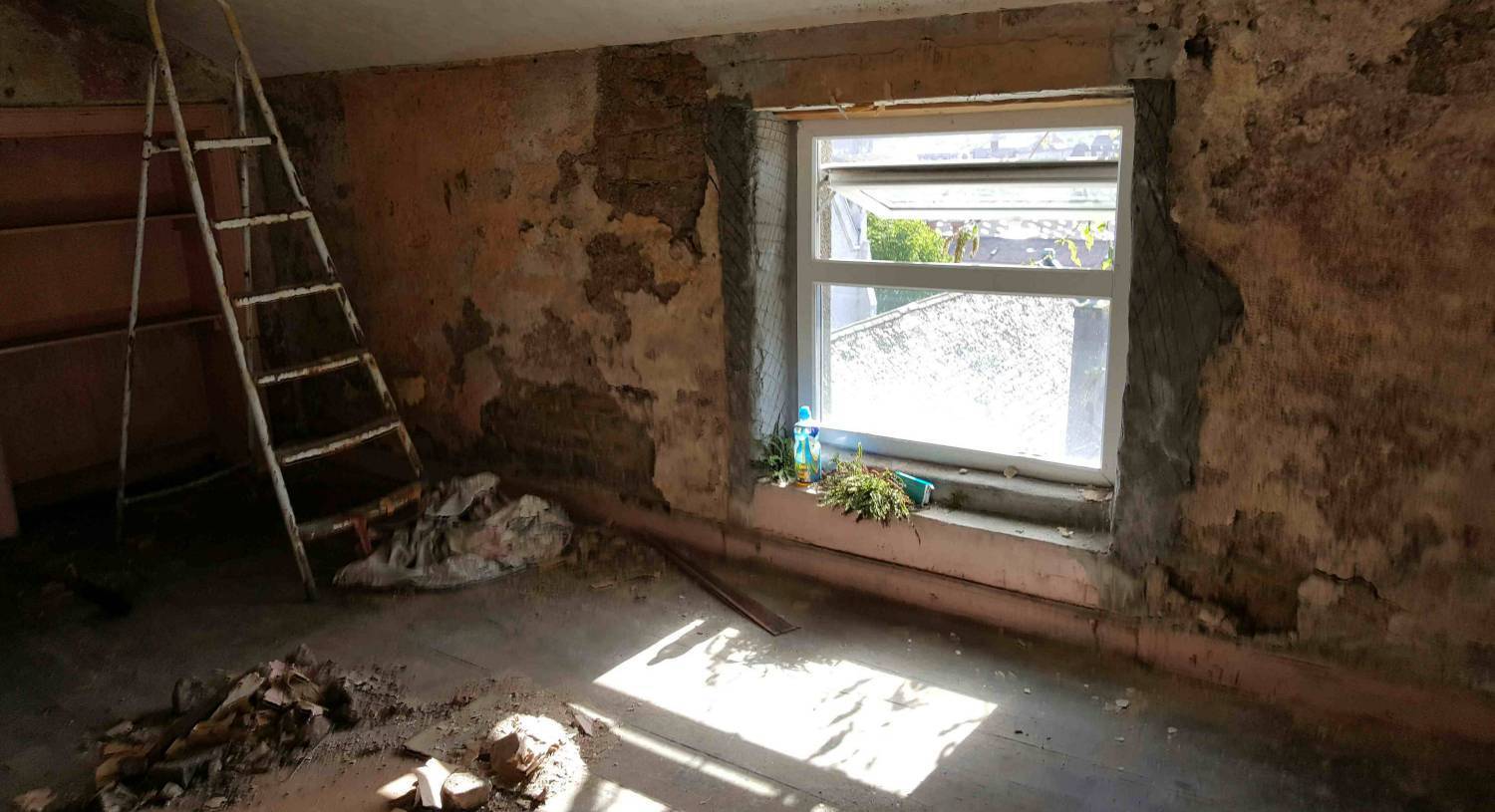
The house on Wellington Road, a three-storey, over-basement, terraced home, had to be stripped back to the bare bones and there were some serious structural cracks at the gable end. The owner describes how there were “crumbly stone walls”, how they had to rebuild and pin the gable end, and underpin other structural flaws.

Planning permission had to be obtained to knock an extension to the rear housing a bathroom — there were no internal bathrooms when the house was built — and to install additional windows. Elsewhere, new windows replaced old, there was much replastering and repointing and a reconfiguring of some of the internal layout.
The end product is a smashing family home, respectful of its heritage yet transformed into an enviable modern living space within the city’s historic core, which, as the owner points out, “was the object of the exercise”.
The house was kept within its existing footprint with just the rear extension knocked to make way for a lovely south-facing garden, a very special amenity in the inner city.


The owner bought the house for €181,000 and spent another €200,000 getting it in order, of which €165,000 went on building costs. All the building costs were eligible for tax relief under the LCI. Original receipts were submitted and the council followed up with a site visit to make sure everything was in order, before issuing a final letter of certification, which must be presented to Revenue. The applicant is then entitled to 10% of certified expenses per annum over a period of 10 years as long as they are living in the property.
In the case of the Wellington Road home, which took a year to make habitable, the owner is entitled to write off c€16,000 a year against her taxable income for the next 10 years. “I think it’s a no-brainer if you are thinking of buying an old house in the city because it makes it feasible financially,” she says.

While it does sound like a “no-brainer”, national uptake of the LCI has been low. Figures given out at Unlocking Upstairs last year show just 174 applicants, including 58 from Cork, since it was introduced in May 2015. Of these, 13 applications had been completed, with a total of €1.7m expenditure certified by the council. There is no upper limit on spend.
The council is trying to improve take-up as the scheme has been extended by the government from its original five-year timeframe, to a closing date in 2022. While it was initially open to owner/occupier residential and retail/commercial (owner-occupier and lessor), it was extended to rented residential on January 1, 2017. All three elements will terminate on December 31, 2022.
Ciara says there are other schemes in addition to the LCI that can help with repair and refurbishment.
For instance if you inherited a building on Barrack Street and you didn’t have the energy or money to invest in it, you can let it out to the council under the Repair and Lease scheme.They will repair it up front and you will still get rent from it.
The property must be made available for use as social housing for a period of at least five years. The owner will receive an agreed lease payment from the council (or approved housing body) with the value of the repairs offset against it over a specified period. The maximum funding available is €40,000, inclusive of Vat. The council is currently progressing three properties under this scheme, which are all due to be tenanted in the coming months.
The scheme is ideally suited to properties in need of minimum refurbishment to bring back to residential use, says Diarmuid O’Connell who looks after the scheme for Cork City Council.

For properties in need of significant refurbishment, there’s the Buy and Renew scheme.
In fact there’s a whole palette of schemes to address vacancy and dereliction. As City Conservation Officer Pat Ruane points out, there is financial help available under the Architectural Conservation Area (ACA) grant, to assist owners of historical buildings to undertake works such as roof repairs, repairs to historic ironwork, shopfronts, windows, and doors. There are also grants available under the Built Heritage Investment Scheme (BHIS).
A fine example of how grants such as these have been put to good use is along North Mall. Here terraced townhouses previously in multiple occupancy have been transformed, with owner/occupiers back in situ, doorways, windows, and cast-iron railings restored and roofs repaired, transforming the face of the area.
There were 37 ACAs across Cork City, but the number has increased following last year’s boundary extension. The scheme is not confined to historic buildings. As Pat says, it can also be “ordinary buildings that contribute to the character of an area”.
These would include buildings such as the former workers’ cottages associated with the St Patrick’s Woollen Mills in Douglas.
Pat says one of the good things about the ACA scheme is they can adapt it subject to councillors voting in favour. “For instance we can vary the geographical spread if councillors agree and we can respond to need,” he says.
One of the negative elements is that not nearly enough money is available. The ACA grant scheme this year is just €65,000, but, as Pat points out, it’s from the council’s own funds and it is one of the few councils nationally to offer it. This year’s allocation under the BHIS scheme, funded by the Department of Culture, Heritage and the Gaeltacht is €95,000.
Pat is hopeful that through working in partnership with building owners, they can help turn the city around, albeit slowly. “I definitely feel a corner has been turned. We are looking at a lot of problems, but there is a fizzing interest and energy about how to live in the city in a different way and our job is to help with that.”
For more information on council grants and schemes. log on to:
- http://www.corkcity.ie/en/council-services/services/planning/city-centre-revitalisation/incentives-and-grants.html
- Unlocking Upstairs seminar: https://www.corkcity.ie/en/council-services/news-room/latest-news/-unlocking-upstairs-event-to-explore-inner-city-living-possiblities.html
(This seminar took place last year, but the link is included for those interested in its range, topics and speakers’ backgrounds.)