The best materials for those outdoor spaces
looks at a variety of materials when it comes to hard surfaces for those outdoor spaces; from patios to driveways there are choices with concrete, stone and clay bricks.
Hard landscaping is an expensive, highly visible ingredient. Getting the looks, durability, economy and performance out of these materials is essential. Take your eye and your boots a-walking on the best of what the market has to offer.
Warming to concrete
The modern-day hero of honest materials, concrete is going through something of a renaissance indoors and out. The quality of the materials for driveways, patios and paths has never been higher, with award-winning manufacturers Tobermore, and Kilsaren standing shoulder to shoulder with European brands.
Concrete is a stone porridge, naturally based but more energy-hungry to produce than natural cut stone. Wet cast from real slabs it takes a beat to spot the difference between a riven or shot-blasted aggregate paver and the real thing. Where you prefer weathering, it soon blends into natural surroundings.
Produced in batches, concrete colours and finishes have a pleasing uniformity where required, and can be easily handled in smaller projects by a weekend warrior attempting their first simple patio.
Set designs in kit form, are a great start and blocks can be laid with flexible joints (silica sand) or on a mortared bed and mortar jointed (less usual for residential).
Colour fastness has been improved dramatically in recent years and surface treatments offer dozens of unique choices. Block paving is immensely strong and dimensionally accurate, but some mild wearing back to the aggregate is possible over decades. Depths of 50-60mm are best suited to home applications. If you want a natural stone look, consider concrete blocks ‘faced’ in a top layer of reconstituted granite or a quartzite sandstone.
Concrete block driveways are a straightforward but skilled job — ground preparation, levels, the addition of substrata, the use of blinding, and dedicated drainage must be carefully worked out. A property landscaping contractor or road work expert is called for and use top quality products.
Stone, concrete, brick and resin bonded driveways will also require drainage, from a small soak away area to full on municipal level piping. Again, the advice is to hire a reputable professional unless tracing simple horticultural paths.
50/51 standard (50mm thick) rectangular blocks in a square metre — €10-€70 per m² depending on product.
Stone
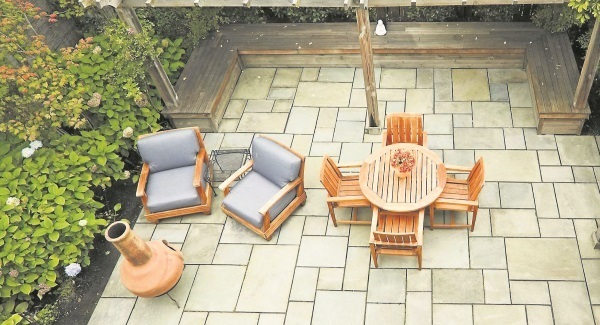
Solid natural stone comes in a variety of colours, various depths and size of slab and given its weight and expense, it can cost as much to lay correctly as it does to buy.
The most important thing is that it is installed to be stable, level and durable, and that the surface has sufficient skid and frost resistance in the face of our moist Irish climate.
Finishes applied to sawn paving slabs include bush hammered, honed, abrasive washes and mechanical and naturally riven textures, to provide character and some essential ‘bite’.
Depending on its type, stone can be hot-flamed — gorgeous in limestone where calcium carbonate crystal inclusions sparkle to life, or honed with dedicated grits that change the colour of lime-stones to darker or lighter.
In Irish stone go native with limestone, slate, granite or sandstone or plumb for travertine or even exotic marbles. Ensure the product size and depth is intended for vehicular traffic, if that’s what you’re interested in.
Travertine has a large part of the import market for its patterning, economy and variety of colour. With the increasing popularity of complete glass walls without the interrupting sight lines of any sill, there is a trend for continuing the indoor surface, either stone or tile, out to outside spaces with an similar but different depth of material.
Don’t presume those familiar vernaculars like silver limestone are Irish. Granite in all its forms, including setts, is as likely to come from China as an Irish quarry.
Chinese and Indian sandstone is chosen for its striations of colour fossil inclusions and of course, for it’s price, which is considerably less than Irish-quarried products.
In approach, it’s okay to mix up your colours and sizing for a random, casual finish or choose one colour and slab size for crisp formality.
An expanse of patio will require careful drainage planning, bed preparation and grouting for a safe surface. Seal with a brush-on product formulated to fight algae growth and to cut down on maintenance.
Prices vary on product and quality with sandstone from €16 per m², imported limestone from €30 per m², solid stone setts €72 per m².
Shop around and try oconnellstone.com; finbarroneill.ie; or ballygarvanstonecraft.ie
Clay brick
Traditional clay brick in paths and edging is a beautiful, sustainable accompaniment, absorbing and releasing moisture and will deal with all but torrential rain with ease.
Laid without mortar, the fired brick has a colourfast nature and can be reclaimed for other projects or moved as needed to do groundwork.
Where bricks are stained over time, they can be turned over. Herringbone patterns not only lock up nicely as garden paths, but look extremely handsome when laid correctly and maintained well.
New fired clay pavers from €30 per m² without rain water inclusions. Reclaimed clay brick for paving (garden, not drives) from €1 a piece salvage. Try centurionstone.ie


CONNECT WITH US TODAY



Be the first to know the latest news and updates