VIDEO: Former Church of Ireland chapel along the Wild Atlantic Way an enchanting prospect
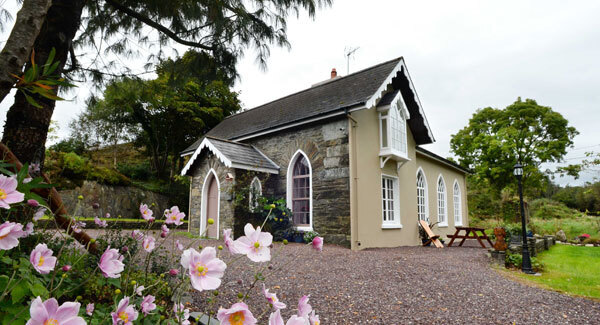
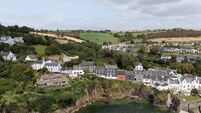
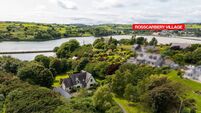
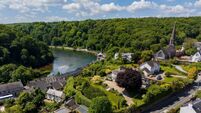
THE setting is very much the star at this west Cork church conversion home, a bit of a bayside charmer, by beautiful Ballylickey and in a mellow and verdant Bantry Bay spot along the Wild Atlantic Way, with a pier for boat launches just across this scenic stretch of the N71.
With views over water and seaweed-strewn rocks to Bantry Bay and Whiddy Island, this is a bend in the inlet where passing motorists frequently stop for landscape photographs; and, when they glimpse this Snave, Ballylickey former church building, it’s one they often ‘snap’ for the album also.
Dating back to 1798, as churches go it was ever-modest, appearing now without a spire or many of the usually, and often over-powering, accoutrements, that go with ecclesiastical buildings.
In fact, it’s positively, and perfectly, domestic, with about 1,400 sq ft within, and on several acres of its own grounds for further good standing.
Sold out of church hands in the early 1990s, this stout, stubby and thick stone-walled building half way between Bantry and Glengarriff was made over for private residential use in the 1990s by a west Cork art gallery owner, and it changed hands once or twice in the past 20-25 years, yet is unlikely to have been in as good a condition previously as it now presents, as it come up for sale in smart order.
It had been for sale in 2005, in then-rude good health priced at €565,000, and more recently various agents had it since the ‘slump,’ and it dropped to €250,000 in asking price after it had deteriorated, and shows up on the Price Register as having subsequently sold to the current owner for €215,000, before his programme of building and grounds salvation.
Media reports from previous sales have described it as having previously been a Methodist chapel and school, but local Bantry families say it was a Church of Ireland ‘Chapel of Ease,’ a subsidiary church for a once-larger and more scattered Protestant population out along these jutting peninsulae.

One C of I family note this Ballylickey/Snave chapel was used by a place of worship by the locally-born Ellen Hutchins, who was deemed to have been Ireland’s first female botanist.
Miss Hutchins was born at Ballylickey House in 1785, and died at just 30 years of age, having proven adept at botanical drawings, and a capacity to find algae, seaweeds and rare plants.
When visited in 1809 by two of Britain’s most eminent botanists, they described her as ‘a very sensible, pleasing, square made and tolerably good looking woman’.
Christian charity indeed: might they have rated the aesthetics of her chapel more highly?
Very much a one-off, with instant ‘kerb appeal’ and interior flourishes, it’s listed just this week with joint selling agents Denis Harrington of Harrington Estates in Bantry and with Elaine Daly of Sherry FitzGerald Daly in Kenmare.
They guide the niche buy at €395,000, and expect the next owners to almost definitely come from overseas, or at least from up country, moving and swooping for lifestyle reasons.
Its current owner came via London in 2014, but has Bantry family roots and when he saw it it had been rented for a number of years, and it definitely wasn’t looking its best and its grounds were closing in on it, almost disappearing from view.
“Within six weeks I had purchased the property, I fell for its charm and spotted its potential immediately despite its then unloved state,” he states.
Now, having restored, reinvigorated and having enjoyed the tranquillity to be had, city living is beckoning once more and he’s making a move to Dublin.
During his tenure, the grounds have been tackled, with a digger on site for a week, cutting back encroaching gorse, and reinstating paths and graveled drives, he’s highlighted much of the acid-soil loving natural planting, heathers are reinstating themselves (Miss Hutchins might approve?) and he also put in oil-fired water heating to go along with the central heating, as previously under-sink geysers were used for hot water.
Although the decor’s been fully updated, it hasn’t gone so far as to deviate from the essential original character, and the most ‘church-y’ part of the interior is, of course the high ceilinged main living space, open to the rafters and with a feature stained glass window at the far, altar end by what’s now a den/sprawling space.
The window depicts both a Star of David at its top, and winding yellow Passion flowers beneath in two tall panels; other windows are in a variety of shapes but mostly arched and gothic-style, are less formal.

A side window, looking into a sheltered side door porch, is painted cast iron and latticed, and is quite the gem.
Likely to have been much-altered down the centuries, this home is now T-shaped, with a stone-fronted facade and pretty porch with painted hardwood half door between narrow gothic windows, all entwined with rambling roses, and this front section internally has a full-width 23’ by 10’ double aspect living room, with beamed ceiling and cast iron wood-burning stove set into a brick hearth.
Beyond stretches the main 27’ by 16’ long hall, full height up to the roof apex amid pitch pine beams, and a previous owner put in a mezzanine bedroom over a portion, up top above the kitchen, done in matching old timbers, complete with three circular quartrefoil style carved inserts, reportedly sourced from Rochestown Monastery in Cork.
Very bright thanks to a double/triple aspect, this very large space fortunately hasn’t been overly carved up, and has an older style kitchen with tiled worktops under the mezzanine, while a side passage has a rear/side entrance, and very large utility/laundry/store room.

Also off the main central feature section is a bathroom, with shower, while a WC upstairs serves the two/three bedrooms for night time calls of nature.
Upstairs isn’t a mix to suit standard family life, but then this isn’t likely to serve as a standard family home.
There’s a pleasant double bedroom, with feature projecting window seat overlooking the side gardens, and next to it is a smaller bedroom.
The largest is probably the mezzanine bedroom/bed 3, with its great internal vista overlooking the dining and living areas and altar/den.
It would be shame to lose this openess and interconnection but for those who might want or need more privacy up here, options could include a back-up glass wall inside the feature railings, or curtains, or both.
As it stands, this Snave (pronounced snámh, as in swimming) home would be a stunning and memorable setting for entertaining, throwing dinner parties, catering or Air B’nB.
The former waterfronting large Canadian-style cedar-faced home of the recently deceased Peter Barry, Westerly, by Mannings of Ballylickey, sold in the past few years for €565,00 and is now a niche, upmarket rental, after being bought by a French investor.
For those with more space needs than this Snave church building’s current c 1,400 sq ft, or looking to cater for regular influxes of guests, planning permission was granted back around 2005 for a guest cottage and garage on the grounds.

Subsequently, planners/engineers have indicated that subject to a satisfactory design there’s still the chance “to take advantage of the vast grounds to the right of the property where the views of the bay are at its best.
There is also a separate gated entrance at this side of the property,” notes the vendor, who admits the very best bay views are from the enormous, shouldering boulders of rock either side of his property and forming the boundaries to the road, while wild deer are occasional visitors to this garden via the cover of the forested Coomhola valley.
For those into boats or fishing, the pier/slipway across the road is a boon and entry point to the delights of Bantry Bay, and Snave beach is 500 yards away.
Also close enough to walk to is famed Manning’s Emporium for fine food, provisions and tapas, as well as a large Centra supermarket half a mile away.
By car, Bantry’s a 10-minute spin in one direction, and Glengarriff’s about the same further out the peninsula, (and both have golf courses) while diverting along the side of the Ouvane falls and river is a quick, handy back road to Cork city via Kealkil, the Bantry Line and Béal na mBláth.
Unique