Elbows out in town
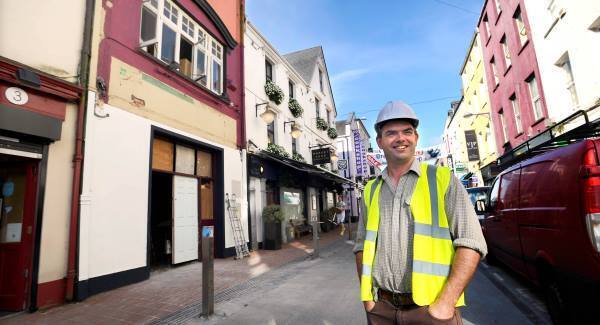
The Elbow Lane Brew & Smoke House, off Oliver Plunkett St, is also set to breathe new life into an old four-storey building it will inhabit, as well as adding to the growing feel-good factor in the city centre.
While the exact opening date is to be finalised, manager Jerry O’Sullivan says the Elbow Lane Brew & Smoke House will open for business between mid-and late September, and should offer something new— even in a boom era for craft brewers.
The team behind the new venture has pedigree — they are involved in the Market Lane bar and restaurant, the Castle café and restaurant in Blackrock Castle, and Orso café — three in the Oliver Plunkett/ South Mall zone. The new enterprise will dovetail neatly with the existing businesses, as the beer brewed in the nano-brewery will also be provided to the other eateries. Jerry will work front of house alongside brewer Russell Garrett, with Stephen Kehoe as chef.
“For us, at the centre of everything we do is food,” Jerry says. “We have four storeys, but we are just using the ground and first floor — the ground will have the brewery and 25 seats. It is a very small venue.
“Upstairs we will have conditioning and storage rooms and for us the unique aspect is the combination of craft beer and food — to produce and put the two side by side.”
According to Jerry, the massive growth in Craft beer has now reached such a sophisticated level that the notion of pairing certain types of stout or ale with particular food, in much the same way as you might with wine, does not seem outlandish.
The team has had a longstanding connection with craft beer and the process behind it and has designed recipes with certain flavours, pairing up with White Gypsy Brewers in Tipperary. The merging of a plate of monkfish with a Continental-style weissbeir attracted compliments from customers and proved that creating their own nano-brewery was the way forward, Jerry says.
“Supply is an issue with craft beers,” he says. “A lot of people have difficulty keeping up with demand, so a nano-brewery will mean we have more control over our own.”
Orso will be supplied by bottled product, but the other restaurants will have their own beer on tap.
“If you look at the American and New Zealand market, and the way it has grown and succeeded there, a lot of that is like here. Tourists would come in and say ‘can we have a local beer?’ For us, there was a demand we could see for this.”
With just 25 seats, Elbow Lane will be snug, and Jerry says even though it will be supplying other restaurants “it will have to stand on its own two feet”. However, the smaller size also has limited operational costs.
“We know we are quite small, and we are very proud to be the smallest in the city,” Jerry says. “People, I think, got bored with the mainstream. Also, our food, coffee and wine culture has grown in the last number of years. People want to try different things. It’s people being open to new beers.”
One worry might be that the boom in craft brewing is unsustainable, either because companies cannot keep up with demand, or because people might veer away from what might prove to be just another trend. The idea of matching niche beers and food in the one space is certainly novel, Jerry asserts, adding that Elbow Lane will have tasting boards as well as four beers created on site and one rotating ‘guest beer’ from a micro-brewer elsewhere.
Expect stouts, pale and red ales, all named after local streets, served up in a building with its own distinctive character.
“When you look at it from the front, it looks like a doll’s house,” Jerry says. “We are not sure of the original construction [date]...we found a little case that had documents, and a coin inside it from 1916.
“We have a little bit of work to do there, but it has a fantastic history. We also found an arrow directly outside the front door and we believe, at some stage, it was called the Cork Arrow company.”
Elbow Lane will be launching in a more optimistic retail atmosphere. Jerry says that customers are now not just coming in, but with smiles on their faces: “They’re happier”. I do think Cork has turned a corner and is getting much stronger,” he says.
Cork’s reputation as a food capital has also served it well, he says, and the latest entrant will be doing its best to maintain that high standard.