Fota frameyard award
Well, if not beer, cider, to be brewed from the apples in the old orchard which remains as a further restoration project for Fota’s proprietors, The Irish Heritage Trust.
Glistening in their wicker baskets the apples were on display for Minister Leo Varadkar, whose Department of Transport, Tourism and Sport gave €1.7 million to the €2.5 million resurrection of Fota’s kitchen gardens.
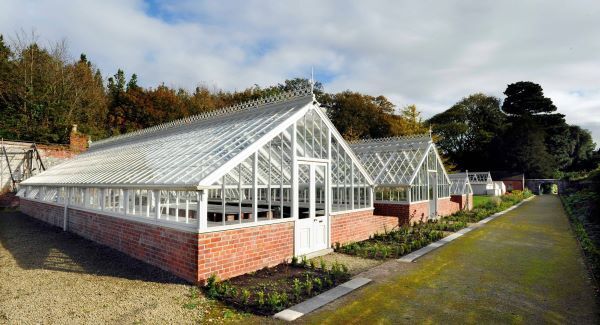
Known as the frameyard and now in the care of Daire Cleary, this collection of pits, glass-houses, bothy and cold-frames hidden behind the formal gardens, was the focus of the first phase of the four-year programme.
Two weeks ago it was this ostensibly humble complex which won the Irish Georgian Society’s Conservation Award, with the judges applauding the way in which architect Audrey Farrell of John O’Connell Architects worked with conservation engineer Naoise Connolly to maintain the structural integrity of the Victorian glasshouses, originally designed by Richardson of London.
A frameyard and kitchen garden not only provided vegetables and fruit for the household but also propagated shrubs and bedding plants for the formal grounds and arboretum, all of which was crucial to the hospitable country house. That was what Arthur Hugh Smith-Barry, the last Lord Barrymore, intended Fota to be.
In praising his design team,architect John O’Connell explained the original development of the frameyard as a way of expanding the house and its importance at the time Lord Barrymore brought his second wife to live on his Irish estates.
For O’Connell, it is Lord Barrymore’s daughter, Mrs. Dorothy Bell, who stands out in high relief.
“She was the second child of the second marriage and obviously she was a most loved child who, in turn, greatly loved Fota. When she could not inherit it, she managed to buy it; what she ran here was the equivalent of an extremely good quality IDA factory concerned with hospitality, flowers and fruit and therefore, the frameyard was all part of that.
After 40 years of dereliction, the desolate site sealed behind metal doors grew nothing but skeletal greenhouses, falling glass, rotting timbers, stagnant water and free-range rodents.
Throughout the project everything that could be salvaged was re-used and replacement items were sourced so that the authenticity of the buildings remained paramount. Equally Finola Reid’s planting design for the greenhouses and the borders along the revived paths adheres to the Victorian principal of function made pleasurable. All that is lacking now is the return of the Munster Agricultural Society award labels and cards won over the years by Mrs. Bell herself and kept here in the bothy at Fota.
The drama of Fota House since it came into public ownership in the 1970s has a long cast-list including the Reiker Family’s donation to the frameyard project, the work of Sir David Davies, retiring chairman of the Irish Heritage Trust; Fota gardeners Dave O’Regan and Pat Walsh, UCC’s Professor Tom Raftery, the OPW, the Fota Trust’s recent chairman David Bird, and the McCarthy family, which had bought and presented the Richard Wood collection of Irish landscape paintings to the Trust for display at Fota.
It’s never the end of the story for Fota: ‘Our perspective is a long one,’ warned Heritage Trust CEO Kevin Baird as he addressed the people gathered to hear the minister formally mark the achievements of the past four years.
* (Fota House and frameyard are open through the winter for groups by appointment only: 021-4815543) Gardens open all year.