TLC and much more went into city-top beauty
IN its long, 180-year history, No 3 Landscape Terrace has seen some remarkable times — but little compares with its last 15 years of minding, and careful, guided transformation.
Previously owned by a nightclub owner (the late Dominic O’Keeffe of Cocos) when it last sold in 1996 it had disco-like, Boogie Night features, with some purple walls and mirror-ball lights. It was bought by the remarkable Bernadette Murphy, (with Irish roots, reared in Australia), who became a property developer and interior designer in Britain, and who redeveloped the property with impeccable taste.
Quite extraordinarily, she maintained a clear sense of house vision, despite a degenerative hereditary eye condition which meant she oversaw No 3’s renewal while going almost fully blind.
Her sight eventually went altogether, but it didn’t stop her enjoying Cork city and her adopted home. She went on to do a Law degree in UCC and was just finishing her Master’s dissertation on disability issues when an earlier, treated cancer condition re-emerged. For years a striking, noted figure in a long fur coat and white cane, Ms Murphy passed away last month.
The home has been put on the market with estate agent Robert Harkin of Harkin Associates.
The house’s condition is as impressive as its late owner’s pedigree and spirit, and very much down to it. The many houses Bernadette Murphy had restored and sold in England and Scotland had the Georgian period in common.
She clearly managed to convey that vision to her trades crew who finished the 1830s-built No 3 Landscape Terrace to a very high level, and even now every brass is polished, every period detail intact and perfectly presented, and sash windows and shutters are all in smooth running order.
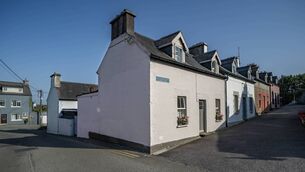
Landscape Terrace is high up above Cork city at the start of Sunday’s Well, and originally comprised of four distinctive slate-hung houses with spectacular southerly city views. Some time ago the last house in, No 4, was split into two houses. No 3 with its 3,000sq ft of space would, in any case, have been the bigger of all four to five houses — and what is certain is that it is now one of the best restorations.
The terrace’s ancient boundary chestnut tree was removed for safety reasons. No 2, meanwhile, is very original, but also in need of some restoration. It is currently for sale with agent Marshs, who seek €260,000 and have it under offer in the mid €230,000s.
In contrast, No 3 is guided at €399,000 by Robert Harkin, and is a walk-in job — just remove your shoes when you do, as its carpets are white wool (much of the interior furnishings can be negotiated in the sale for those who want the entire look, integrity and feel).
Ms Murphy’s talent was in seeing potential in houses, and here she opened up spaces by taking down some internal walls on the right-hand side of the double-fronted house.
This gives a main double-sized reception room 35’ deep, with two fireplaces and internal arch (plus discreet wet bar to the back), with a large sash window section to the south, flooding the room with light. There aren’t too many city homes where a baby grand piano can be casually placed in the middle of a room and still have it look small, but that’s most comfortably the case here.
Across the immaculate polychrome tiled hall is a formal dining room, also facing south, and behind it is a deep galley kitchen with oak units and utility.
These houses are deep, with a double truss roof, and after you’ve admired the sanding work done on the stairs’ mahogany handrail, and the exceptional stained glass work in the back window, the landing opens up as almost a room in itself.
There are three large bedrooms up here, the master is a real and sumptuous suite, running front to back of the house’s 35’ depth with graceful internal arch (Bernadette Murphy specified its proportions), and a seating/morning area with fireplace off the more intimate sleeping area which comes with a large en-suite bathroom. This is finished to a suitably high level with Heritage sanitary ware. Plus on the other side, there’s a walk-in closet.
The guest bedroom at the western side of the house is also large, en-suite and has a wall of recently fitted quality, capacious walnut built-ins.
The house’s third bedroom is also to the front and there’s a sprawling large family bathroom at the rear, with old Shires basin.
A recurring motif in No 3 is the arch shape, it is used as a room divider; in alcoves; to frame the bath and in the original windows and some doorways also.
VERDICT: No 3 is a must-see, and will suit niche buyers wanting quality interiors in a period city home, without too much external grounds, coming with front garden and off-street parking.