Ard na Greine revamp proves a work of art
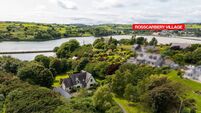
This new 3,000 sq ft home, on a spectacular island site, only came to pass because of persistence from afar on behalf of the owners, who were living in the Far East when it was being built, and their diligent Waterford-based design team, backed up with a builder who lived a mile from the site, and came garlanded with recommendations. Key, especially, to its eventual grant of permission was the fact it was going to replace or morph out of an existing dwelling.
It has replaced a 1970s bungalow holiday/retirement home which, most probably, was kept modest in its own scope five decades ago because, even then, the site was seen as quite sacrosanct thanks to its visibility.
But, the site deserved better than the relatively bland box allowed on it back then, and the replacement house finished a couple of years ago, and seen here in its restrained palette glories, can actually be seen as an enhancement to its setting.
In fact, there’s another brand new architectural arrival to it, just over the mound of hill, and that’s fairly extraordinary with soaring monopitch roofs going all directions, so fair dues to brave planners prepared to allow exceptions for exceptional buildings and homes that intrigue the eye (but, pity we can’t all afford sites and buildings of this quality to make planning arguments for us!)
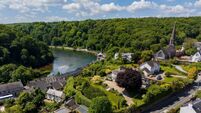
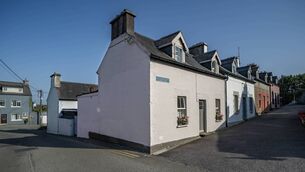
The location is on an island, though with bridge access, fortunately for the sake of Ard na Greine’s house builder, the nd design-literate Mike Leonard, who has done a number of the best one-offs in the Skibbereen area.
(It’s more than a bit ironic the hoops that home-builders can be put through to get permission to build a single dwelling though, when often just up and down the road in lots of clear examples schemes of dozens of houses of little or no architectural merit get built, often for tax reasons, and lie empty for the vast majority of the year.)
The Irish couple who purchased this two-acre, sloping site with coastline access back in 2002 had architectural ambitions for it, and retained Waterford city-based design firm dhbarchitects to design a new-build, to emerge from the shadow and footprint of the original, far smaller dwelling. It took several goes and sketches, though.
dhb architects’ director Fintan Duffy notes that they had been up against a planning diktat of “a ban on any new house on the site, only an extension of the existing being deemed acceptable. This was difficult to understand in light of the poor qualities, both constructional and aesthetic, of this house. The design conditions were presented as restrictions, such as ‘no flat roofs’, ‘traditional materials’ and so on. We took these on board at design stage, and tried to turn them to our advantage — although it is always difficult to approach a design process in an ideal manner when there are already declared ‘no-go’ areas,” adds Mr Duffy.
It took lots of sketches, stretching into two years in pre-planning before a design was approved and moved upon
The new Ard na Greine keeps only a shadow of root with the original house, and is long, and in sections, with a mix of roof profiles to break up its 3,000 sq ft mass into defined, cluster-like sections. This break-up of forms and quarters into up to six linked or interwoven sections allows for lots of roof finish variations, and for huge windows /glazing options too, with low and high level windows, wide sweeps of glass, clerestory, and for a long, full width glazed roof atrium as well over the staircase and link corridor.
The main living section to the front is A-roofed, holding solar panels southwards to the sun with a mono-pitch behind with high level clerestory windows, and there are several ‘extensions’ to give the impression of organic growth, with the bedrooms in the rear, long tee-d in two-storey section.
Deliberately skewed angles, especially in a zinc-roofed pitched run, must have tested the competencies of the roofing carpenter, but it is all carried off with aplomb, and that surely is down to the talents of builder Mike Leonard, who has got design training as well as a strong family building background. This meant Mike had few problems translating the highly individual design, and definitely off-standard plan with some engineering/span challenges.
Despite the engineering challenges, and getting levels right on the slopes, the interior is marked out by the purity of its flooring. It is pretty much all done in the same gently striated large tile, each 60 cm by 60cm. Anyone who has ever DIY tiled a floor will know the blessed relief of being able to cover up imperfections with door saddle boards and skirting boards: no such places to hide here. The tiles flow unobstructed, with just the slenderest of grout lines, from one room to another. It means if any room was off-square, things would go awry the further you went from the starting line. Here, all is ‘true,’ and walls internally are left without skirtings or architraves around doors, with simple ‘shadow lines’ put in to mark boundaries — it’s the hardest work of all to get right, it is utterly unforgiving.
The finished look of the house, coolly white, is down to Helsinki-based interior designer Kaisa Blomstedt, retained by the owners and asked to keep to the architectural purity of the design, with a pared-back palette. Bar blasts of colour from furniture or art, walls, doors, ceilings and the open-tread cantilevered steel staircase are mostly white, spray painted for smooth finish.
Plumbing is done to a high level, with Hansgrohe showers and taps, and Duravit sanitary ware, and several bathrooms have Corian sink stands. Bedrooms are in a two-storey wing, where the master bed’s suite has vibrant red glass mosaic tiling around the bath.
The house’s living/cooking/dining space is open-plan, laid out on a grid system, with large and irregularly-shaped windows across the front stone-faced facade, placed for a mix of long views and framing of particular points of reference. A detached garage picks up the same angle as the bedroom wing to make for a figurative approach courtyard.
Stout Douglas Fir timbers are used to link house and garage, for geometric pergola expressions at either end and as brise soleil over the main living space’s large sliding doors to a decked protrusion. Here, you suddenly realise, you’ve not been led up the garden path — there is no path, the house’s lawn and natural landscaping comes right up to the limestone front wall.
Finishes include breathable lime-rendered masonry and semi-drystone walls done in locally sourced field stone, topped with — for a complete change of texture — cut limestone.
Other finishes include slate, standing seam zinc, and Trocal membrane roofs, stainless steel guttering and steel downpipes for a sense of changing textures, as well as those grid pergola outlines, which craft ever-changing shadows.
Internally, the living/dining and kitchen area is open plan, down four steps on the footprint of the original bungalow from the reading room and a family room to the back, reached via sliding doors.
All clean, uncluttered lines, the kitchen is pared back, with large chocolate-coloured island made from Corian, with gas hob and extract and feature light above. Appliances are the likes of Gaggenau and Miele, kept either under the island, or hidden in the glossy back wall of cupboard storage.
Ard na Greine was finished 18 months ago and is itself starting to meld into its sloped and tiered site, culminating in a path down to a shingle beach: it was a place worth taking the plunge for.

CONNECT WITH US TODAY



Be the first to know the latest news and updates